
Join Our JEE Preparation Group
Prep with like-minded aspirants; Get access to free daily tests and study material.
Sign in
Please select an account to continue using cracku.in
↓ →
Join Our JEE Preparation Group
Prep with like-minded aspirants; Get access to free daily tests and study material.
The number of 4-digit numbers which are neither multiple of 7 nor multiple of 3 is _________.
Correct Answer: 5143
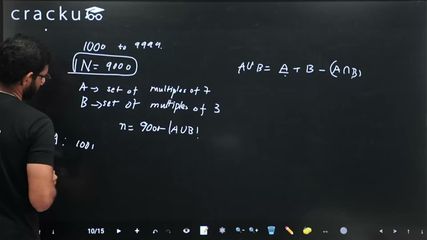
We begin by recalling that every 4-digit natural number lies between $$1000$$ and $$9999$$, inclusive. Hence the total count of 4-digit numbers is obtained from
$$9999-1000+1 = 9000.$$
Let us denote by
$$A = \{\text{4-digit numbers divisible by }7\},$$
$$B = \{\text{4-digit numbers divisible by }3\}.$$
Our aim is to count the 4-digit numbers which are in neither set, that is, numbers which belong to the complement of $$A\cup B$$ within the universe of 4-digit numbers.
Using the principle of inclusion-exclusion, we have
$$|A\cup B| = |A| + |B| - |A\cap B|,$$
and therefore
$$\text{Required count} = 9000 - |A\cup B|.$$
We now compute the three quantities $$|A|,\;|B|$$ and $$|A\cap B|$$ one by one.
Counting the multiples of 7
The smallest multiple of $$7$$ not less than $$1000$$ is found by dividing and taking the ceiling:
$$\left\lceil\frac{1000}{7}\right\rceil = 143,\qquad 7\times143 = 1001.$$
The largest multiple of $$7$$ not exceeding $$9999$$ is obtained via the floor:
$$\left\lfloor\frac{9999}{7}\right\rfloor = 1428,\qquad 7\times1428 = 9996.$$
Thus the integers $$143,144,\dots,1428$$ give all required multiples, so
$$|A| = 1428 - 143 + 1 = 1286.$$
Counting the multiples of 3
Proceeding likewise, the smallest multiple of $$3$$ not less than $$1000$$ is
$$\left\lceil\frac{1000}{3}\right\rceil = 334,\qquad 3\times334 = 1002,$$
and the largest such multiple is
$$\left\lfloor\frac{9999}{3}\right\rfloor = 3333,\qquad 3\times3333 = 9999.$$
Hence the numbers $$334,335,\dots,3333$$ supply every 4-digit multiple of $$3$$, giving
$$|B| = 3333 - 334 + 1 = 3000.$$
Counting the common multiples of 7 and 3
A number divisible by both $$7$$ and $$3$$ must be divisible by their least common multiple, $$\operatorname{lcm}(7,3)=21.$$
The smallest multiple of $$21$$ not less than $$1000$$ is
$$\left\lceil\frac{1000}{21}\right\rceil = 48,\qquad 21\times48 = 1008,$$
while the largest is
$$\left\lfloor\frac{9999}{21}\right\rfloor = 476,\qquad 21\times476 = 9996.$$
This yields the integers $$48,49,\dots,476$$, so
$$|A\cap B| = 476 - 48 + 1 = 429.$$
Applying inclusion-exclusion
Substituting the obtained values, we have
$$|A\cup B| \;=\; 1286 + 3000 - 429 = 3857.$$
Finishing the calculation
Finally, the count of 4-digit numbers which are neither multiples of $$7$$ nor multiples of $$3$$ is
$$9000 - 3857 = 5143.$$
So, the answer is $$5143$$.
Click on the Email ☝️ to Watch the Video Solution
Create a FREE account and get:
_1.webp)

Educational materials for JEE preparation

Ask our AI anything

AI can make mistakes. Please verify important information.
AI can make mistakes. Please verify important information.


