
Join Our JEE Preparation Group
Prep with like-minded aspirants; Get access to free daily tests and study material.
Sign in
Please select an account to continue using cracku.in
↓ →
Join Our JEE Preparation Group
Prep with like-minded aspirants; Get access to free daily tests and study material.
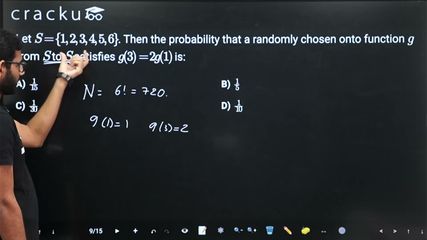
Let $$S = \{1, 2, 3, 4, 5, 6\}$$. Then the probability that a randomly chosen onto function $$g$$ from $$S$$ to $$S$$ satisfies $$g(3) = 2g(1)$$ is:
We have the finite set $$S=\{1,2,3,4,5,6\}$$ as both domain and co-domain. An “onto” function from a finite set to itself must be bijective, so every such function is simply a permutation of the six elements. The total number of permutations of six distinct objects is given by the factorial formula $$n!$$; putting $$n=6$$ we obtain the total number of onto functions
$$6!\;=\;720.$$
Now we impose the condition $$g(3)=2g(1).$$ Because the image of $$g(1)$$ must lie in $$S$$, and because doubling that image must also lie in $$S$$, we list the possibilities one by one.
If $$g(1)=1$$, then $$2g(1)=2$$, so we must have $$g(3)=2.$$
If $$g(1)=2$$, then $$2g(1)=4$$, so we must have $$g(3)=4.$$
If $$g(1)=3$$, then $$2g(1)=6$$, so we must have $$g(3)=6.$$
For $$g(1)=4,5,6$$ the number $$2g(1)$$ would be outside $$S$$, so no further choices are admissible. Thus there are exactly three admissible ordered pairs $$\bigl(g(1),g(3)\bigr)$$:
$$\bigl(1,2\bigr),\qquad\bigl(2,4\bigr),\qquad\bigl(3,6\bigr).$$
Fix any one of these three pairs. Two images have now been used up, leaving four distinct images in $$S$$ and four remaining domain elements, namely $$2,4,5,6.$$ To keep the function bijective we must match these four elements with the four unused images in a one-to-one fashion. The number of ways to arrange a bijection between two four-element sets is given by $$4!$$, and we compute
$$4!\;=\;24.$$
Hence, for each of the three admissible choices for $$\bigl(g(1),g(3)\bigr)$$ there are $$24$$ complete bijections. Multiplying, the total number of favorable functions is
$$3\times24\;=\;72.$$
The required probability is therefore the ratio of favorable cases to total cases:
$$\text{Probability} \;=\;\dfrac{72}{720}\;=\;\dfrac{1}{10}.$$
Hence, the correct answer is Option D.
Was this solution helpful?
Click on the Email ☝️ to Watch the Video Solution
Create a FREE account and get:
_1.webp)

Educational materials for JEE preparation

Ask our AI anything

AI can make mistakes. Please verify important information.
AI can make mistakes. Please verify important information.
