
Join Our JEE Preparation Group
Prep with like-minded aspirants; Get access to free daily tests and study material.
Sign in
Please select an account to continue using cracku.in
↓ →
Join Our JEE Preparation Group
Prep with like-minded aspirants; Get access to free daily tests and study material.
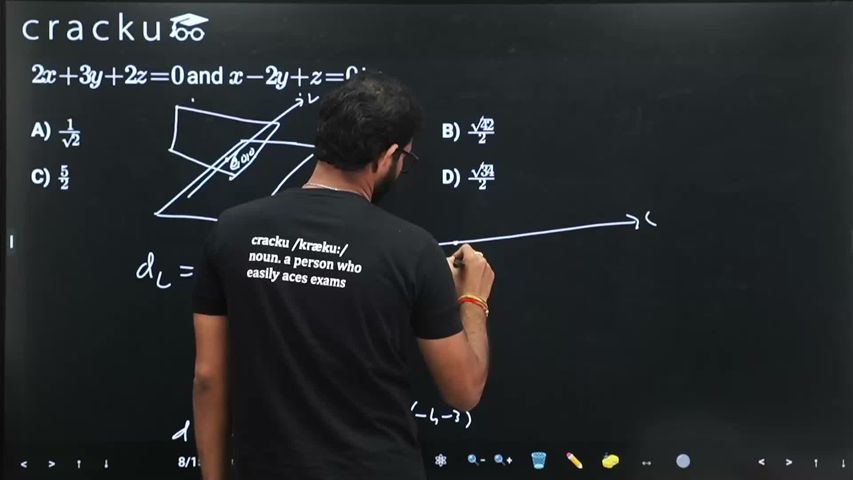
The distance of the point $$(-1, 2, -2)$$ from the line of intersection of the planes $$2x + 3y + 2z = 0$$ and $$x - 2y + z = 0$$ is:
We have to find the shortest distance of the point $$P(-1,\,2,\,-2)$$ from the line which is the intersection of the two given planes
$$2x + 3y + 2z = 0 \qquad \text{and} \qquad x - 2y + z = 0.$$
For a line obtained as the intersection of two planes, a convenient direction vector is the cross-product of the normals of the two planes. So we first write the normal vectors:
For $$2x + 3y + 2z = 0$$ the normal is $$\vec n_1 = (2,\,3,\,2).$$ For $$x - 2y + z = 0$$ the normal is $$\vec n_2 = (1,\,-2,\,1).$$
Now we take the cross product $$\vec d = \vec n_1 \times \vec n_2$$ to obtain a vector along the required line. Writing the determinant form,
$$ \vec d = \begin{vmatrix} \mathbf i & \mathbf j & \mathbf k\\ 2 & 3 & 2\\ 1 & -2 & 1 \end{vmatrix}. $$
Expanding step by step,
$$ \vec d = \mathbf i\,(3\cdot1 - 2\cdot(-2)) \;-\; \mathbf j\,(2\cdot1 - 2\cdot1) \;+\; \mathbf k\,(2\cdot(-2) - 3\cdot1). $$
$$ \vec d = \mathbf i\,(3 + 4) \;-\; \mathbf j\,(2 - 2) \;+\; \mathbf k\,(-4 - 3). $$
$$ \vec d = 7\,\mathbf i \;+\; 0\,\mathbf j \;-\; 7\,\mathbf k = (7,\,0,\,-7). $$
As multiplying or dividing a direction vector by a non-zero scalar does not change the line, we divide by 7 and take the simpler direction vector
$$\vec d = (1,\,0,\,-1).$$
Next we need any one point on the line of intersection. To get such a point, we solve the two plane equations simultaneously. Let us set $$z = t$$ (a parameter) and solve for $$x$$ and $$y$$.
From the second plane, $$x - 2y + t = 0 \;\Longrightarrow\; x = 2y - t.$$
Substituting this into the first plane,
$$2(2y - t) + 3y + 2t = 0.$$
$$4y - 2t + 3y + 2t = 0.$$
$$7y = 0 \;\Longrightarrow\; y = 0.$$
Putting $$y = 0$$ in $$x = 2y - t$$ gives $$x = -t.$$ Hence a general point on the line is $$(-t,\,0,\,t).$$ Choosing the convenient value $$t = 0$$ we get the specific point
$$A(0,\,0,\,0)$$
on the line.
Now we have the required data for the distance formula. The vector from the point $$A$$ on the line to the external point $$P$$ is
$$\vec{AP} = (-1 - 0,\,2 - 0,\,-2 - 0) = (-1,\,2,\,-2).$$
The standard formula for the distance of a point from a line (in vector form) is
$$\text{Distance} = \dfrac{\|\vec{AP} \times \vec d\|}{\|\vec d\|},$$
where $$\vec d$$ is the direction vector of the line.
We already have $$\vec d = (1,\,0,\,-1).$$ Let us compute the cross product $$\vec{AP} \times \vec d$$ in full detail:
$$ \vec{AP} \times \vec d = \begin{vmatrix} \mathbf i & \mathbf j & \mathbf k\\ -1 & 2 & -2\\ 1 & 0 & -1 \end{vmatrix}. $$
Expanding,
$$ \vec{AP} \times \vec d = \mathbf i\,(2\cdot(-1) - (-2)\cdot0) \;-\; \mathbf j\,((-1)\cdot(-1) - (-2)\cdot1) \;+\; \mathbf k\,((-1)\cdot0 - 2\cdot1). $$
$$ \vec{AP} \times \vec d = \mathbf i\,(-2 - 0) \;-\; \mathbf j\,(1 + 2) \;+\; \mathbf k\,(0 - 2). $$
$$ \vec{AP} \times \vec d = (-2)\,\mathbf i \;-\; 3\,\mathbf j \;-\; 2\,\mathbf k = (-2,\,-3,\,-2). $$
The magnitude of this cross product is
$$ \|\vec{AP} \times \vec d\| = \sqrt{(-2)^2 + (-3)^2 + (-2)^2} = \sqrt{4 + 9 + 4} = \sqrt{17}. $$
The magnitude of the direction vector is
$$ \|\vec d\| = \sqrt{1^2 + 0^2 + (-1)^2} = \sqrt{1 + 0 + 1} = \sqrt{2}. $$
Therefore the required distance is
$$ \text{Distance} = \frac{\sqrt{17}}{\sqrt{2}} = \frac{\sqrt{17}\,\sqrt{2}}{\sqrt{2}\,\sqrt{2}} = \frac{\sqrt{34}}{2}. $$
The numerical value matches Option D. Hence, the correct answer is Option D.
Click on the Email ☝️ to Watch the Video Solution
Create a FREE account and get:
_1.webp)

Educational materials for JEE preparation

Ask our AI anything

AI can make mistakes. Please verify important information.
AI can make mistakes. Please verify important information.


