
Join Our JEE Preparation Group
Prep with like-minded aspirants; Get access to free daily tests and study material.
Sign in
Please select an account to continue using cracku.in
↓ →
Join Our JEE Preparation Group
Prep with like-minded aspirants; Get access to free daily tests and study material.
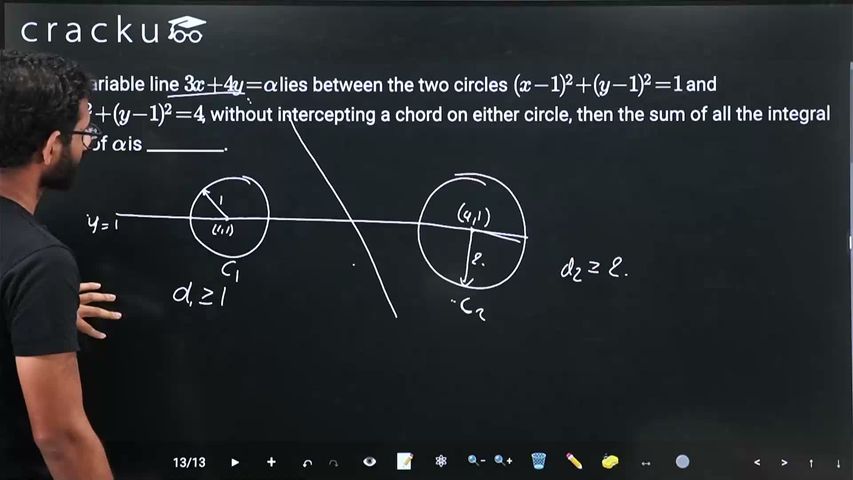
If the variable line $$3x + 4y = \alpha$$ lies between the two circles $$(x-1)^2 + (y-1)^2 = 1$$ and $$(x-9)^2 + (y-1)^2 = 4$$, without intercepting a chord on either circle, then the sum of all the integral values of $$\alpha$$ is _________.
Correct Answer: 165
We have the two circles
$$\bigl(x-1\bigr)^2+\bigl(y-1\bigr)^2 = 1$$
with centre $$C_1(1,\,1)$$ and radius $$r_1 = 1,$$ and
$$\bigl(x-9\bigr)^2+\bigl(y-1\bigr)^2 = 4$$
with centre $$C_2(9,\,1)$$ and radius $$r_2 = 2.$$
The variable straight line is
$$3x+4y=\alpha.$$
Formula used: the perpendicular distance of a point $$(x_0,\,y_0)$$ from the line $$Ax+By+C=0$$ is
$$\dfrac{|Ax_0+By_0+C|}{\sqrt{A^2+B^2}}.$$
Writing the given line in the form $$3x+4y-\alpha=0,$$ its coefficients are $$A=3,$$ $$B=4,$$ $$C=-\alpha,$$ and $$\sqrt{A^2+B^2}=\sqrt{9+16}=5.$$
Perpendicular distance of $$C_1(1,1)$$ from the line is therefore
$$d_1=\dfrac{|3\cdot1+4\cdot1-\alpha|}{5}= \dfrac{|7-\alpha|}{5}.$$
Similarly, distance of $$C_2(9,1)$$ from the line is
$$d_2=\dfrac{|3\cdot9+4\cdot1-\alpha|}{5}= \dfrac{|31-\alpha|}{5}.$$
The line must not cut either circle; it may at the most touch them. Hence we need
$$d_1\ge r_1 \quad\text{and}\quad d_2\ge r_2,$$
that is
$$\dfrac{|7-\alpha|}{5}\;\ge\;1\quad\Longrightarrow\quad |7-\alpha|\;\ge\;5,$$
$$\dfrac{|31-\alpha|}{5}\;\ge\;2\quad\Longrightarrow\quad |31-\alpha|\;\ge\;10.$$
Simplifying the first inequality gives
$$\alpha\le 2 \quad\text{or}\quad \alpha\ge 12,$$
while the second gives
$$\alpha\le 21 \quad\text{or}\quad \alpha\ge 41.$$
Combining them we obtain three possible ranges
$$(-\infty,\,2],\qquad [12,\,21],\qquad [41,\,\infty).$$
Next, for the line to lie between the two circles, the centres $$C_1$$ and $$C_2$$ must lie on opposite sides of the line. This happens exactly when
$$(7-\alpha)(31-\alpha)\lt 0,$$
because the expressions $$7-\alpha$$ and $$31-\alpha$$ are, up to sign, the numerators of the two distances and indicate on which side of the line each centre lies.
The inequality
$$(7-\alpha)(31-\alpha)\lt 0$$
is satisfied whenever
$$7\lt \alpha\lt 31.$$
Intersecting this with the three ranges obtained earlier, only the middle interval survives:
$$12\le\alpha\le21.$$
Thus every real number $$\alpha$$ in the closed interval $$[12,\,21]$$ (including the endpoints, which correspond to tangency) places the line between the two circles without cutting them.
The integral values are
$$12,\,13,\,14,\,15,\,16,\,17,\,18,\,19,\,20,\,21.$$
Count: $$10$$ integers.
Sum: Using the formula for the sum of an arithmetic progression,
$$S=\dfrac{n}{2}(a_1+a_n)=\dfrac{10}{2}(12+21)=5\times33=165.$$
Hence, the correct answer is Option A: $$165.$$
Was this solution helpful?
Click on the Email ☝️ to Watch the Video Solution
Create a FREE account and get:
_1.webp)

Educational materials for JEE preparation

Ask our AI anything

AI can make mistakes. Please verify important information.
AI can make mistakes. Please verify important information.
