
Join Our JEE Preparation Group
Prep with like-minded aspirants; Get access to free daily tests and study material.
Sign in
Please select an account to continue using cracku.in
↓ →
Join Our JEE Preparation Group
Prep with like-minded aspirants; Get access to free daily tests and study material.
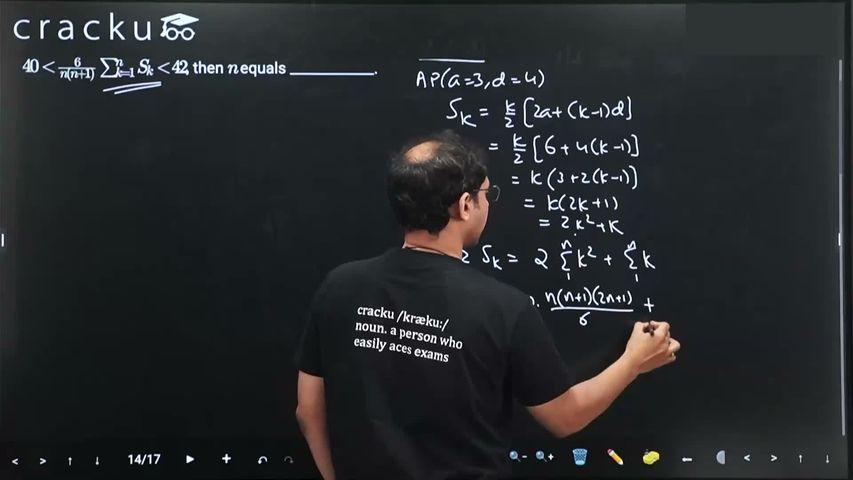
Let $$S_n$$ be the sum to n-terms of an arithmetic progression $$3, 7, 11, \ldots$$, if $$40 < \frac{6}{n(n+1)}\sum_{k=1}^{n} S_k < 42$$, then $$n$$ equals ____________.
Correct Answer: 9
The given arithmetic progression is $$3,\,7,\,11,\ldots$$, so
first term $$a = 3$$ and common difference $$d = 4$$.
Sum of the first $$n$$ terms of an A.P. is
$$S_n = \frac{n}{2}\Bigl[2a + (n-1)d\Bigr]$$
$$= \frac{n}{2}\Bigl[2\cdot3 + (n-1)\cdot4\Bigr]$$
$$= \frac{n}{2}\Bigl[6 + 4n - 4\Bigr]$$
$$= \frac{n}{2}\,(4n + 2)$$
$$= n(2n + 1)\quad -(1)$$
Next, we need the cumulative sum $$\sum_{k=1}^{n} S_k$$. Using $$(1)$$,
$$S_k = k(2k + 1) = 2k^2 + k$$.
Hence
$$\sum_{k=1}^{n} S_k = \sum_{k=1}^{n} (2k^2 + k)$$
$$= 2\sum_{k=1}^{n} k^2 + \sum_{k=1}^{n} k$$
Using the standard formulas $$\sum_{k=1}^{n} k^2 = \frac{n(n+1)(2n+1)}{6}, \qquad \sum_{k=1}^{n} k = \frac{n(n+1)}{2},$$ we get
$$\sum_{k=1}^{n} S_k = 2\cdot\frac{n(n+1)(2n+1)}{6} + \frac{n(n+1)}{2}$$
$$= \frac{n(n+1)(2n+1)}{3} + \frac{n(n+1)}{2}$$
$$= n(n+1)\left[\frac{2n+1}{3} + \frac{1}{2}\right]$$
Common denominator $$6$$ gives
$$\frac{2n+1}{3} + \frac{1}{2} = \frac{4n+2}{6} + \frac{3}{6} = \frac{4n + 5}{6}.$$
Therefore
$$\sum_{k=1}^{n} S_k = \frac{n(n+1)(4n + 5)}{6}\quad -(2)$$
The problem states
$$40 \lt \frac{6}{n(n+1)}\sum_{k=1}^{n} S_k \lt 42.$$ Substituting from $$(2)$$:
$$\frac{6}{n(n+1)}\cdot\frac{n(n+1)(4n + 5)}{6} = 4n + 5.$$
Hence the inequality becomes
$$40 \lt 4n + 5 \lt 42.$$
Subtract $$5$$ everywhere:
$$35 \lt 4n \lt 37.$$
The only integer multiple of $$4$$ between $$35$$ and $$37$$ is $$36$$, so
$$4n = 36 \;\Rightarrow\; n = 9.$$
Therefore, $$n = 9$$.
Was this solution helpful?
Click on the Email ☝️ to Watch the Video Solution
Create a FREE account and get:
_1.webp)

Educational materials for JEE preparation

Ask our AI anything

AI can make mistakes. Please verify important information.
AI can make mistakes. Please verify important information.
