
Join Our JEE Preparation Group
Prep with like-minded aspirants; Get access to free daily tests and study material.
Sign in
Please select an account to continue using cracku.in
↓ →
Join Our JEE Preparation Group
Prep with like-minded aspirants; Get access to free daily tests and study material.
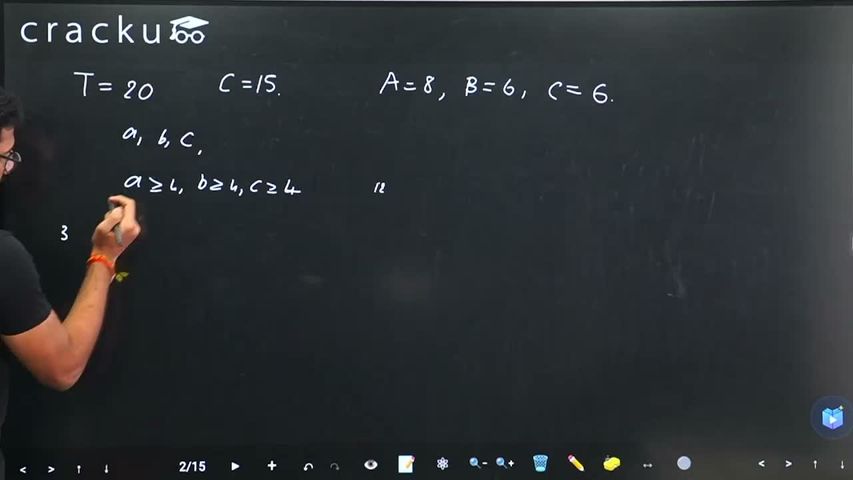
In an examination of Mathematics paper, there are 20 questions of equal marks and the question paper is divided into three sections: A, B and C. A student is required to attempt total 15 questions taking at least 4 questions from each section. If section A has 8 questions, section B has 6 questions and section C has 6 questions, then the total number of ways a student can select 15 questions is _________.
Correct Answer: 11376
Let $$a,\,b,\,c$$ denote the numbers of questions chosen from Sections A, B and C respectively.
Total questions to be attempted: $$a+b+c = 15$$.
Minimum requirement: $$a \ge 4,\; b \ge 4,\; c \ge 4$$.
Upper limits (because of the number of questions present): $$a \le 8,\; b \le 6,\; c \le 6$$.
Introduce new variables to handle the “at least 4” condition:
$$a = a' + 4,\; b = b' + 4,\; c = c' + 4,\qquad a',b',c' \ge 0$$.
Substituting in $$a+b+c=15$$ gives
$$a' + b' + c' = 15 - 12 = 3 \qquad -(1)$$
Equation $$(1)$$ demands non-negative integer solutions of sum $$3$$. These are:
• $$\,(3,0,0)$$ and its permutations • $$\,(2,1,0)$$ and its permutations • $$\,(1,1,1)$$.
Now apply the upper bounds.
Case 1: $$(a',b',c') = (3,0,0)$$
Then $$(a,b,c)=(7,4,4)$$ which satisfies $$a\le 8,\;b\le 6,\;c\le 6$$.
The other two permutations give $$(a,b,c)=(4,7,4)$$ or $$(4,4,7)$$, both violating $$b\le6$$ or $$c\le6$$.
Hence only one admissible triple: $$(7,4,4)$$.
Case 2: $$(a',b',c') = (2,1,0)$$
All six permutations obey the limits, giving
$$(6,5,4),\;(6,4,5),\;(5,6,4),\;(4,6,5),\;(5,4,6),\;(4,5,6).$$
Case 3: $$(a',b',c') = (1,1,1)$$
This single solution yields $$(5,5,5)$$, within the limits.
Thus the admissible $$(a,b,c)$$ triples are
$$(7,4,4),\;(6,5,4),\;(6,4,5),\;(5,6,4),\;(4,6,5),\;(5,4,6),\;(4,5,6),\;(5,5,5).$$
For each triple, multiply the individual combinations:
Section A: choose $$a$$ out of $$8 \;\;(\binom{8}{a})$$
Section B: choose $$b$$ out of $$6 \;\;(\binom{6}{b})$$
Section C: choose $$c$$ out of $$6 \;\;(\binom{6}{c})$$.
Compute every case:
$$\begin{aligned} (7,4,4):&\;\binom{8}{7}\binom{6}{4}\binom{6}{4}=8\cdot15\cdot15=1800\\[2pt] (6,5,4):&\;\binom{8}{6}\binom{6}{5}\binom{6}{4}=28\cdot6\cdot15=2520\\[2pt] (6,4,5):&\;28\cdot15\cdot6=2520\\[2pt] (5,6,4):&\;\binom{8}{5}\binom{6}{6}\binom{6}{4}=56\cdot1\cdot15=840\\[2pt] (4,6,5):&\;\binom{8}{4}\cdot1\cdot6=70\cdot6=420\\[2pt] (5,4,6):&\;56\cdot15\cdot1=840\\[2pt] (4,5,6):&\;70\cdot6\cdot1=420\\[2pt] (5,5,5):&\;56\cdot6\cdot6=2016 \end{aligned}$$
Add the eight results:
$$1800+2520+2520+840+420+840+420+2016 = 11376.$$
Hence, a student can select the required 15 questions in $$\mathbf{11376}$$ different ways.
Was this solution helpful?
Click on the Email ☝️ to Watch the Video Solution
Create a FREE account and get:
_1.webp)

Educational materials for JEE preparation

Ask our AI anything

AI can make mistakes. Please verify important information.
AI can make mistakes. Please verify important information.
