
Join Our JEE Preparation Group
Prep with like-minded aspirants; Get access to free daily tests and study material.
Sign in
Please select an account to continue using cracku.in
↓ →
Join Our JEE Preparation Group
Prep with like-minded aspirants; Get access to free daily tests and study material.
If the sum of the coefficients in the expansion of $$(x + y)^n$$ is 4096, then the greatest coefficient in the expansion is _________.
Correct Answer: 924
We begin with the standard binomial expansion
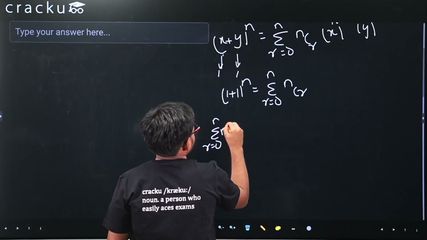
$$ (x+y)^n \;=\; \sum_{k=0}^{n} \binom{n}{k} \, x^{\,n-k}\,y^{\,k}. $$
The “sum of the coefficients’’ is obtained by putting $$x=1$$ and $$y=1$$, because each term $$\binom{n}{k}\,x^{\,n-k}y^{\,k}$$ then reduces to just $$\binom{n}{k}$$. Thus we have
$$ (1+1)^n \;=\; 2^{\,n} \;=\; \sum_{k=0}^{n} \binom{n}{k}. $$
The question tells us that this sum equals $$4096$$, so
$$ 2^{\,n} \;=\; 4096. $$
We now solve for $$n$$. Recognising $$4096$$ as a power of $$2$$, we write
$$ 4096 = 2^{12}, $$
and therefore
$$ n = 12. $$
So the expansion we are really interested in is
$$ (x+y)^{12}. $$
Next, we must find the greatest (i.e. the largest numerical) binomial coefficient among $$\binom{12}{0},\binom{12}{1},\dots,\binom{12}{12}$$. A basic result from the theory of binomial coefficients states:
The sequence $$\binom{n}{0},\binom{n}{1},\dots,\binom{n}{n}$$ increases up to $$k=\left\lfloor\dfrac{n}{2}\right\rfloor$$ and then decreases symmetrically.
Since $$n=12$$ is even, the maximum value occurs at
$$ k = \dfrac{n}{2} = \dfrac{12}{2} = 6. $$
The corresponding coefficient is therefore
$$ \binom{12}{6}. $$
We compute it explicitly using the formula $$\displaystyle \binom{n}{k} = \dfrac{n!}{k!\,(n-k)!}$$:
$$ \binom{12}{6} = \frac{12!}{6!\,6!} = \frac{12 \times 11 \times 10 \times 9 \times 8 \times 7 \times 6!}{6!\, (6 \times 5 \times 4 \times 3 \times 2 \times 1)} = \frac{12 \times 11 \times 10 \times 9 \times 8 \times 7}{6 \times 5 \times 4 \times 3 \times 2 \times 1}. $$
We simplify step by step:
First cancel the factor $$6$$:
$$ \frac{12}{6} = 2 $$
so one pair of factors becomes $$2$$. Proceeding orderly, we have
$$ \frac{2 \times 11 \times 10 \times 9 \times 8 \times 7}{5 \times 4 \times 3 \times 2 \times 1}. $$
Now cancel a factor $$5$$ with the $$10$$:
$$ 10 \div 5 = 2, $$
giving
$$ \frac{2 \times 11 \times 2 \times 9 \times 8 \times 7}{4 \times 3 \times 2 \times 1}. $$
Next cancel a factor $$4$$ with the $$8$$:
$$ 8 \div 4 = 2, $$
so we obtain
$$ \frac{2 \times 11 \times 2 \times 9 \times 2 \times 7}{3 \times 2 \times 1}. $$
Cancel a factor $$3$$ with the $$9$$:
$$ 9 \div 3 = 3, $$
giving
$$ \frac{2 \times 11 \times 2 \times 3 \times 2 \times 7}{2 \times 1}. $$
Finally cancel the remaining denominator $$2$$ with one of the numerators $$2$$, leaving
$$ 11 \times 2 \times 3 \times 2 \times 7. $$
Multiplying in order,
$$ 11 \times 2 = 22, \\ 22 \times 3 = 66, \\ 66 \times 2 = 132, \\ 132 \times 7 = 924. $$
Thus
$$ \binom{12}{6} = 924. $$
Hence, the correct answer is Option 924.
Click on the Email ☝️ to Watch the Video Solution
Create a FREE account and get:
_1.webp)

Educational materials for JEE preparation

Ask our AI anything

AI can make mistakes. Please verify important information.
AI can make mistakes. Please verify important information.


