
Join Our JEE Preparation Group
Prep with like-minded aspirants; Get access to free daily tests and study material.
Sign in
Please select an account to continue using cracku.in
↓ →
Join Our JEE Preparation Group
Prep with like-minded aspirants; Get access to free daily tests and study material.
$$3 \times 7^{22} + 2 \times 10^{22} - 44$$ when divided by 18 leaves the remainder _________.
Correct Answer: 15
We are asked to find the remainder obtained when the quantity $$3 \times 7^{22} + 2 \times 10^{22} - 44$$ is divided by $$18$$. In modular-arithmetic language, this means that we must evaluate the given expression modulo $$18$$, i.e. find its value in $$\pmod{18}$$.
First, we note that for any integers $$a$$ and $$b$$, the basic property of congruences is
$$a \equiv b \pmod{m} \;\;\Longrightarrow\;\; a \cdot c \equiv b \cdot c \pmod{m},$$
and
$$a \equiv b \pmod{m},\; c \equiv d \pmod{m} \;\;\Longrightarrow\;\; a \pm c \equiv b \pm d \pmod{m}.$$
We shall therefore replace each large power by its much smaller remainder modulo $$18$$ and then combine the results.
Step 1: Evaluate $$7^{22} \pmod{18}.$$
We first look for a pattern in the powers of $$7$$ modulo $$18$$:
$$7^1 = 7 \equiv 7 \pmod{18}.$$
$$7^2 = 49 \equiv 49 - 2\!\times\!18 = 49 - 36 = 13 \pmod{18}.$$
Now multiply again by $$7$$:
$$7^3 \;=\; 7^2 \times 7 = 13 \times 7 = 91 \equiv 91 - 5\!\times\!18 = 91 - 90 = 1 \pmod{18}.$$
We have reached $$7^3 \equiv 1 \pmod{18}.$$ This is extremely useful because now every third power will repeat the remainder $$1$$. In other words,
$$7^{3k} \equiv 1 \pmod{18}\quad\text{for every integer }k.$$
We write $$22$$ as a multiple of $$3$$ plus the remainder:
$$22 = 21 + 1 = 3 \times 7 + 1.$$
So
$$7^{22} = 7^{21 + 1} = 7^{21}\,7^1 = (7^3)^7 \, 7.$$
Because $$7^3 \equiv 1$$, we replace it by $$1$$:
$$(7^3)^7 \, 7 \equiv 1^7 \, 7 = 7 \pmod{18}.$$
Thus we have
$$7^{22} \equiv 7 \pmod{18}.$$
Step 2: Evaluate $$10^{22} \pmod{18}.$$
We again look for a pattern, this time in the powers of $$10$$ modulo $$18$$:
$$10^1 = 10 \equiv 10 \pmod{18}.$$
Now square that value:
$$10^2 = 100 \equiv 100 - 5\!\times\!18 = 100 - 90 = 10 \pmod{18}.$$
Notice that the remainder has come back to $$10$$. Therefore a second multiplication by $$10$$ will do the same:
$$10^3 = 10^2 \times 10 \equiv 10 \times 10 = 100 \equiv 10 \pmod{18}.$$
Hence once we reach the power $$2$$, every additional power leaves the remainder unchanged at $$10$$. Concretely, for all positive integers $$n \ge 1,$$
$$10^n \equiv 10 \pmod{18}.$$
In particular,
$$10^{22} \equiv 10 \pmod{18}.$$
Step 3: Substitute the reduced remainders into the original expression.
We have obtained
$$7^{22} \equiv 7 \pmod{18},$$
and
$$10^{22} \equiv 10 \pmod{18}.$$
Thus
$$3 \times 7^{22} + 2 \times 10^{22} - 44$$
becomes
$$3 \times 7 + 2 \times 10 - 44 \pmod{18}.$$
Carrying out the multiplications gives
$$21 + 20 - 44 \pmod{18}.$$
Add the first two numbers:
$$21 + 20 = 41,$$
so we now have
$$41 - 44 = -3 \pmod{18}.$$
Step 4: Convert the negative remainder to a positive one.
A remainder of $$-3$$ can be made positive by adding $$18$$ (because adding or subtracting any multiple of the modulus does not change a congruence):
$$-3 + 18 = 15.$$
Therefore
$$-3 \equiv 15 \pmod{18}.$$
The required non-negative remainder is thus $$15$$.
So, the answer is $$15$$.
Was this solution helpful?
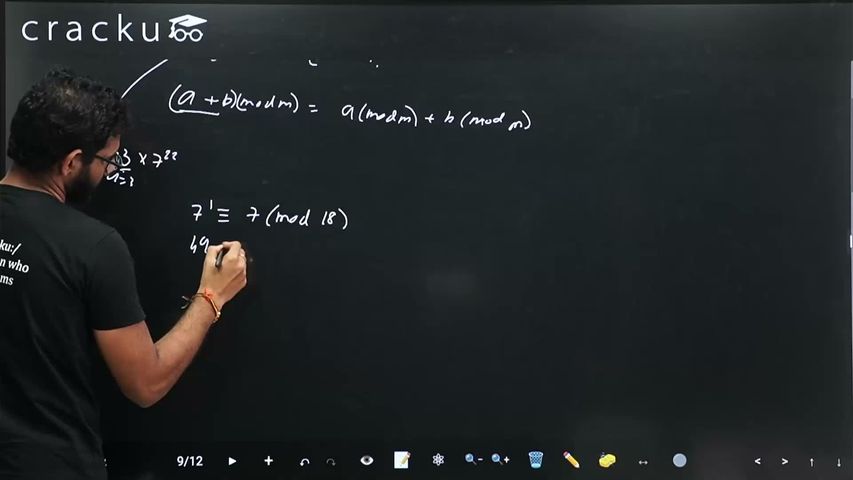
Click on the Email ☝️ to Watch the Video Solution
Create a FREE account and get:
_1.webp)

Educational materials for JEE preparation

Ask our AI anything

AI can make mistakes. Please verify important information.
AI can make mistakes. Please verify important information.
