
Join Our JEE Preparation Group
Prep with like-minded aspirants; Get access to free daily tests and study material.
Sign in
Please select an account to continue using cracku.in
↓ →
Join Our JEE Preparation Group
Prep with like-minded aspirants; Get access to free daily tests and study material.
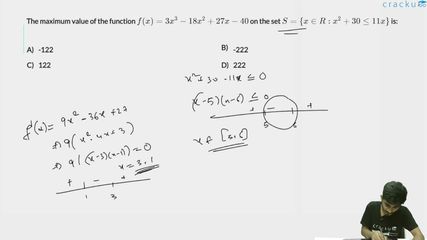
The maximum value of the function $$f(x) = 3x^3 - 18x^2 + 27x - 40$$ on the set $$S = \{x \in R : x^2 + 30 \le 11x\}$$ is:
We have to maximize the cubic function
$$f(x)=3x^{3}-18x^{2}+27x-40$$
but only for those real numbers $$x$$ that satisfy the inequality
$$x^{2}+30\le 11x.$$
First we rewrite the inequality in standard form. Subtracting $$11x$$ from both sides gives
$$x^{2}+30-11x\le 0.$$
Re-ordering the terms in descending powers of $$x$$ we get
$$x^{2}-11x+30\le 0.$$
Now we factor the quadratic. We look for two numbers whose product is $$30$$ and whose sum is $$-11$$. The numbers $$-5$$ and $$-6$$ fit. So
$$x^{2}-11x+30=(x-5)(x-6).$$
Hence the inequality becomes
$$(x-5)(x-6)\le 0.$$
Because the quadratic opens upward, the product is non-positive exactly between the roots. Therefore
$$5\le x\le 6.$$
So the feasible set $$S$$ is the closed interval $$[5,6]$$.
To locate maxima or minima of $$f(x)$$ on this interval we examine critical points. The critical points occur where the derivative is zero or undefined. The derivative of a polynomial is defined everywhere, so we only need to solve $$f'(x)=0$$.
Using the power rule $$\dfrac{d}{dx}\bigl(x^{n}\bigr)=nx^{\,n-1}$$, we differentiate term by term:
$$f'(x)=\dfrac{d}{dx}\bigl(3x^{3}\bigr)-\dfrac{d}{dx}\bigl(18x^{2}\bigr)+\dfrac{d}{dx}\bigl(27x\bigr)-\dfrac{d}{dx}(40).$$
Calculating each derivative:
$$\dfrac{d}{dx}(3x^{3})=9x^{2},\qquad \dfrac{d}{dx}(18x^{2})=36x,\qquad \dfrac{d}{dx}(27x)=27,\qquad \dfrac{d}{dx}(40)=0.$$
Substituting these,
$$f'(x)=9x^{2}-36x+27.$$
We can factor out the common factor $$9$$:
$$f'(x)=9\bigl(x^{2}-4x+3\bigr).$$
Next we factor the quadratic inside the parentheses. We need two numbers whose product is $$3$$ and whose sum is $$-4$$; these are $$-1$$ and $$-3$$. So
$$x^{2}-4x+3=(x-1)(x-3).$$
Hence
$$f'(x)=9(x-1)(x-3).$$
The derivative is zero when either $$(x-1)=0$$ or $$(x-3)=0$$, i.e.
$$x=1\quad\text{or}\quad x=3.$$
These critical points lie at $$x=1$$ and $$x=3$$, but our domain of interest is $$5\le x\le 6$$. Therefore, no stationary points lie inside the interval $$[5,6]$$.
When a continuous function has no interior critical points on a closed interval, any extremum must occur at an endpoint. So we evaluate $$f(x)$$ at the two endpoints $$x=5$$ and $$x=6$$.
First endpoint, $$x=5$$:
$$\begin{aligned} f(5) &=3(5)^{3}-18(5)^{2}+27(5)-40\\ &=3\cdot125-18\cdot25+135-40\\ &=375-450+135-40\\ &=(375-450)+135-40\\ &=-75+135-40\\ &=60-40\\ &=20. \end{aligned}$$
Second endpoint, $$x=6$$:
$$\begin{aligned} f(6) &=3(6)^{3}-18(6)^{2}+27(6)-40\\ &=3\cdot216-18\cdot36+162-40\\ &=648-648+162-40\\ &=(648-648)+122\\ &=0+122\\ &=122. \end{aligned}$$
Since $$122\gt 20$$, the maximum value of $$f(x)$$ on the set $$S$$ is $$122$$ and it occurs at $$x=6$$.
Among the given options, $$122$$ corresponds to Option C.
Hence, the correct answer is Option C.
Was this solution helpful?
Click on the Email ☝️ to Watch the Video Solution
Create a FREE account and get:
_1.webp)

Educational materials for JEE preparation

Ask our AI anything

AI can make mistakes. Please verify important information.
AI can make mistakes. Please verify important information.
