
Join Our JEE Preparation Group
Prep with like-minded aspirants; Get access to free daily tests and study material.
Sign in
Please select an account to continue using cracku.in
↓ →
Join Our JEE Preparation Group
Prep with like-minded aspirants; Get access to free daily tests and study material.
If three successive terms of a G.P. with common ratio $$r$$ $$(r > 1)$$ are the length of the sides of a triangle and $$\lfloor r \rfloor$$ denotes the greatest integer less than or equal to r, then $$3\lfloor r \rfloor + \lfloor -r \rfloor$$ is equal to:
Correct Answer: 1
Let the three successive terms of the G.P. be $$a,\;ar,\;ar^{2}$$ with common ratio $$r$$, where $$r \gt 1$$.
For these three numbers to be the lengths of the sides of a triangle, they must satisfy the triangle inequality.
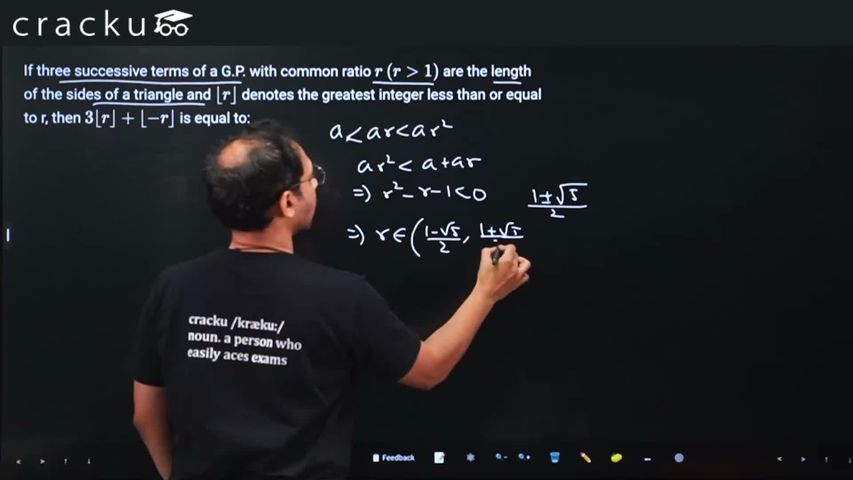
Since $$r \gt 1$$, the terms are in increasing order: $$a \lt ar \lt ar^{2}$$. The only non-trivial inequality is
$$a + ar \gt ar^{2}\;.$$
Dividing by the positive number $$a$$ gives
$$1 + r \gt r^{2}\;.$$
Re-arranging,
$$r^{2} - r - 1 \lt 0 \;.$$
The roots of $$r^{2} - r - 1 = 0$$ are $$r = \dfrac{1 \pm \sqrt{5}}{2}$$.
Let $$\alpha = \dfrac{1 + \sqrt{5}}{2} \approx 1.618\;.$$
Because the parabola opens upward, $$r^{2} - r - 1 \lt 0$$ for $$-\;0.618\;\lt r \lt \alpha$$.
With the given condition $$r \gt 1$$, we obtain
$$1 \lt r \lt \alpha\;.$$
Thus $$r$$ lies strictly between $$1$$ and $$\alpha \;( \lt 2)$$. Therefore
$$\lfloor r \rfloor = 1\;.$$
Next, $$-r$$ lies between $$-\,\alpha$$ and $$-1$$, i.e. $$-1.618\lt -r\lt -1$$, so
$$\lfloor -r \rfloor = -2\;.$$
Hence
$$3\lfloor r \rfloor + \lfloor -r \rfloor \;=\; 3(1) + (-2) \;=\; 1\;.$$
Therefore, the required value is $$1$$.
Was this solution helpful?
Click on the Email ☝️ to Watch the Video Solution
Create a FREE account and get:
_1.webp)

Educational materials for JEE preparation

Ask our AI anything

AI can make mistakes. Please verify important information.
AI can make mistakes. Please verify important information.
