
Join Our JEE Preparation Group
Prep with like-minded aspirants; Get access to free daily tests and study material.
Sign in
Please select an account to continue using cracku.in
↓ →
Join Our JEE Preparation Group
Prep with like-minded aspirants; Get access to free daily tests and study material.
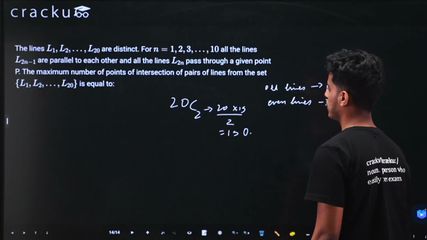
The lines $$L_1, L_2, \ldots, L_{20}$$ are distinct. For $$n = 1, 2, 3, \ldots, 10$$ all the lines $$L_{2n-1}$$ are parallel to each other and all the lines $$L_{2n}$$ pass through a given point P. The maximum number of points of intersection of pairs of lines from the set $$\{L_1, L_2, \ldots, L_{20}\}$$ is equal to:
Correct Answer: 101
We have 20 lines: $$L_1, L_2, \ldots, L_{20}$$.
Odd-indexed lines $$L_1, L_3, L_5, \ldots, L_{19}$$ (10 lines) are all parallel to each other.
Even-indexed lines $$L_2, L_4, L_6, \ldots, L_{20}$$ (10 lines) all pass through a point P.
For maximum intersections, we count using $$\binom{20}{2}$$ total pairs and subtract cases where pairs don't intersect.
Total pairs: $$\binom{20}{2} = 190$$.
Pairs that don't give distinct intersection points:
1) Parallel lines (odd-indexed) don't intersect each other: $$\binom{10}{2} = 45$$ pairs with 0 intersection points.
2) Concurrent lines (even-indexed) all meet at point P: $$\binom{10}{2} = 45$$ pairs, but they all intersect at the same point P. So they contribute 1 point instead of 45 distinct points. We lose $$45 - 1 = 44$$ points.
Maximum intersection points = $$190 - 45 - 44 = 101$$.
The answer is $$\boxed{101}$$.
Was this solution helpful?
Click on the Email ☝️ to Watch the Video Solution
Create a FREE account and get:
_1.webp)

Educational materials for JEE preparation

Ask our AI anything

AI can make mistakes. Please verify important information.
AI can make mistakes. Please verify important information.
