
Join Our JEE Preparation Group
Prep with like-minded aspirants; Get access to free daily tests and study material.
Sign in
Please select an account to continue using cracku.in
↓ →
Join Our JEE Preparation Group
Prep with like-minded aspirants; Get access to free daily tests and study material.
If $$\log_3 2, \log_3(2^x - 5), \log_3\left(2^x - \frac{7}{2}\right)$$ are in an arithmetic progression, then the value of $$x$$ is equal to _________.
Correct Answer: 3
We are given that $$\log_3 2 ,\; \log_3(2^x-5),\; \log_3\left(2^x-\dfrac{7}{2}\right)$$ form an arithmetic progression. In any arithmetic progression, the middle term is the average of the other two, so we have
$$2\;\log_3(2^x-5)=\log_3 2+\log_3\!\left(2^x-\dfrac{7}{2}\right).$$
Now, we recall the logarithmic addition formula: if $$\log_a p+\log_a q=\log_a(pq).$$ Applying this on the right-hand side gives
$$2\;\log_3(2^x-5)=\log_3\!\Bigl(2\bigl(2^x-\dfrac{7}{2}\bigr)\Bigr).$$
Next, we use the power formula $$k\log_a m=\log_a(m^k)$$ on the left-hand side:
$$\log_3\!\bigl((2^x-5)^2\bigr)=\log_3\!\Bigl(2\bigl(2^x-\dfrac{7}{2}\bigr)\Bigr).$$
Because the two logarithms have the same base and are equal, their arguments must be equal:
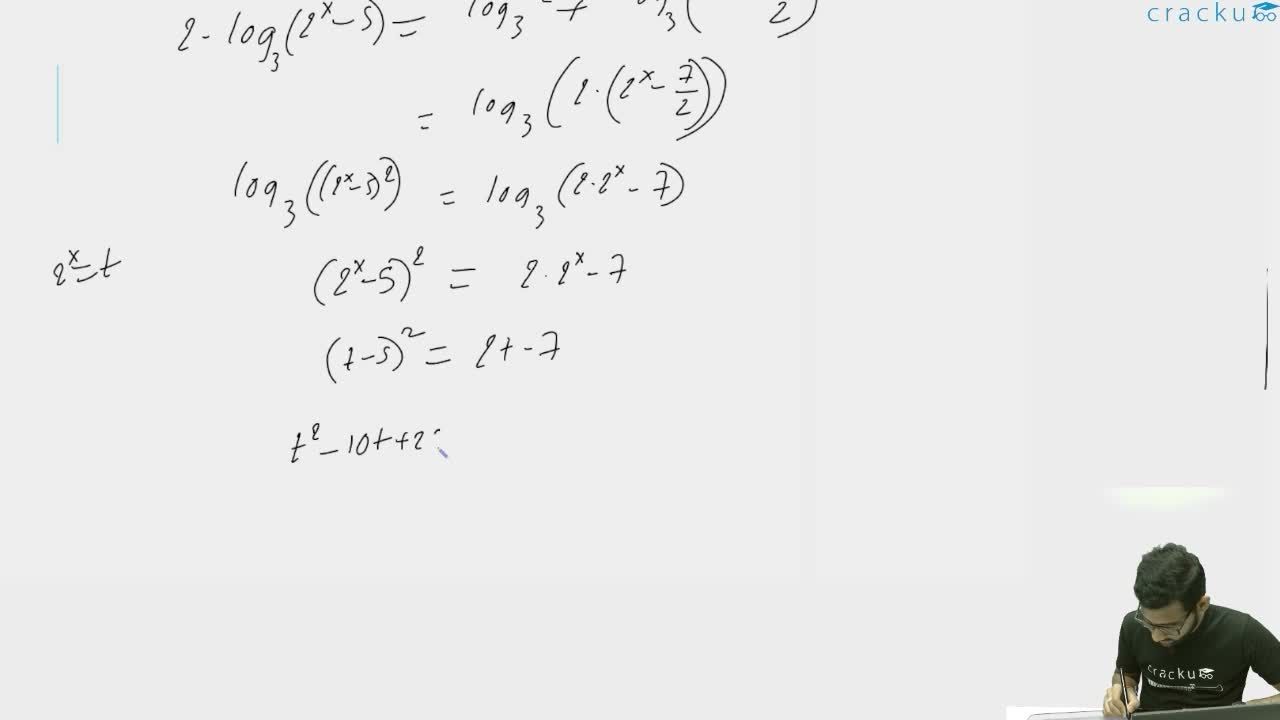
$$(2^x-5)^2=2\left(2^x-\dfrac{7}{2}\right).$$
Simplifying the right-hand side first, we obtain
$$2\left(2^x-\dfrac{7}{2}\right)=2\cdot2^x-7.$$
So the equation becomes
$$(2^x-5)^2=2\cdot2^x-7.$$
Expanding the square on the left gives
$$\bigl(2^x\bigr)^2-10\cdot2^x+25=2\cdot2^x-7.$$
Bringing every term to one side, we have
$$\bigl(2^x\bigr)^2-10\cdot2^x-2\cdot2^x+25+7=0,$$
which simplifies to
$$\bigl(2^x\bigr)^2-12\cdot2^x+32=0.$$
Let us set $$y=2^x$$ (note that $$y>0$$). The equation becomes
$$y^2-12y+32=0.$$
This is a quadratic in $$y$$. Using the quadratic-formula result $$y=\dfrac{-b\pm\sqrt{b^2-4ac}}{2a}$$ with $$a=1,\;b=-12,\;c=32,$$ we get
$$y=\dfrac{12\pm\sqrt{(-12)^2-4\cdot1\cdot32}}{2} =\dfrac{12\pm\sqrt{144-128}}{2} =\dfrac{12\pm4}{2}.$$
Therefore,
$$y=\dfrac{12+4}{2}=8 \quad\text{or}\quad y=\dfrac{12-4}{2}=4.$$
Replacing $$y$$ by $$2^x$$ gives
$$2^x=8 \quad\text{or}\quad 2^x=4.$$
Hence,
$$x=\log_2 8=3 \quad\text{or}\quad x=\log_2 4=2.$$
But the original logarithms are defined only when their arguments are positive. In particular, we need $$2^x-5>0,$$ i.e., $$2^x>5.$$ For $$x=2,$$ we have $$2^2=4<5,$$ which is not allowed. For $$x=3,$$ we have $$2^3=8>5,$$ which is permissible.
Thus only $$x=3$$ satisfies all conditions.
So, the answer is $$3$$.
Was this solution helpful?
Click on the Email ☝️ to Watch the Video Solution
Create a FREE account and get:
_1.webp)

Educational materials for JEE preparation

Ask our AI anything

AI can make mistakes. Please verify important information.
AI can make mistakes. Please verify important information.
