
Join Our JEE Preparation Group
Prep with like-minded aspirants; Get access to free daily tests and study material.
Sign in
Please select an account to continue using cracku.in
↓ →
Join Our JEE Preparation Group
Prep with like-minded aspirants; Get access to free daily tests and study material.
The probability that a randomly selected 2-digit number belongs to the set $$\{n \in N : (2^n - 2)$$ is a multiple of 3$$\}$$ is equal to
First, let us interpret the condition. We want those natural numbers $$n$$ for which the expression $$2^{\,n}-2$$ is a multiple of $$3$$. Writing this in modular arithmetic language, “is a multiple of $$3$$” means “is congruent to $$0$$ modulo $$3$$”. So we require
$$2^{\,n}-2 \equiv 0 \pmod 3.$$
Adding $$2$$ to both sides keeps the equivalence true, therefore
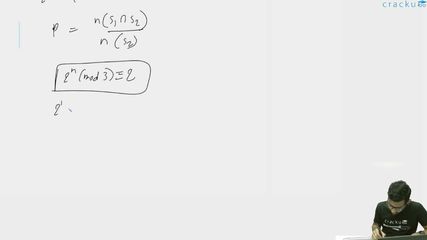
$$2^{\,n}\equiv 2 \pmod 3.$$
Now we study the powers of $$2$$ modulo $$3$$. We begin with the smallest exponents and proceed step by step.
$$\begin{aligned} 2^{1}&=2 &\Longrightarrow&\; 2^{1}\equiv 2 \pmod 3,\\[2pt] 2^{2}&=4 &\Longrightarrow&\; 2^{2}\equiv 1 \pmod 3,\\[2pt] 2^{3}&=8 &\Longrightarrow&\; 2^{3}\equiv 2 \pmod 3,\\[2pt] 2^{4}&=16 &\Longrightarrow&\; 2^{4}\equiv 1 \pmod 3. \end{aligned}$$
We notice a repeating pattern: $$2,\,1,\,2,\,1,\ldots$$ Thus the remainder alternates between $$2$$ and $$1$$ every time we increase the exponent by $$1$$. Consequently,
$$\boxed{2^{\,n}\equiv 2 \pmod 3 \;\Longleftrightarrow\; n \text{ is odd}.}$$
So the given condition is satisfied exactly when $$n$$ is an odd integer.
But the problem restricts us to two-digit numbers. The set of all two-digit natural numbers is $$\{10,11,12,\ldots,99\}$$, and its size is
$$99-10+1 \;=\;90.$$
Among these, we list the odd ones: $$11,13,15,\ldots,99.$$ This is an arithmetic progression with first term $$11$$, common difference $$2$$, and last term $$99$$. Using the standard counting formula for such a progression,
$$\text{Number of odd terms}= \frac{99-11}{2}+1 = \frac{88}{2}+1 =44+1 =45.$$
Therefore, exactly $$45$$ out of the $$90$$ two-digit numbers meet the required criterion.
Probability is defined as $$\text{Probability}= \frac{\text{favourable cases}}{\text{total cases}}.$$ Substituting the values we have just obtained,
$$\text{Probability}= \frac{45}{90}= \frac{1}{2}.$$
Hence, the correct answer is Option C.
Was this solution helpful?
Click on the Email ☝️ to Watch the Video Solution
Create a FREE account and get:
_1.webp)

Educational materials for JEE preparation

Ask our AI anything

AI can make mistakes. Please verify important information.
AI can make mistakes. Please verify important information.
