
Join Our JEE Preparation Group
Prep with like-minded aspirants; Get access to free daily tests and study material.
Sign in
Please select an account to continue using cracku.in
↓ →
Join Our JEE Preparation Group
Prep with like-minded aspirants; Get access to free daily tests and study material.
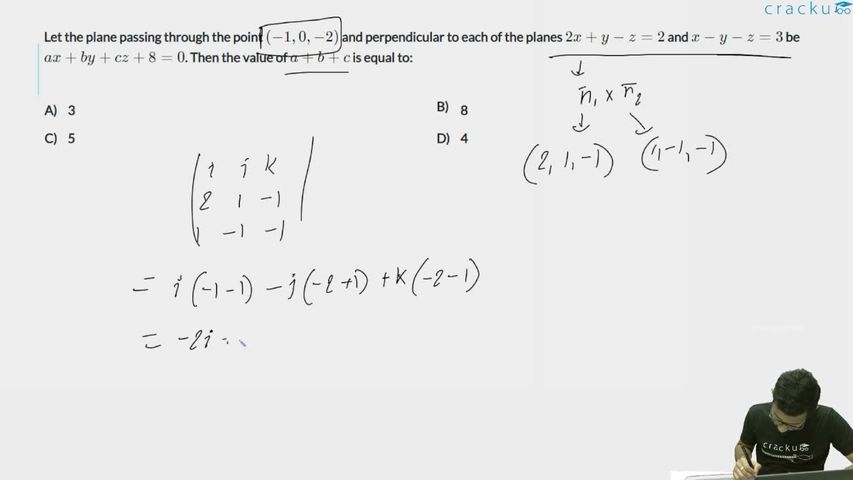
Let the plane passing through the point $$(-1, 0, -2)$$ and perpendicular to each of the planes $$2x + y - z = 2$$ and $$x - y - z = 3$$ be $$ax + by + cz + 8 = 0$$. Then the value of $$a + b + c$$ is equal to:
We need a plane that (i) passes through the fixed point $$P(-1,0,-2)$$ and (ii) is perpendicular to each of the two given planes
$$2x + y - z = 2 \qquad\text{and}\qquad x - y - z = 3.$$
A plane is represented by $$ax + by + cz + d = 0,$$ where the vector $$\vec n = \langle a,\;b,\;c\rangle$$ is its normal (perpendicular) vector. Two planes are perpendicular when their normals are perpendicular, that is, when the dot-product of the normals is zero.
The first given plane has normal
$$\vec n_1 = \langle 2,\,1,\,-1\rangle,$$
and the second has normal
$$\vec n_2 = \langle 1,\,-1,\,-1\rangle.$$
Let $$\vec n = \langle a,\,b,\,c\rangle$$ be the normal of the required plane. Because our plane must be perpendicular to both planes, we require
$$\vec n\cdot\vec n_1 = 0 \quad\text{and}\quad \vec n\cdot\vec n_2 = 0.$$
A single vector that is simultaneously perpendicular to $$\vec n_1$$ and $$\vec n_2$$ is given by their cross-product. We state the formula first:
For vectors $$\vec u=\langle u_1,u_2,u_3\rangle$$ and $$\vec v=\langle v_1,v_2,v_3\rangle,$$
$$\vec u\times\vec v =\bigl(u_2v_3-u_3v_2,\;u_3v_1-u_1v_3,\;u_1v_2-u_2v_1\bigr).$$
Applying this to $$\vec n_1$$ and $$\vec n_2$$ we have
$$\vec n =\vec n_1\times\vec n_2 =\begin{vmatrix} \mathbf i & \mathbf j & \mathbf k\\[2pt] 2 & 1 & -1\\ 1 & -1 & -1 \end{vmatrix}.$$
Expanding the determinant step by step,
$$\vec n =\mathbf i\,(1\cdot(-1)-(-1)\cdot(-1)) -\mathbf j\,(2\cdot(-1)-(-1)\cdot1) +\mathbf k\,(2\cdot(-1)-1\cdot1).$$
Simplifying each component,
$$\vec n =\mathbf i\,(-1-1) -\mathbf j\,(-2+1) +\mathbf k\,(-2-1),$$
$$\vec n =\mathbf i\,(-2) -\mathbf j\,(-1) +\mathbf k\,(-3),$$
$$\vec n =\langle -2,\;1,\;-3\rangle.$$
Thus one normal vector of the desired plane is $$(-2,\,1,\,-3).$$ Any non-zero scalar multiple of this will also serve, so we may start with the equation
$$-2x + y - 3z + d = 0.$$
Because the plane must pass through $$P(-1,0,-2),$$ we substitute these coordinates:
$$-2(-1) + 0 - 3(-2) + d = 0,$$
$$2 + 0 + 6 + d = 0,$$
$$8 + d = 0 \;\;\Longrightarrow\;\; d = -8.$$
This gives
$$-2x + y - 3z - 8 = 0.$$
The statement of the problem writes the plane as $$ax + by + cz + 8 = 0.$$ We therefore multiply the entire equation by $$-1$$ to match the +8:
$$2x - y + 3z + 8 = 0.$$
Now we can read the required coefficients:
$$a = 2,\qquad b = -1,\qquad c = 3.$$
Adding them,
$$a + b + c = 2 + (-1) + 3 = 4.$$
Hence, the correct answer is Option D.
Was this solution helpful?
Click on the Email ☝️ to Watch the Video Solution
Create a FREE account and get:
_1.webp)

Educational materials for JEE preparation

Ask our AI anything

AI can make mistakes. Please verify important information.
AI can make mistakes. Please verify important information.
