
Join Our JEE Preparation Group
Prep with like-minded aspirants; Get access to free daily tests and study material.
Sign in
Please select an account to continue using cracku.in
↓ →
Join Our JEE Preparation Group
Prep with like-minded aspirants; Get access to free daily tests and study material.
Let $$\vec{a} = \hat{i} + \hat{j} + 2\hat{k}$$ and $$\vec{b} = -\hat{i} + 2\hat{j} + 3\hat{k}$$. Then the vector product $$\left(\vec{a} + \vec{b}\right) \times \left(\left(\vec{a} \times \left(\left(\vec{a} - \vec{b}\right) \times \vec{b}\right)\right) \times \vec{b}\right)$$ is equal to:
We have the two given vectors
$$\vec a = \hat i + \hat j + 2\hat k, \qquad \vec b = -\hat i + 2\hat j + 3\hat k.$$
The expression to be evaluated is
$$\bigl(\vec a+\vec b\bigr)\;\times\;\Bigl(\bigl(\vec a \times \bigl((\vec a-\vec b)\times \vec b\bigr)\bigr)\times\vec b\Bigr).$$
We shall build it part by part, showing every algebraic step.
1. Calculating $$\vec a+\vec b$$
$$\vec a+\vec b = (1\hat i+1\hat j+2\hat k)+(-1\hat i+2\hat j+3\hat k) = 0\hat i+3\hat j+5\hat k.$$
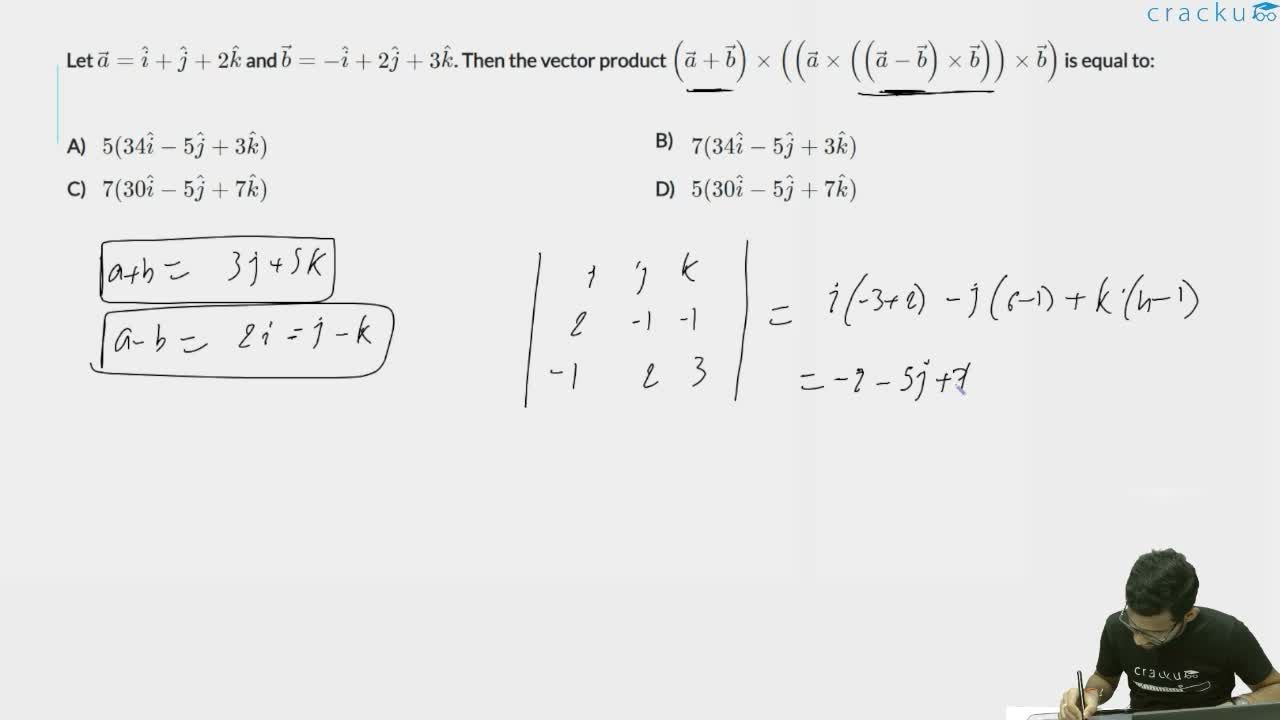
2. Calculating $$\vec a-\vec b$$
$$\vec a-\vec b = (1\hat i+1\hat j+2\hat k)-(-1\hat i+2\hat j+3\hat k) = 2\hat i-1\hat j-1\hat k.$$
3. Calculating the first cross product $$\bigl(\vec a-\vec b\bigr)\times\vec b$$
Using the determinant form for the cross product,
$$ \bigl(\vec a-\vec b\bigr)\times\vec b =\begin{vmatrix} \hat i & \hat j & \hat k\\ 2 & -1 & -1\\ -1 & 2 & 3 \end{vmatrix} =\hat i\bigl((-1)\cdot3-(-1)\cdot2\bigr) -\hat j\bigl(2\cdot3-(-1)\cdot(-1)\bigr) +\hat k\bigl(2\cdot2-(-1)\cdot(-1)\bigr). $$
This gives
$$ \hat i(-3+2)-\hat j(6-1)+\hat k(4-1) =-1\hat i-5\hat j+3\hat k. $$
4. Calculating the next cross product $$\vec a\times\Bigl((\vec a-\vec b)\times\vec b\Bigr)$$
Now we cross $$\vec a=(1,1,2)$$ with $$(-1,-5,3).$$ Again using the determinant,
$$ \vec a\times\bigl((\vec a-\vec b)\times\vec b\bigr) =\begin{vmatrix} \hat i & \hat j & \hat k\\ 1 & 1 & 2\\ -1 & -5 & 3 \end{vmatrix} =\hat i\bigl(1\cdot3-2\cdot(-5)\bigr) -\hat j\bigl(1\cdot3-2\cdot(-1)\bigr) +\hat k\bigl(1\cdot(-5)-1\cdot(-1)\bigr). $$
Simplifying term by term,
$$ \hat i(3+10)-\hat j(3+2)+\hat k(-5+1) =13\hat i-5\hat j-4\hat k. $$
5. Calculating $$\Bigl(\vec a\times\bigl((\vec a-\vec b)\times\vec b\bigr)\Bigr)\times\vec b$$
We now cross $$\bigl(13,-5,-4\bigr)$$ with $$\vec b=(-1,2,3).$$ Writing the determinant,
$$ \begin{vmatrix} \hat i & \hat j & \hat k\\ 13 & -5 & -4\\ -1 & 2 & 3 \end{vmatrix} =\hat i\bigl((-5)\cdot3-(-4)\cdot2\bigr) -\hat j\bigl(13\cdot3-(-4)\cdot(-1)\bigr) +\hat k\bigl(13\cdot2-(-5)\cdot(-1)\bigr). $$
Evaluating each component,
$$ \hat i(-15+8)-\hat j(39-4)+\hat k(26-5) =-7\hat i-35\hat j+21\hat k. $$
6. Finally, computing $$\bigl(\vec a+\vec b\bigr)\times\Bigl(\dots\Bigr)$$
The last cross product is between $$\vec a+\vec b=(0,3,5)$$ and $$(-7,-35,21).$$ Using the determinant once more,
$$ \begin{vmatrix} \hat i & \hat j & \hat k\\ 0 & 3 & 5\\ -7 & -35 & 21 \end{vmatrix} =\hat i\bigl(3\cdot21-5\cdot(-35)\bigr) -\hat j\bigl(0\cdot21-5\cdot(-7)\bigr) +\hat k\bigl(0\cdot(-35)-3\cdot(-7)\bigr). $$
Simplifying,
$$ \hat i(63+175)-\hat j(0+35)+\hat k(0+21) =238\hat i-35\hat j+21\hat k. $$
7. Recognising a common factor
All three coefficients share the common factor $$7$$:
$$238\hat i-35\hat j+21\hat k =7\bigl(34\hat i-5\hat j+3\hat k\bigr).$$
Thus the required vector product equals
$$7\bigl(34\hat i-5\hat j+3\hat k\bigr).$$
Comparing with the given alternatives, this matches Option B.
Hence, the correct answer is Option 2.
Was this solution helpful?
Click on the Email ☝️ to Watch the Video Solution
Create a FREE account and get:
_1.webp)

Educational materials for JEE preparation

Ask our AI anything

AI can make mistakes. Please verify important information.
AI can make mistakes. Please verify important information.
