
Join Our JEE Preparation Group
Prep with like-minded aspirants; Get access to free daily tests and study material.
Sign in
Please select an account to continue using cracku.in
↓ →
Join Our JEE Preparation Group
Prep with like-minded aspirants; Get access to free daily tests and study material.
Let $$y = y(x)$$ be solution of the differential equation $$\log_e\left(\frac{dy}{dx}\right) = 3x + 4y$$, with $$y(0) = 0$$. If $$y\left(-\frac{2}{3}\log_e 2\right) = \alpha \log_e 2$$, then the value of $$\alpha$$ is equal to:
We begin with the given differential equation
$$\log_e\!\left(\frac{dy}{dx}\right)=3x+4y.$$
Changing the logarithmic form into exponential form, we obtain
$$\frac{dy}{dx}=e^{\,3x+4y}=e^{3x}\,e^{4y}.$$
We now separate the variables. Dividing both sides by $$e^{4y}$$ and multiplying by $$dx$$ gives
$$e^{-4y}\,dy=e^{3x}\,dx.$$
Next we integrate both sides. First, we recall the integral formula $$\int e^{kx}\,dx=\frac{1}{k}e^{kx}+C.$$ Applying it separately on each side, we get
$$\int e^{-4y}\,dy=\int e^{3x}\,dx,$$
$$\frac{-1}{4}e^{-4y}=\frac{1}{3}e^{3x}+C_1.$$
To remove the fraction on the left, we multiply every term by $$-4$$, giving
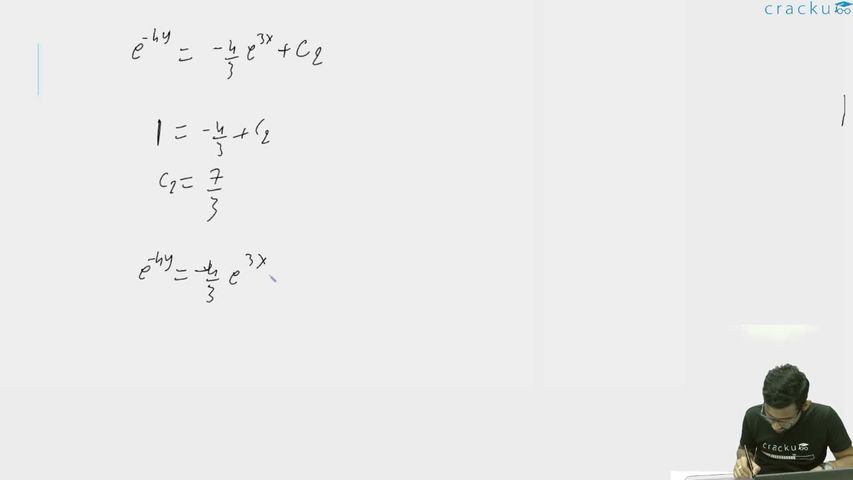
$$e^{-4y}=-\frac{4}{3}e^{3x}+C_2,$$
where $$C_2=-4C_1$$ is another constant of integration.
We now use the initial condition $$y(0)=0$$ to evaluate the constant. Substituting $$x=0$$ and $$y=0$$ into the preceding relation, we have
$$e^{-4(0)}=-\frac{4}{3}e^{3\cdot0}+C_2\;\;\Longrightarrow\;\;1=-\frac{4}{3}(1)+C_2.$$ So
$$C_2=1+\frac{4}{3}=\frac{7}{3}.$$
Hence the relation between $$x$$ and $$y$$ becomes
$$e^{-4y}=-\frac{4}{3}e^{3x}+\frac{7}{3}=\frac{-4e^{3x}+7}{3}.$$
Writing this more compactly,
$$e^{-4y}=\frac{7-4e^{3x}}{3}.$$
To express $$y$$ explicitly, we take the natural logarithm on both sides:
$$-4y=\ln\!\left(\frac{7-4e^{3x}}{3}\right),$$
so
$$y=-\frac14\,\ln\!\left(\frac{7-4e^{3x}}{3}\right).$$
Now we must evaluate $$y$$ at $$x=-\dfrac{2}{3}\log_e 2$$. First we compute $$e^{3x}$$:
$$3x=3\!\left(-\frac{2}{3}\log_e 2\right)=-2\log_e 2=\log_e(2^{-2})=\log_e\!\left(\frac14\right),$$
so
$$e^{3x}=\frac14.$$
Substituting $$e^{3x}=\dfrac14$$ into the expression for $$e^{-4y}$$, we get
$$e^{-4y}=\frac{7-4\!\left(\dfrac14\right)}{3}=\frac{7-1}{3}=\frac{6}{3}=2.$$
Taking the natural logarithm once more,
$$-4y=\ln 2\quad\Longrightarrow\quad y=-\frac14\,\ln 2.$$
The problem statement writes this value as $$\alpha\ln 2$$, so by comparison
$$\alpha\ln 2=-\frac14\,\ln 2\quad\Longrightarrow\quad\alpha=-\frac14.$$
Hence, the correct answer is Option A.
Was this solution helpful?
Click on the Email ☝️ to Watch the Video Solution
Create a FREE account and get:
_1.webp)

Educational materials for JEE preparation

Ask our AI anything

AI can make mistakes. Please verify important information.
AI can make mistakes. Please verify important information.
