
Join Our JEE Preparation Group
Prep with like-minded aspirants; Get access to free daily tests and study material.
Sign in
Please select an account to continue using cracku.in
↓ →
Join Our JEE Preparation Group
Prep with like-minded aspirants; Get access to free daily tests and study material.
If the area of the bounded region $$R = \{(x, y) : \max\{0, \log_e x\} \leq y \leq 2^x, \frac{1}{2} \leq x \leq 2\}$$ is, $$\alpha(\log_e 2)^{-1} + \beta(\log_e 2) + \gamma$$ then the value of $$(\alpha + \beta - 2\gamma)^2$$ is equal to:
We want the area of the region
$$R=\{(x,y):\max\{0,\log_e x\}\le y\le 2^x,\; \tfrac12\le x\le 2\}.$$
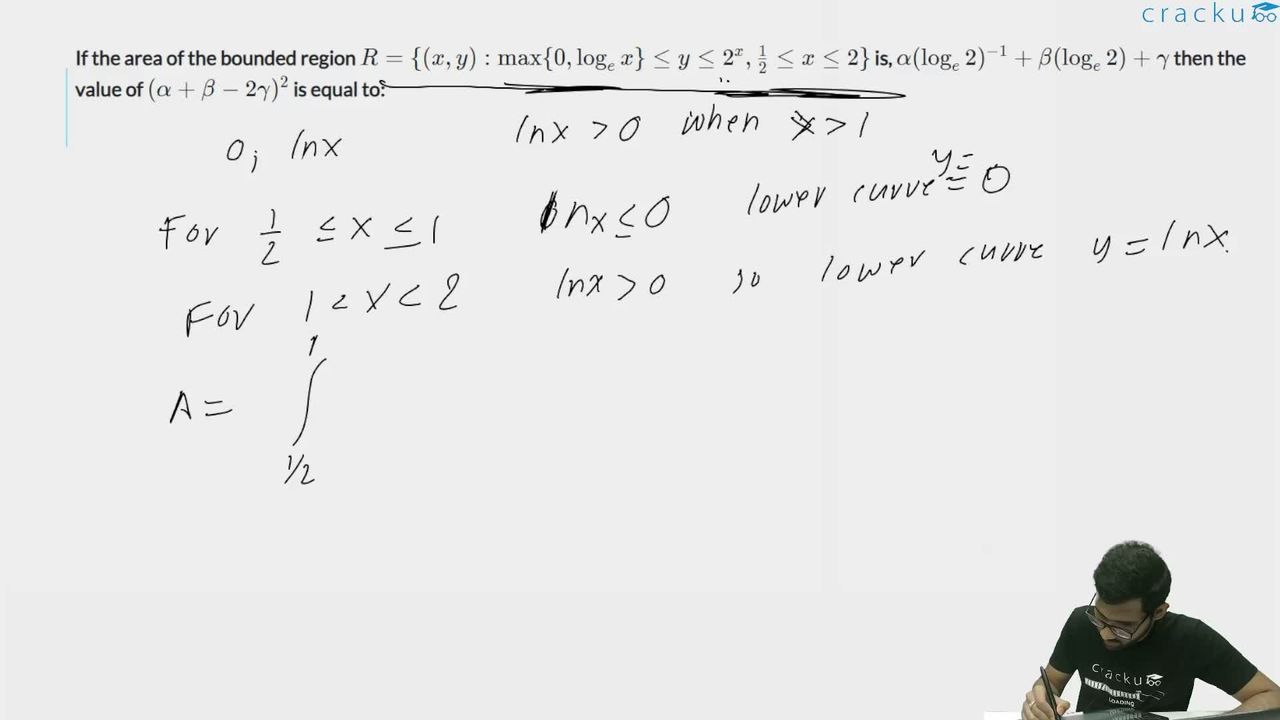
The lower curve is the larger of $$0$$ and $$\log_e x.$$ Observe that $$\log_e x>0$$ exactly when $$x>1.$$ Hence:
For $$\tfrac12\le x\le1$$ we have $$\log_e x\le0,$$ so the lower curve is $$y=0.$$
For $$1\le x\le2$$ we have $$\log_e x\ge0,$$ so the lower curve is $$y=\log_e x.$$
Therefore the required area $$A$$ breaks into two integrals:
$$A=\int_{1/2}^{1}\bigl(2^x-0\bigr)\,dx+\int_{1}^{2}\bigl(2^x-\log_e x\bigr)\,dx.$$
We evaluate each part separately.
First integral. We use the formula $$\displaystyle\int 2^x\,dx=\frac{2^x}{\log_e 2}+C,$$ because $$\frac{d}{dx}\bigl(2^x\bigr)=2^x\log_e2.$$ Hence
$$\int_{1/2}^{1}2^x\,dx=\left[\frac{2^x}{\log_e2}\right]_{1/2}^{1} =\frac{2^1-2^{1/2}}{\log_e2} =\frac{2-\sqrt2}{\log_e2}.$$
Second integral. Again applying the same antiderivative for $$2^x, $$ we get
$$\int_{1}^{2}2^x\,dx=\left[\frac{2^x}{\log_e2}\right]_{1}^{2} =\frac{2^2-2^1}{\log_e2} =\frac{4-2}{\log_e2} =\frac{2}{\log_e2}.$$
For $$\displaystyle\int_{1}^{2}\log_e x\,dx$$ we first recall the standard result
$$\int\log_e x\,dx=x\log_e x-x+C,$$
because differentiating $$x\log_e x-x$$ yields $$\log_e x.$$ Therefore
$$\int_{1}^{2}\log_e x\,dx=\left[x\log_e x-x\right]_{1}^{2} =\bigl(2\log_e2-2\bigr)-\bigl(1\cdot0-1\bigr) =2\log_e2-2+1 =2\log_e2-1.$$
Putting the pieces together, the second integral becomes
$$\int_{1}^{2}\bigl(2^x-\log_e x\bigr)\,dx =\frac{2}{\log_e2}-\bigl(2\log_e2-1\bigr) =\frac{2}{\log_e2}-2\log_e2+1.$$
Add both parts.
$$\begin{aligned} A&=\frac{2-\sqrt2}{\log_e2}+\left(\frac{2}{\log_e2}-2\log_e2+1\right)\\[4pt] &=\frac{(2-\sqrt2)+2}{\log_e2}-2\log_e2+1\\[4pt] &=\frac{4-\sqrt2}{\log_e2}-2\log_e2+1. \end{aligned}$$
We compare this with the given form $$\alpha(\log_e2)^{-1}+\beta(\log_e2)+\gamma.$$ We can read directly:
$$\alpha=4-\sqrt2,\qquad \beta=-2,\qquad \gamma=1.$$
We are asked to compute $$\bigl(\alpha+\beta-2\gamma\bigr)^2.$$ Substituting the values,
$$\begin{aligned} \alpha+\beta-2\gamma&=(4-\sqrt2)+(-2)-2\cdot1\\ &=4-\sqrt2-2-2\\ &=-\sqrt2. \end{aligned}$$
Finally,
$$\bigl(\alpha+\beta-2\gamma\bigr)^2=(-\sqrt2)^2=2.$$
Hence, the correct answer is Option B.
Was this solution helpful?
Click on the Email ☝️ to Watch the Video Solution
Create a FREE account and get:
_1.webp)

Educational materials for JEE preparation

Ask our AI anything

AI can make mistakes. Please verify important information.
AI can make mistakes. Please verify important information.
