
Join Our JEE Preparation Group
Prep with like-minded aspirants; Get access to free daily tests and study material.
Sign in
Please select an account to continue using cracku.in
↓ →
Join Our JEE Preparation Group
Prep with like-minded aspirants; Get access to free daily tests and study material.
The value of the definite integral $$\int_{-\frac{\pi}{4}}^{\frac{\pi}{4}} \frac{dx}{(1 + e^{x\cos x})(\sin^4 x + \cos^4 x)}$$ is equal to:
We have to evaluate the definite integral
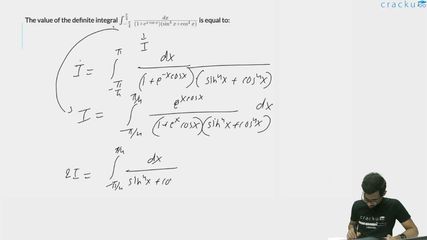
$$I=\int_{-\frac{\pi}{4}}^{\frac{\pi}{4}}\dfrac{dx}{\bigl(1+e^{x\cos x}\bigr)\bigl(\sin^4x+\cos^4x\bigr)}.$$
Put
$$f(x)=\dfrac{1}{\bigl(1+e^{x\cos x}\bigr)\bigl(\sin^4x+\cos^4x\bigr)}.$$
First we examine $$f(-x)$$:
$$f(-x)=\dfrac{1}{\bigl(1+e^{-x\cos x}\bigr)\bigl(\sin^4(-x)+\cos^4(-x)\bigr)} =\dfrac{1}{\bigl(1+e^{-x\cos x}\bigr)\bigl(\sin^4x+\cos^4x\bigr)},$$
because $$\sin(-x)=-\sin x$$ and $$\cos(-x)=\cos x$$, while the fourth powers eliminate the signs.
Now we add $$f(x)$$ and $$f(-x)$$:
$$\begin{aligned} f(x)+f(-x)&=\dfrac{1}{\sin^4x+\cos^4x}\left[\dfrac{1}{1+e^{x\cos x}}+\dfrac{1}{1+e^{-x\cos x}}\right].\\ \end{aligned}$$
Inside the brackets we simplify the sum of two fractions. Let $$a=x\cos x$$. Then
$$\dfrac{1}{1+e^{a}}+\dfrac{1}{1+e^{-a}} =\dfrac{1+e^{-a}+1+e^{a}}{(1+e^{a})(1+e^{-a})} =\dfrac{2+e^{a}+e^{-a}}{2+e^{a}+e^{-a}} =1.$$
Hence
$$f(x)+f(-x)=\dfrac{1}{\sin^4x+\cos^4x}.$$
The integral $$I$$ can now be written as
$$\begin{aligned} I&=\int_{-\frac{\pi}{4}}^{\frac{\pi}{4}}f(x)\,dx =\frac12\int_{-\frac{\pi}{4}}^{\frac{\pi}{4}}\bigl[f(x)+f(-x)\bigr]\,dx =\frac12\int_{-\frac{\pi}{4}}^{\frac{\pi}{4}}\dfrac{dx}{\sin^4x+\cos^4x}. \end{aligned}$$
Because $$\dfrac{1}{\sin^4x+\cos^4x}$$ is an even function, the integral over the symmetric limits doubles when we restrict to the positive side:
$$\int_{-\frac{\pi}{4}}^{\frac{\pi}{4}}\dfrac{dx}{\sin^4x+\cos^4x} =2\int_{0}^{\frac{\pi}{4}}\dfrac{dx}{\sin^4x+\cos^4x}.$$
Therefore
$$I=\int_{0}^{\frac{\pi}{4}}\dfrac{dx}{\sin^4x+\cos^4x}.$$
We now tackle the simpler integral
$$J=\int_{0}^{\frac{\pi}{4}}\dfrac{dx}{\sin^4x+\cos^4x}.$$
First, simplify the denominator. Using $$\sin^2x+\cos^2x=1$$,
$$\begin{aligned} \sin^4x+\cos^4x&=(\sin^2x+\cos^2x)^2-2\sin^2x\cos^2x\\ &=1-2\sin^2x\cos^2x\\ &=1-\frac12\sin^22x\quad\bigl(\text{since }\sin2x=2\sin x\cos x\bigr). \end{aligned}$$
A more convenient form arises from the multiple-angle formulae:
$$\sin^4x=\dfrac{3-4\cos2x+\cos4x}{8},\qquad \cos^4x=\dfrac{3+4\cos2x+\cos4x}{8},$$
so
$$\sin^4x+\cos^4x =\dfrac{6+2\cos4x}{8} =\dfrac{3+\cos4x}{4}.$$
Thus
$$\dfrac{1}{\sin^4x+\cos^4x}=\dfrac{4}{3+\cos4x},$$
and the integral becomes
$$J=\int_{0}^{\frac{\pi}{4}}\dfrac{4\,dx}{3+\cos4x}.$$
Introduce the substitution
$$y=4x\quad\Longrightarrow\quad dy=4\,dx,\;\;dx=\dfrac{dy}{4}.$$
When $$x=0$$, $$y=0$$; when $$x=\dfrac{\pi}{4}$$, $$y=\pi$$. Therefore
$$J=\int_{0}^{\pi}\dfrac{4}{3+\cos y}\cdot\dfrac{dy}{4} =\int_{0}^{\pi}\dfrac{dy}{3+\cos y}.$$
Now we recall the standard definite integral (valid for $$a\gt \lvert b\rvert$$):
$$\int_{0}^{\pi}\dfrac{dy}{a+b\cos y}=\dfrac{\pi}{\sqrt{a^{2}-b^{2}}}.$$
Here $$a=3$$ and $$b=1$$, and indeed $$3\gt 1$$, so we can apply the formula directly:
$$\int_{0}^{\pi}\dfrac{dy}{3+\cos y} =\dfrac{\pi}{\sqrt{3^{2}-1^{2}}} =\dfrac{\pi}{\sqrt{9-1}} =\dfrac{\pi}{\sqrt{8}} =\dfrac{\pi}{2\sqrt2}.$$
Hence
$$J=\dfrac{\pi}{2\sqrt2}.$$
But we have already shown that $$I=J$$, so
$$I=\dfrac{\pi}{2\sqrt2}.$$
Hence, the correct answer is Option B.
Was this solution helpful?
Click on the Email ☝️ to Watch the Video Solution
Create a FREE account and get:
_1.webp)

Educational materials for JEE preparation

Ask our AI anything

AI can make mistakes. Please verify important information.
AI can make mistakes. Please verify important information.
