
Join Our JEE Preparation Group
Prep with like-minded aspirants; Get access to free daily tests and study material.
Sign in
Please select an account to continue using cracku.in
↓ →
Join Our JEE Preparation Group
Prep with like-minded aspirants; Get access to free daily tests and study material.
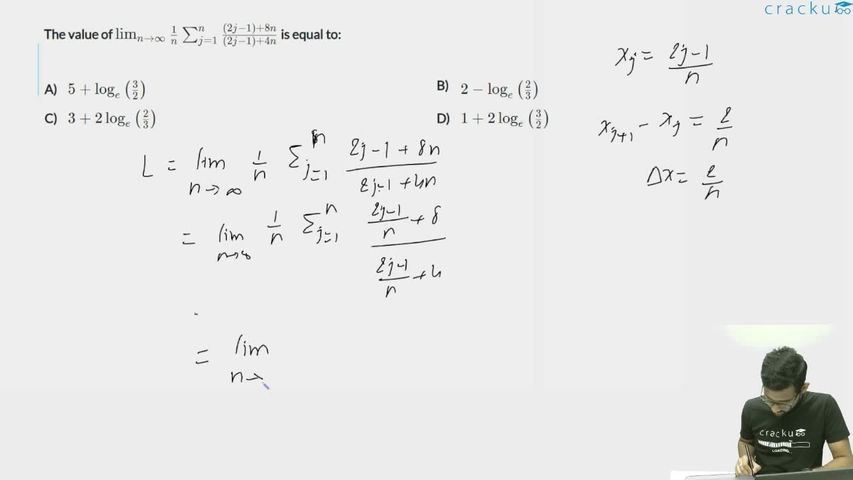
The value of $$\lim_{n \to \infty} \frac{1}{n} \sum_{j=1}^{n} \frac{(2j-1) + 8n}{(2j-1) + 4n}$$ is equal to:
We have to evaluate the limit
$$\displaystyle L=\lim_{n\to\infty}\frac1n\sum_{j=1}^{n}\frac{(2j-1)+8n}{(2j-1)+4n}\,.$$
First we simplify the general term of the sum. For every positive integer $$j$$,
$$\frac{(2j-1)+8n}{(2j-1)+4n} =\frac{8n+(2j-1)}{4n+(2j-1)}.$$
To prepare the expression for a Riemann-sum interpretation we divide numerator and denominator by $$n$$ (this is legitimate because $$n\neq0$$):
$$\frac{8n+(2j-1)}{4n+(2j-1)} =\frac{8+\dfrac{2j-1}{n}}{4+\dfrac{2j-1}{n}}.$$
Let us introduce the auxiliary quantity
$$x_j=\frac{2j-1}{n}.$$
For $$j=1,2,\dots ,n$$ we see that $$x_j$$ runs over the interval $$0<x_j<2$$ in equal steps, because
$$x_{j+1}-x_j=\frac{2(j+1)-1}{n}-\frac{2j-1}{n}=\frac{2}{n}.$$
Hence the common spacing is
$$\Delta x=\frac{2}{n}.$$
With this notation the general term becomes
$$\frac{8+\dfrac{2j-1}{n}}{4+\dfrac{2j-1}{n}} =\frac{8+x_j}{4+x_j}.$$
Therefore the whole sum can be rewritten as
$$\frac1n\sum_{j=1}^{n}\frac{8+x_j}{4+x_j} =\frac{\Delta x}{2}\sum_{j=1}^{n}\frac{8+x_j}{4+x_j},$$
because $$\displaystyle\Delta x=\frac{2}{n}\;\Longrightarrow\;\frac1n=\frac{\Delta x}{2}.$$
We recall the definition of a Riemann sum: if $$x_j$$ are sample points in an interval and $$\Delta x$$ is the common sub-interval length, then
$$\sum f(x_j)\,\Delta x\;\xrightarrow[n\to\infty]{}\;\int f(x)\,dx.$$
Applying this fact, and noting that as $$n\to\infty$$ the points $$x_j$$ fill the closed interval $$[0,2]$$, we get
$$L=\lim_{n\to\infty}\frac{\Delta x}{2}\sum_{j=1}^{n}\frac{8+x_j}{4+x_j} =\frac12\int_{0}^{2}\frac{8+x}{4+x}\,dx.$$
Now we evaluate the integral. We first simplify the integrand algebraically:
$$\frac{8+x}{4+x} =\frac{(4+x)+4}{4+x} =1+\frac{4}{4+x}.$$
So
$$\int_{0}^{2}\frac{8+x}{4+x}\,dx =\int_{0}^{2}1\,dx+\int_{0}^{2}\frac{4}{4+x}\,dx.$$
The first integral is elementary:
$$\int_{0}^{2}1\,dx = \bigl[x\bigr]_{0}^{2}=2.$$
For the second integral we use the standard formula $$\displaystyle\int\frac{1}{a+x}\,dx=\ln|a+x|+C.$$ Hence
$$\int_{0}^{2}\frac{4}{4+x}\,dx =4\bigl[\ln|4+x|\bigr]_{0}^{2} =4\bigl(\ln6-\ln4\bigr) =4\ln\!\left(\frac{6}{4}\right) =4\ln\!\left(\frac{3}{2}\right).$$
Adding the two parts,
$$\int_{0}^{2}\frac{8+x}{4+x}\,dx =2+4\ln\!\left(\frac{3}{2}\right).$$
Finally we multiply by the prefactor $$\dfrac12$$ that we carried along:
$$L=\frac12\left[2+4\ln\!\left(\frac{3}{2}\right)\right] =1+2\ln\!\left(\frac{3}{2}\right).$$
Hence, the correct answer is Option 4.
Was this solution helpful?
Click on the Email ☝️ to Watch the Video Solution
Create a FREE account and get:
_1.webp)

Educational materials for JEE preparation

Ask our AI anything

AI can make mistakes. Please verify important information.
AI can make mistakes. Please verify important information.
