
Join Our JEE Preparation Group
Prep with like-minded aspirants; Get access to free daily tests and study material.
Sign in
Please select an account to continue using cracku.in
↓ →
Join Our JEE Preparation Group
Prep with like-minded aspirants; Get access to free daily tests and study material.
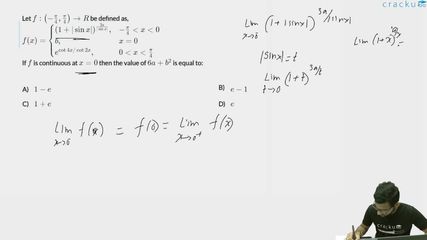
Let $$f : \left(-\frac{\pi}{4}, \frac{\pi}{4}\right) \rightarrow R$$ be defined as,
$$f(x) = \begin{cases} (1 + |\sin x|)^{\frac{3a}{|\sin x|}}, & -\frac{\pi}{4} < x < 0 \\ b, & x = 0 \\ e^{\cot 4x / \cot 2x}, & 0 < x < \frac{\pi}{4} \end{cases}$$
If $$f$$ is continuous at $$x = 0$$ then the value of $$6a + b^2$$ is equal to:
We want the function to be continuous at $$x = 0$$, so the left-hand limit, the value at the point, and the right-hand limit must all be equal. In symbols:
$$\lim_{x \to 0^-} f(x) \;=\; f(0) \;=\; \lim_{x \to 0^+} f(x).$$
First we examine $$x \to 0^-$$. For $$x < 0$$ we have
$$f(x) \;=\; (1 + |\sin x|)^{\dfrac{3a}{|\sin x|}}.$$
Because $$x < 0$$, $$\sin x < 0$$ and therefore $$|\sin x| = -\sin x$$. Put $$t = |\sin x|$$; then as $$x \to 0^-$$ we get $$t \to 0^+$$. We now recall the standard limit formula
$$\lim_{t \to 0} (1 + t)^{\frac{k}{t}} \;=\; e^{\,k}.$$
Comparing, we see $$k = 3a$$, so
$$\lim_{x \to 0^-} f(x) \;=\; \lim_{t \to 0^+} (1 + t)^{\frac{3a}{t}} \;=\; e^{\,3a}.$$
Next we examine $$x \to 0^+$$. For $$0 < x < \dfrac{\pi}{4}$$ we have
$$f(x) \;=\; e^{\frac{\cot 4x}{\cot 2x}}.$$
We need $$\displaystyle \lim_{x \to 0^+} \frac{\cot 4x}{\cot 2x}$$. Using the small-angle expansion $$\cot \theta \approx \dfrac{1}{\theta}$$ (the dominant term as $$\theta \to 0$$), we get
$$\cot 4x \;\approx\; \frac{1}{4x}, \qquad \cot 2x \;\approx\; \frac{1}{2x}.$$
Hence
$$\frac{\cot 4x}{\cot 2x} \;\approx\; \frac{\dfrac{1}{4x}}{\dfrac{1}{2x}} \;=\; \frac{1}{4x}\cdot 2x \;=\; \frac12.$$
Therefore
$$\lim_{x \to 0^+} f(x) \;=\; e^{\frac12} \;=\; e^{\,1/2}.$$
Now let $$f(0) = b$$. Continuity demands
$$e^{\,3a} = b = e^{\,1/2}.$$
Equating the exponents in the first equality gives
$$3a = \frac12 \;\Longrightarrow\; a = \frac16.$$
The second equality already gives
$$b = e^{\,1/2}.$$
We now compute the required expression:
$$6a + b^2 \;=\; 6\bigl(\tfrac16\bigr) + \bigl(e^{\,1/2}\bigr)^2 \;=\; 1 + e.$$
Hence, the correct answer is Option 3.
Was this solution helpful?
Click on the Email ☝️ to Watch the Video Solution
Create a FREE account and get:
_1.webp)

Educational materials for JEE preparation

Ask our AI anything

AI can make mistakes. Please verify important information.
AI can make mistakes. Please verify important information.
