
Join Our JEE Preparation Group
Prep with like-minded aspirants; Get access to free daily tests and study material.
Sign in
Please select an account to continue using cracku.in
↓ →
Join Our JEE Preparation Group
Prep with like-minded aspirants; Get access to free daily tests and study material.
For real numbers $$\alpha$$ and $$\beta$$, consider the following system of linear equations: $$x + y - z = 2$$, $$x + 2y + \alpha z = 1$$ and $$2x - y + z = \beta$$. If the system has infinite solutions, then $$\alpha + \beta$$ is equal to _________.
Correct Answer: 5
We have the system of three linear equations in the variables $$x$$, $$y$$ and $$z$$:
$$\begin{aligned} x+y-z&=2,\\ x+2y+\alpha z&=1,\\ 2x-y+z&=\beta. \end{aligned}$$
For infinitely many solutions to exist, the three equations must be dependent, that is, the rank of the coefficient matrix must be smaller than the number of variables. In particular, the determinant of the coefficient matrix must be zero.
First we write the coefficient matrix $$A$$ and compute its determinant. The matrix is
$$A=\begin{bmatrix} 1&1&-1\\ 1&2&\alpha\\ 2&-1&1 \end{bmatrix}.$$
The determinant of a $$3\times3$$ matrix $$\begin{bmatrix} a_{11}&a_{12}&a_{13}\\ a_{21}&a_{22}&a_{23}\\ a_{31}&a_{32}&a_{33} \end{bmatrix}$$ is given by the rule
$$\det A = a_{11}(a_{22}a_{33}-a_{23}a_{32})-a_{12}(a_{21}a_{33}-a_{23}a_{31})+a_{13}(a_{21}a_{32}-a_{22}a_{31}).$$
Applying this formula, we get
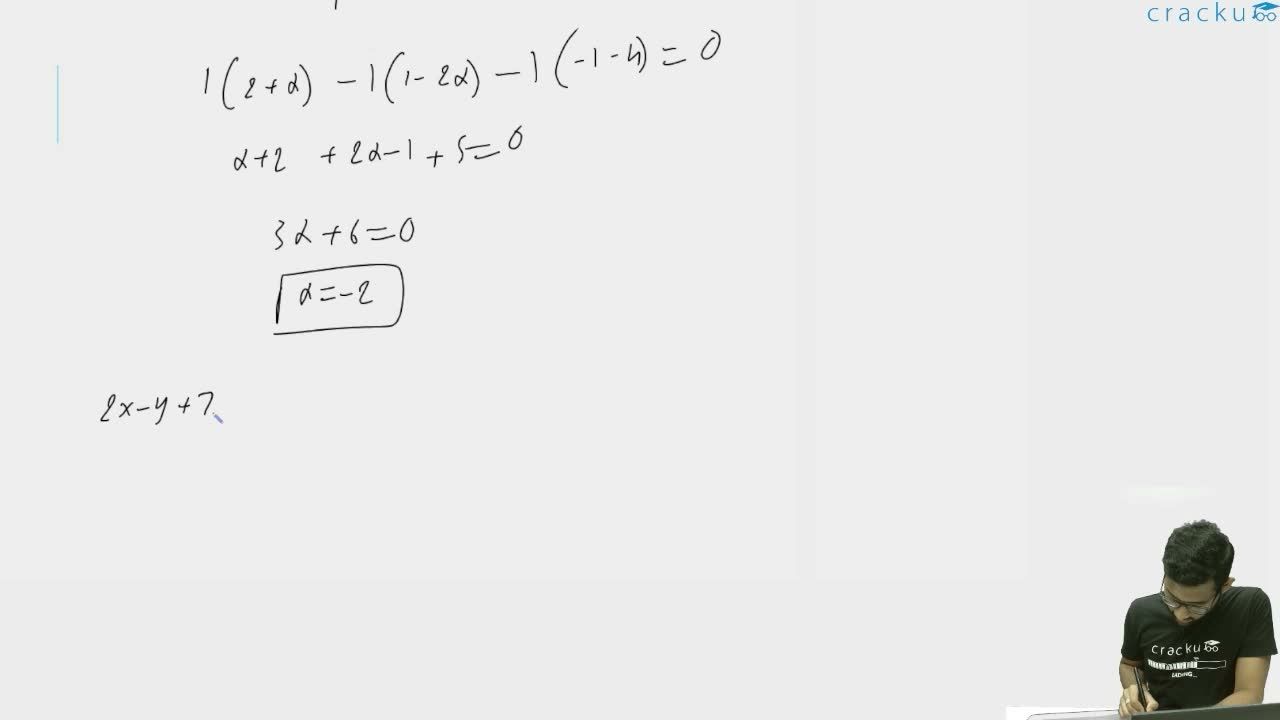
$$\begin{aligned} \det A &= 1\bigl(2\cdot1-\alpha(-1)\bigr)\;-\;1\bigl(1\cdot1-\alpha\cdot2\bigr)\;+\;(-1)\bigl(1\cdot(-1)-2\cdot2\bigr)\\ &= 1(2+\alpha)\;-\;1(1-2\alpha)\;+\;(-1)(-1-4)\\ &= (2+\alpha)\;-\;(1-2\alpha)\;+\;5\\ &= 2+\alpha-1+2\alpha+5\\ &= 6+3\alpha\\ &= 3(2+\alpha). \end{aligned}$$
For infinite solutions, $$\det A=0$$, so
$$3(2+\alpha)=0 \quad\Longrightarrow\quad \alpha=-2.$$
With $$\alpha=-2$$, the second equation becomes
$$x+2y-2z=1.$$
Now one of the three equations must be a linear combination of the other two. Let us try to express the third equation as a combination of the first two. Assume there exist real numbers $$p$$ and $$q$$ such that
$$p\,(x+y-z=2)+q\,(x+2y-2z=1)=2x-y+z=\beta.$$
Equating coefficients of $$x$$, $$y$$ and $$z$$ on both sides, we obtain the system
$$\begin{aligned} \text{(i)}&\; p+q &=& 2,\\ \text{(ii)}&\; p+2q &=& -1,\\ \text{(iii)}&\; -p-2q &=& 1. \end{aligned}$$
Solving (i) and (ii): subtract (i) from (ii) to eliminate $$p$$,
$$p+2q-(p+q)= -1-2\quad\Longrightarrow\quad q=-3.$$
Substituting $$q=-3$$ in (i) gives
$$p+(-3)=2\quad\Longrightarrow\quad p=5.$$
Checking with (iii): $$-p-2q=-5-2(-3)=1,$$ which is exactly the required coefficient of $$z$$, so the choice of $$p$$ and $$q$$ is consistent.
The right-hand side now yields
$$\beta = 2p+ q = 2\cdot5 + (-3)=10-3=7.$$
Finally, we calculate
$$\alpha+\beta = (-2)+7 = 5.$$
So, the answer is $$5$$.
Was this solution helpful?
Click on the Email ☝️ to Watch the Video Solution
Create a FREE account and get:
_1.webp)

Educational materials for JEE preparation

Ask our AI anything

AI can make mistakes. Please verify important information.
AI can make mistakes. Please verify important information.
