
Join Our JEE Preparation Group
Prep with like-minded aspirants; Get access to free daily tests and study material.
Sign in
Please select an account to continue using cracku.in
↓ →
Join Our JEE Preparation Group
Prep with like-minded aspirants; Get access to free daily tests and study material.
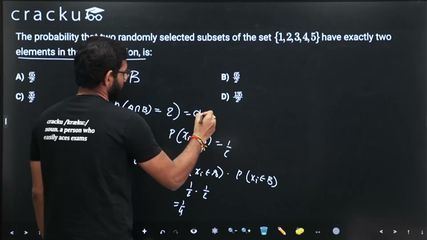
The probability that two randomly selected subsets of the set $$\{1, 2, 3, 4, 5\}$$ have exactly two elements in their intersection, is:
For each element of the set $$\{1, 2, 3, 4, 5\}$$, there are four equally likely possibilities when two subsets $$A$$ and $$B$$ are chosen randomly: the element is in both $$A$$ and $$B$$, in $$A$$ only, in $$B$$ only, or in neither. Each possibility has probability $$\frac{1}{4}$$, since each element is independently included in $$A$$ with probability $$\frac{1}{2}$$ and in $$B$$ with probability $$\frac{1}{2}$$.
The total number of ways to choose two subsets is $$2^5 \times 2^5 = 2^{10}$$. We need exactly 2 elements in the intersection $$A \cap B$$. An element belongs to $$A \cap B$$ with probability $$\frac{1}{4}$$, and does not belong to $$A \cap B$$ (i.e., is in at most one of the two subsets) with probability $$\frac{3}{4}$$.
The required probability is $$\binom{5}{2} \left(\frac{1}{4}\right)^2 \left(\frac{3}{4}\right)^3 = 10 \cdot \frac{1}{16} \cdot \frac{27}{64} = \frac{270}{1024} = \frac{135}{512} = \frac{135}{2^9}$$.
The correct answer is $$\frac{135}{2^9}$$.
Was this solution helpful?
Click on the Email ☝️ to Watch the Video Solution
Create a FREE account and get:
_1.webp)

Educational materials for JEE preparation

Ask our AI anything

AI can make mistakes. Please verify important information.
AI can make mistakes. Please verify important information.


