
Join Our JEE Preparation Group
Prep with like-minded aspirants; Get access to free daily tests and study material.
Sign in
Please select an account to continue using cracku.in
↓ →
Join Our JEE Preparation Group
Prep with like-minded aspirants; Get access to free daily tests and study material.
Let $$a, b \in R$$. If the mirror image of the point $$P(a, 6, 9)$$ with respect to the line $$\frac{x - 3}{7} = \frac{y - 2}{5} = \frac{z - 1}{-9}$$ is $$(20, b, -a - 9)$$, then $$|a + b|$$ is equal to:
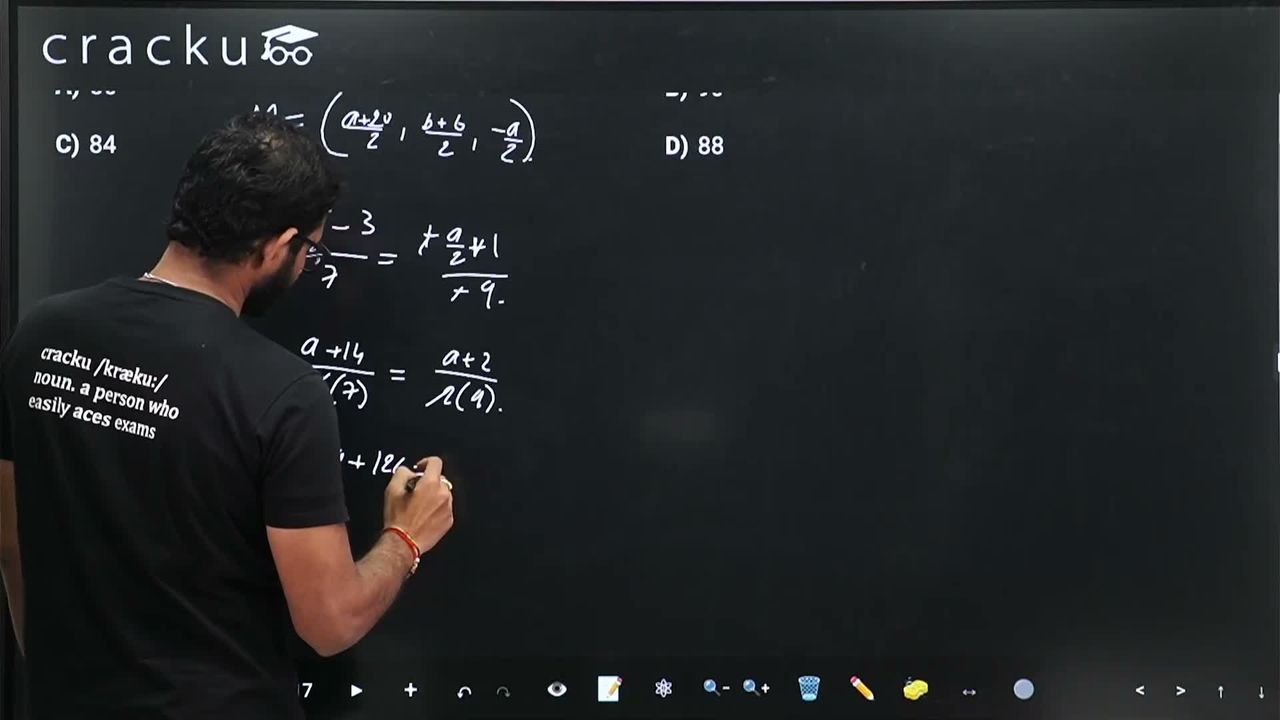
The point $$P(a, 6, 9)$$ has its mirror image $$(20, b, -a - 9)$$ with respect to the line $$\frac{x - 3}{7} = \frac{y - 2}{5} = \frac{z - 1}{-9}$$. Let the midpoint of $$P$$ and its image be $$M$$. Then $$M = \left(\frac{a + 20}{2},\, \frac{6 + b}{2},\, \frac{9 + (-a - 9)}{2}\right) = \left(\frac{a + 20}{2},\, \frac{6 + b}{2},\, \frac{-a}{2}\right)$$.
Since $$M$$ lies on the given line, we can write $$M = (3 + 7t,\, 2 + 5t,\, 1 - 9t)$$ for some parameter $$t$$. Equating the coordinates: $$\frac{a + 20}{2} = 3 + 7t$$, $$\frac{6 + b}{2} = 2 + 5t$$, and $$\frac{-a}{2} = 1 - 9t$$.
From the first equation, $$a = 14t - 14$$. From the third equation, $$a = 18t - 2$$. Setting these equal: $$14t - 14 = 18t - 2$$, which gives $$-4t = 12$$, so $$t = -3$$.
Substituting $$t = -3$$: $$a = 14(-3) - 14 = -56$$ and $$b = 2(2 + 5(-3)) - 6 = 2(-13) - 6 = -32$$.
We can verify the perpendicularity condition: the vector $$\overrightarrow{PP'} = (20 - (-56),\, -32 - 6,\, -(-56) - 9 - 9) = (76, -38, 38)$$, and its dot product with the direction vector $$(7, 5, -9)$$ is $$532 - 190 - 342 = 0$$. This confirms our answer.
Therefore, $$|a + b| = |-56 + (-32)| = |-88| = 88$$.
The correct answer is $$88$$.
Was this solution helpful?
Click on the Email ☝️ to Watch the Video Solution
Create a FREE account and get:
_1.webp)

Educational materials for JEE preparation

Ask our AI anything

AI can make mistakes. Please verify important information.
AI can make mistakes. Please verify important information.


