
Join Our JEE Preparation Group
Prep with like-minded aspirants; Get access to free daily tests and study material.
Sign in
Please select an account to continue using cracku.in
↓ →
Join Our JEE Preparation Group
Prep with like-minded aspirants; Get access to free daily tests and study material.
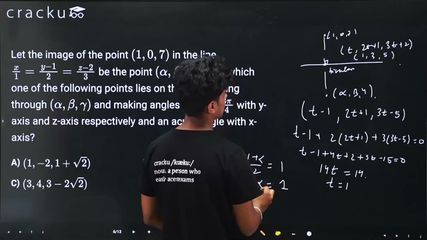
Let the image of the point $$(1, 0, 7)$$ in the line $$\frac{x}{1} = \frac{y - 1}{2} = \frac{z - 2}{3}$$ be the point $$(\alpha, \beta, \gamma)$$. Then which one of the following points lies on the line passing through $$(\alpha, \beta, \gamma)$$ and making angles $$\frac{2\pi}{3}$$ and $$\frac{3\pi}{4}$$ with y-axis and z-axis respectively and an acute angle with x-axis?
Point on line: $$(0, 1, 2)$$, direction: $$(1, 2, 3)$$.
$$\vec{AP} = (1, -1, 5)$$ where $$A = (0,1,2)$$, $$P = (1,0,7)$$.
Projection on direction: $$\frac{1-2+15}{14} = \frac{14}{14} = 1$$
Foot of perpendicular: $$F = (0+1, 1+2, 2+3) = (1, 3, 5)$$.
Image: $$(\alpha, \beta, \gamma) = 2F - P = (2-1, 6-0, 10-7) = (1, 6, 3)$$.
Now we need a line through $$(1, 6, 3)$$ making angles $$\frac{2\pi}{3}$$, $$\frac{3\pi}{4}$$ with y-axis and z-axis, and acute with x-axis.
Direction cosines: $$\cos\alpha_y = \cos(2\pi/3) = -1/2$$, $$\cos\alpha_z = \cos(3\pi/4) = -1/\sqrt{2}$$.
$$l^2 + m^2 + n^2 = 1$$: $$l^2 + 1/4 + 1/2 = 1$$, so $$l^2 = 1/4$$, $$l = 1/2$$ (acute angle).
Direction: $$(1/2, -1/2, -1/\sqrt{2})$$ or proportional to $$(1, -1, -\sqrt{2})$$.
Line: $$(1+t, 6-t, 3-\sqrt{2}t)$$.
Checking option (3): $$(3, 4, 3-2\sqrt{2})$$: $$t = 2$$ gives $$(3, 4, 3-2\sqrt{2})$$ ✓.
The answer corresponds to Option (3).
Was this solution helpful?
Click on the Email ☝️ to Watch the Video Solution
Create a FREE account and get:
_1.webp)

Educational materials for JEE preparation

Ask our AI anything

AI can make mistakes. Please verify important information.
AI can make mistakes. Please verify important information.
