
Join Our JEE Preparation Group
Prep with like-minded aspirants; Get access to free daily tests and study material.
Sign in
Please select an account to continue using cracku.in
↓ →
Join Our JEE Preparation Group
Prep with like-minded aspirants; Get access to free daily tests and study material.
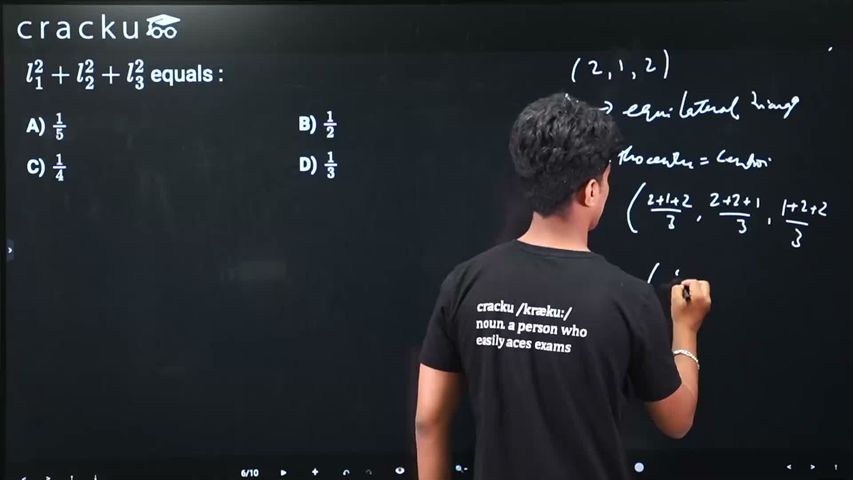
Let the position vectors of the vertices A, B and C of a triangle be $$2\hat{i} + 2\hat{j} + \hat{k}$$, $$\hat{i} + 2\hat{j} + 2\hat{k}$$ and $$2\hat{i} + \hat{j} + 2\hat{k}$$ respectively. Let $$l_1, l_2$$ and $$l_3$$ be the lengths of perpendiculars drawn from the ortho centre of the triangle on the sides AB, BC and CA respectively, then $$l_1^2 + l_2^2 + l_3^2$$ equals :
$$A(2,2,1)$$, $$B(1,2,2)$$, $$C(2,1,2)$$.
$$AB = \sqrt{1+0+1} = \sqrt{2}$$, $$BC = \sqrt{1+1+0} = \sqrt{2}$$, $$CA = \sqrt{0+1+1} = \sqrt{2}$$.
The triangle is equilateral. For an equilateral triangle, the orthocenter coincides with the centroid.
Centroid/orthocenter: $$H = \left(\frac{5}{3}, \frac{5}{3}, \frac{5}{3}\right)$$.
For an equilateral triangle with side $$a = \sqrt{2}$$, the distance from the center to any side is $$h/3$$ where $$h = \frac{\sqrt{3}}{2}a$$ is the height. So distance = $$\frac{a}{2\sqrt{3}} = \frac{\sqrt{2}}{2\sqrt{3}} = \frac{1}{\sqrt{6}}$$.
All three perpendicular distances are equal: $$l_1 = l_2 = l_3 = \frac{1}{\sqrt{6}}$$.
$$l_1^2 + l_2^2 + l_3^2 = 3 \times \frac{1}{6} = \frac{1}{2}$$.
The answer corresponds to Option (2).
Was this solution helpful?
Click on the Email ☝️ to Watch the Video Solution
Create a FREE account and get:
_1.webp)

Educational materials for JEE preparation

Ask our AI anything

AI can make mistakes. Please verify important information.
AI can make mistakes. Please verify important information.
