
Join Our JEE Preparation Group
Prep with like-minded aspirants; Get access to free daily tests and study material.
Sign in
Please select an account to continue using cracku.in
↓ →
Join Our JEE Preparation Group
Prep with like-minded aspirants; Get access to free daily tests and study material.
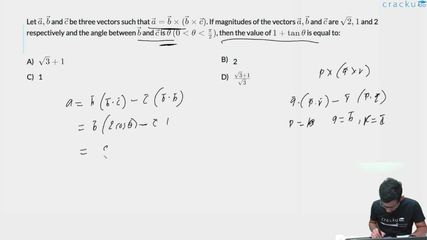
Let $$\vec{a}, \vec{b}$$ and $$\vec{c}$$ be three vectors such that $$\vec{a} = \vec{b} \times (\vec{b} \times \vec{c})$$. If magnitudes of the vectors $$\vec{a}, \vec{b}$$ and $$\vec{c}$$ are $$\sqrt{2}, 1$$ and 2 respectively and the angle between $$\vec{b}$$ and $$\vec{c}$$ is $$\theta$$ $$(0 < \theta < \frac{\pi}{2})$$, then the value of $$1 + \tan \theta$$ is equal to:
We have the relation $$\vec a=\vec b\times(\vec b\times\vec c)$$.
First we recall the standard vector triple-product identity:
$$\vec p\times(\vec q\times\vec r)=\vec q(\vec p\cdot\vec r)-\vec r(\vec p\cdot\vec q).$$
Applying it with $$\vec p=\vec b,\;\vec q=\vec b,\;\vec r=\vec c$$ we get
$$\vec a=\vec b(\vec b\cdot\vec c)-\vec c(\vec b\cdot\vec b).$$
Now we substitute the given magnitudes. We know $$|\vec b|=1,\;|\vec c|=2,$$ and if the angle between $$\vec b$$ and $$\vec c$$ is $$\theta\;(0<\theta<\tfrac{\pi}{2})$$, then
$$\vec b\cdot\vec c=|\vec b||\vec c|\cos\theta=1\cdot2\cos\theta=2\cos\theta.$$
Also $$\vec b\cdot\vec b=|\vec b|^{2}=1^{2}=1.$$
Substituting these scalar products into the expression for $$\vec a$$ gives
$$\vec a=2\cos\theta\,\vec b-1\cdot\vec c=2\cos\theta\,\vec b-\vec c.$$
Next we compute the magnitude of $$\vec a$$. Let us denote
$$\vec u=2\cos\theta\,\vec b,\qquad\vec v=\vec c,$$
so that $$\vec a=\vec u-\vec v.$$
The square of the magnitude is
$$|\vec a|^{2}=|\vec u-\vec v|^{2}=|\vec u|^{2}+|\vec v|^{2}-2\,\vec u\cdot\vec v.$$
We evaluate each term separately:
$$|\vec u|^{2}=(2\cos\theta)^{2}|\vec b|^{2}=4\cos^{2}\theta\cdot1=4\cos^{2}\theta,$$
$$|\vec v|^{2}=|\vec c|^{2}=2^{2}=4,$$
$$\vec u\cdot\vec v=(2\cos\theta\,\vec b)\cdot\vec c=2\cos\theta(\vec b\cdot\vec c)=2\cos\theta(2\cos\theta)=4\cos^{2}\theta.$$
Putting these into the formula for $$|\vec a|^{2}$$ we obtain
$$|\vec a|^{2}=4\cos^{2}\theta+4-2\cdot4\cos^{2}\theta=4\cos^{2}\theta+4-8\cos^{2}\theta=4-4\cos^{2}\theta.$$
Simplifying we have
$$|\vec a|^{2}=4(1-\cos^{2}\theta)=4\sin^{2}\theta.$$
But the problem states that $$|\vec a|=\sqrt{2},$$ so $$|\vec a|^{2}=2.$$ Therefore
$$4\sin^{2}\theta=2\quad\Longrightarrow\quad\sin^{2}\theta=\frac12.$$
Since $$0<\theta<\tfrac{\pi}{2},$$ the sine and cosine are both positive, giving
$$\sin\theta=\frac1{\sqrt2},\qquad\cos\theta=\frac1{\sqrt2}.$$
Hence
$$\tan\theta=\frac{\sin\theta}{\cos\theta}=1.$$
Finally,
$$1+\tan\theta=1+1=2.$$
Hence, the correct answer is Option B.
Was this solution helpful?
Click on the Email ☝️ to Watch the Video Solution
Create a FREE account and get:
_1.webp)

Educational materials for JEE preparation

Ask our AI anything

AI can make mistakes. Please verify important information.
AI can make mistakes. Please verify important information.
