
Join Our JEE Preparation Group
Prep with like-minded aspirants; Get access to free daily tests and study material.
Sign in
Please select an account to continue using cracku.in
↓ →
Join Our JEE Preparation Group
Prep with like-minded aspirants; Get access to free daily tests and study material.
For real numbers $$\alpha$$ and $$\beta \neq 0$$, if the point of intersection of the straight lines $$\frac{x - \alpha}{1} = \frac{y - 1}{2} = \frac{z - 1}{3}$$ and $$\frac{x - 4}{\beta} = \frac{y - 6}{3} = \frac{z - 7}{3}$$ lies on the plane $$x + 2y - z = 8$$, then $$\alpha - \beta$$ is equal to:
We have two straight lines written in symmetric form.
The first line is $$\dfrac{x-\alpha}{1}=\dfrac{y-1}{2}=\dfrac{z-1}{3}.$$
To convert this into parametric form, we take a common parameter, say $$t,$$ and put every ratio equal to $$t.$$ Thus
$$\dfrac{x-\alpha}{1}=t,\quad \dfrac{y-1}{2}=t,\quad \dfrac{z-1}{3}=t.$$
Multiplying each equation we obtain
$$x-\alpha = t,\qquad y-1 = 2t,\qquad z-1 = 3t.$$
So the coordinates of any point on the first line are
$$x=\alpha + t,\qquad y = 1 + 2t,\qquad z = 1 + 3t.$$
Exactly in the same manner we treat the second line
$$\dfrac{x-4}{\beta}=\dfrac{y-6}{3}=\dfrac{z-7}{3}.$$
Equating every ratio to another parameter, say $$s,$$ we have
$$\dfrac{x-4}{\beta}=s,\quad \dfrac{y-6}{3}=s,\quad \dfrac{z-7}{3}=s.$$
Multiplying throughout gives
$$x-4=\beta s,\qquad y-6=3s,\qquad z-7=3s.$$
Hence an arbitrary point on the second line has coordinates
$$x = 4+\beta s,\qquad y = 6+3s,\qquad z = 7+3s.$$
Because the two lines intersect, there is a unique point which belongs to both lines. Therefore there exist values of $$t$$ and $$s$$ such that the corresponding $$x,\,y,\,z$$ coordinates from the two sets are identical. Equating the three coordinates, we write
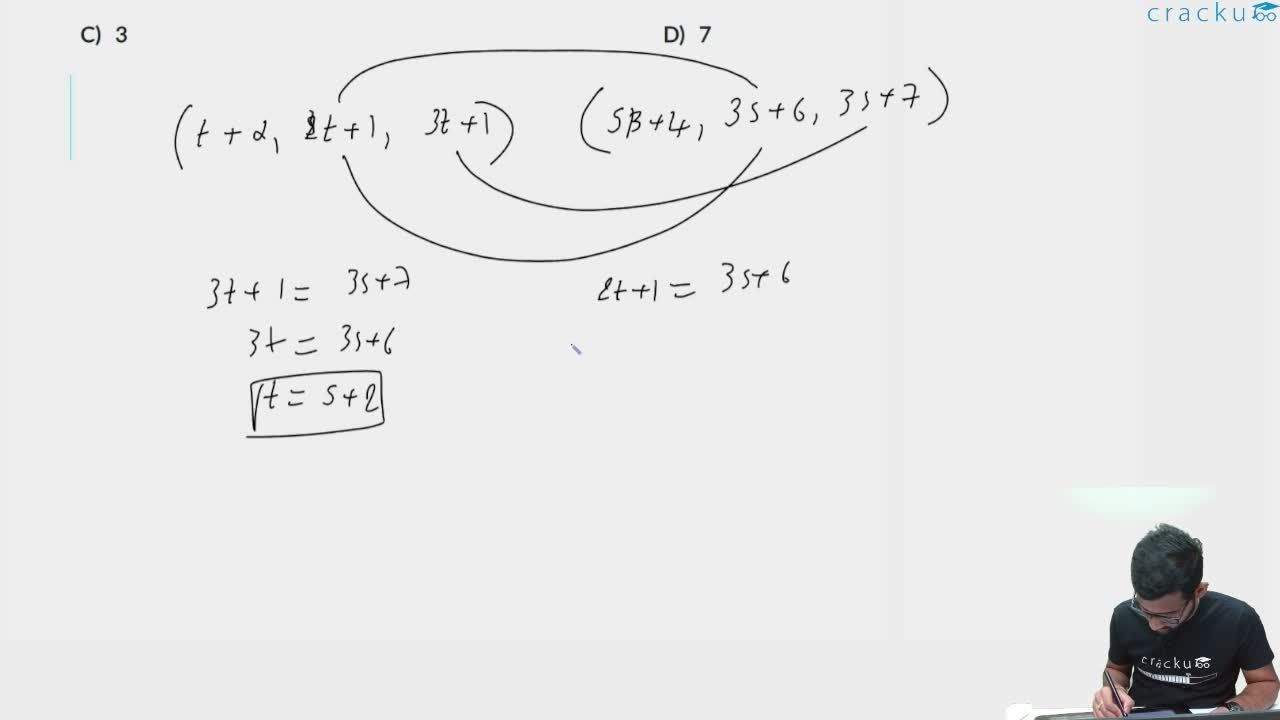
$$\alpha + t = 4 + \beta s \qquad\text{(1)}$$ $$1 + 2t = 6 + 3s \qquad\text{(2)}$$ $$1 + 3t = 7 + 3s \qquad\text{(3)}.$$
First we solve (2) and (3) for $$t$$ and $$s$$ because they do not involve the unknowns $$\alpha$$ and $$\beta.$$
From (2) we get $$1 + 2t = 6 + 3s \;\Longrightarrow\; 2t - 3s = 5.$$
From (3) we get $$1 + 3t = 7 + 3s \;\Longrightarrow\; 3t - 3s = 6.$$
Dividing the second relation by $$3$$ gives $$t - s = 2,$$ so
$$t = s + 2.$$
Substituting this value of $$t$$ into $$2t - 3s = 5$$ we get
$$2(s+2) - 3s = 5 \;\Longrightarrow\; 2s + 4 - 3s = 5 \;\Longrightarrow\; -s + 4 = 5 \;\Longrightarrow\; -s = 1 \;\Longrightarrow\; s = -1.$$
Now $$t = s + 2 = -1 + 2 = 1.$$
So the unique intersection point corresponds to $$t = 1$$ and $$s = -1.$$
Using $$t = 1$$ in the first-line parametric equations, the coordinates of the intersection point are
$$x = \alpha + 1,\qquad y = 1 + 2(1) = 3,\qquad z = 1 + 3(1) = 4.$$
This point is given to lie on the plane $$x + 2y - z = 8.$$ Substituting the coordinates into the plane equation we obtain
$$(\alpha + 1) + 2(3) - 4 = 8.$$
Simplifying the left side: $$\alpha + 1 + 6 - 4 = \alpha + 3.$$
So $$\alpha + 3 = 8 \;\Longrightarrow\; \alpha = 5.$$
We still need $$\beta.$$ To find it, we go back to equation (1): $$\alpha + t = 4 + \beta s.$$ We now know $$\alpha = 5,\; t = 1,\; s = -1.$$ Substituting these values gives
$$5 + 1 = 4 + \beta(-1).$$
Thus $$6 = 4 - \beta \;\Longrightarrow\; -\beta = 2 \;\Longrightarrow\; \beta = -2.$$
Finally, we compute the required difference
$$\alpha - \beta = 5 - (-2) = 5 + 2 = 7.$$
Hence, the correct answer is Option D.
Was this solution helpful?
Click on the Email ☝️ to Watch the Video Solution
Create a FREE account and get:
_1.webp)

Educational materials for JEE preparation

Ask our AI anything

AI can make mistakes. Please verify important information.
AI can make mistakes. Please verify important information.
