
Join Our JEE Preparation Group
Prep with like-minded aspirants; Get access to free daily tests and study material.
Sign in
Please select an account to continue using cracku.in
↓ →
Join Our JEE Preparation Group
Prep with like-minded aspirants; Get access to free daily tests and study material.
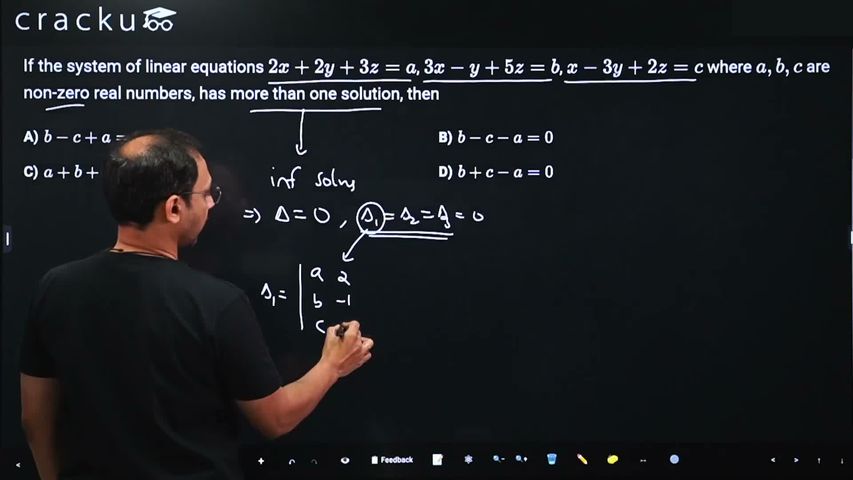
If the system of linear equations $$2x + 2y + 3z = a$$, $$3x - y + 5z = b$$, $$x - 3y + 2z = c$$ where $$a, b, c$$ are non-zero real numbers, has more than one solution, then
For a system of linear equations to have infinitely many solutions, the equations must be linearly dependent. This means we can find non zero constants $$\alpha$$, $$\beta$$, and $$\gamma$$ such that multiplying the three equations by these constants and adding them together results in zero for the coefficients of x, y, and z. Let us set up the relation:
$$\alpha(2x + 2y + 3z) + \beta(3x - y + 5z) + \gamma(x - 3y + 2z) = 0$$
Grouping the terms by the variables x, y, and z, we get:
$$(2\alpha + 3\beta + \gamma)x + (2\alpha - \beta - 3\gamma)y + (3\alpha + 5\beta + 2\gamma)z = 0$$
For this to hold true, the coefficients must individually be equal to zero. This gives us a new system to solve for the multipliers:
$$2\alpha + 3\beta + \gamma = 0, $$ $$2\alpha - \beta - 3\gamma = 0, $$ $$3\alpha + 5\beta + 2\gamma = 0.$$
We can solve for the ratio of these constants. Subtracting the second equation from the first gives $$4\beta + 4\gamma = 0$$, which simplifies to $$\beta = -\gamma$$. Substituting $$\beta = -\gamma$$ into the first equation yields $$2\alpha - 3\gamma + \gamma = 0$$, leading to $$2\alpha = 2\gamma$$, or $$\alpha = \gamma$$. Let us assign $$\gamma = 1$$, which immediately makes $$\alpha = 1$$ and $$\beta = -1$$. Checking these values in the third equation gives $$3(1) + 5(-1) + 2(1) = 0$$, which is perfectly consistent.
Since applying these specific weights to the variables on the left side of our original system cancels them out to zero, applying the exact same weights to the constant terms on the right side must also result in zero for the system to be consistent and yield infinitely many solutions. Therefore, we evaluate the relation $$\alpha a + \beta b + \gamma c = 0$$. Substituting our derived values gives $$1a - 1b + 1c = 0$$, which simplifies to $$a - b + c = 0$$. Multiplying the entire equation by negative one to match the given options yields $$b - c - a = 0$$. Therefore, the correct option is B.
Was this solution helpful?
Click on the Email ☝️ to Watch the Video Solution
Create a FREE account and get:
_1.webp)

Educational materials for JEE preparation

Ask our AI anything

AI can make mistakes. Please verify important information.
AI can make mistakes. Please verify important information.
