
Join Our JEE Preparation Group
Prep with like-minded aspirants; Get access to free daily tests and study material.
Sign in
Please select an account to continue using cracku.in
↓ →
Join Our JEE Preparation Group
Prep with like-minded aspirants; Get access to free daily tests and study material.
If $$y = y(x)$$ is the solution curve of the differential equation $$x^2 dy + (y - \frac{1}{x}) dx = 0$$; $$x > 0$$ and $$y(1) = 1$$, then $$y\left(\frac{1}{2}\right)$$ is equal to:
We start with the differential equation
$$x^{2}\,dy+\left(y-\frac{1}{x}\right)dx=0,\qquad x>0.$$
First we rewrite it in the standard form $$\dfrac{dy}{dx}+P(x)\,y=Q(x).$$ Dividing every term by $$dx$$ and then by $$x^{2}$$ we obtain
$$\frac{dy}{dx}+\frac{1}{x^{2}}\,y=\frac{1}{x^{3}}.$$
Here we can see that $$P(x)=\dfrac{1}{x^{2}}$$ and $$Q(x)=\dfrac{1}{x^{3}}.$$
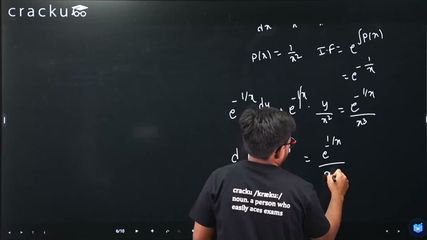
For a linear first-order differential equation the integrating factor is given by the formula $$\text{I.F.}=e^{\int P(x)\,dx}.$$ Evaluating the integral, we have
$$\int P(x)\,dx=\int\frac{1}{x^{2}}\,dx=-\frac{1}{x},$$
so the integrating factor becomes
$$\text{I.F.}=e^{-\frac{1}{x}}.$$
Now we multiply the entire differential equation by this integrating factor:
$$e^{-\frac{1}{x}}\frac{dy}{dx}+e^{-\frac{1}{x}}\frac{1}{x^{2}}\,y=e^{-\frac{1}{x}}\frac{1}{x^{3}}.$$
The left-hand side is recognised as the derivative of the product $$y\cdot e^{-\frac{1}{x}},$$ because
$$\frac{d}{dx}\Bigl(y\,e^{-\frac{1}{x}}\Bigr)=e^{-\frac{1}{x}}\frac{dy}{dx}+y\cdot e^{-\frac{1}{x}}\cdot\frac{1}{x^{2}}.$$
Hence we may rewrite the equation compactly as
$$\frac{d}{dx}\Bigl(y\,e^{-\frac{1}{x}}\Bigr)=\frac{e^{-\frac{1}{x}}}{x^{3}}.$$
Integrating both sides with respect to $$x$$ gives
$$y\,e^{-\frac{1}{x}}=\int\frac{e^{-\frac{1}{x}}}{x^{3}}\,dx+C.$$
To evaluate the integral on the right we use the substitution $$t=-\frac{1}{x}\;(\text{so that }dt=\frac{1}{x^{2}}\,dx).$$ Then
$$\frac{1}{x^{3}}\,dx=\frac{1}{x}\,\frac{1}{x^{2}}\,dx=-t\,dt,$$
and $$e^{-\frac{1}{x}}=e^{t}.$$ Therefore
$$\int\frac{e^{-\frac{1}{x}}}{x^{3}}\,dx=\int(-t)\,e^{t}\,dt.$$
We integrate by parts (or use the known integral) to find
$$\int -t\,e^{t}\,dt=-(t-1)e^{t}+C_{1}=(1-t)\,e^{t}+C_{1}.$$
Undoing the substitution $$t=-\dfrac{1}{x}$$ yields
$$\int\frac{e^{-\frac{1}{x}}}{x^{3}}\,dx=\Bigl(1+\frac{1}{x}\Bigr)e^{-\frac{1}{x}}+C_{1}.$$
Putting this back into our earlier expression, we obtain
$$y\,e^{-\frac{1}{x}}=\Bigl(1+\frac{1}{x}\Bigr)e^{-\frac{1}{x}}+C.$$
Multiplying every term by $$e^{\frac{1}{x}}$$ isolates $$y$$:
$$y=1+\frac{1}{x}+C\,e^{\frac{1}{x}}.$$
We now use the initial condition $$y(1)=1.$$ Substituting $$x=1,\;y=1$$ gives
$$1=1+\frac{1}{1}+C\,e^{1}\quad\Longrightarrow\quad 1=2+C\,e.$$
Solving for $$C$$, we have
$$C\,e=-1\quad\Longrightarrow\quad C=-\frac{1}{e}.$$
Putting this value back into the expression for $$y(x)$$ gives the particular solution:
$$y(x)=1+\frac{1}{x}-\frac{1}{e}\,e^{\frac{1}{x}}=1+\frac{1}{x}-e^{\frac{1}{x}-1}.$$
We are asked to find $$y\!\left(\dfrac12\right).$$ Setting $$x=\dfrac12$$ we have $$\dfrac{1}{x}=2,$$ so
$$y\!\left(\frac12\right)=1+\frac{1}{\frac12}-e^{2-1}=1+2-e^{1}=3-e.$$
Hence, the correct answer is Option B.
Was this solution helpful?
Click on the Email ☝️ to Watch the Video Solution
Create a FREE account and get:
_1.webp)

Educational materials for JEE preparation

Ask our AI anything

AI can make mistakes. Please verify important information.
AI can make mistakes. Please verify important information.
