
Join Our JEE Preparation Group
Prep with like-minded aspirants; Get access to free daily tests and study material.
Sign in
Please select an account to continue using cracku.in
↓ →
Join Our JEE Preparation Group
Prep with like-minded aspirants; Get access to free daily tests and study material.
If the solution curve $$y = y(x)$$ of the differential equation $$y^2 dx + (x^2 - xy + y^2)dy = 0$$, which passes through the point $$(1, 1)$$ and intersects the line $$y = \sqrt{3}x$$ at the point $$(\alpha, \sqrt{3}\alpha)$$, then value of $$\log_e \sqrt{3}\alpha$$ is equal to
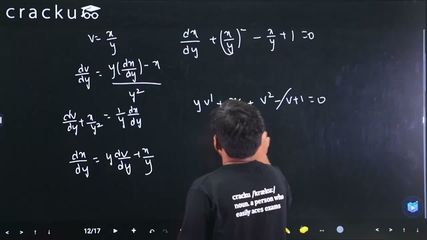
We have $$y^2\,dx + (x^2 - xy + y^2)\,dy = 0$$, and to transform this into a form involving $$\frac{dx}{dy}$$, we rewrite it as:
$$ \frac{dx}{dy} = -\frac{x^2 - xy + y^2}{y^2} = -\frac{x^2}{y^2} + \frac{x}{y} - 1 $$
Next, we set $$v = \frac{x}{y}$$ so that $$x = vy$$ and $$\frac{dx}{dy} = v + y\frac{dv}{dy}$$, which leads to:
$$ v + y\frac{dv}{dy} = -v^2 + v - 1 $$
and hence
$$ y\frac{dv}{dy} = -v^2 - 1 = -(v^2 + 1) $$
Separating the variables gives:
$$ \frac{dv}{v^2 + 1} = -\frac{dy}{y} $$, which upon integration yields
$$ \tan^{-1}(v) = -\ln|y| + C $$. Substituting back $$v=\frac{x}{y}$$ gives
$$ \tan^{-1}\left(\frac{x}{y}\right) = -\ln|y| + C $$
Using the condition that the curve passes through $$(1,1)$$, we substitute into the integrated result to obtain:
$$ \tan^{-1}(1) = -\ln(1) + C \implies \frac{\pi}{4} = C $$. Hence the equation of the curve becomes $$\tan^{-1}\left(\frac{x}{y}\right) + \ln|y| = \frac{\pi}{4}$$
To find the intersection with the line $$y=\sqrt{3}\,x$$, we consider a point $$(\alpha,\sqrt{3}\alpha)$$ for which $$\frac{x}{y}=\frac{1}{\sqrt{3}}$$. Substituting into the curve equation gives:
$$ \tan^{-1}\left(\frac{1}{\sqrt{3}}\right) + \ln(\sqrt{3}\alpha) = \frac{\pi}{4} $$, and since $$\tan^{-1}\left(\frac{1}{\sqrt{3}}\right)=\frac{\pi}{6}$$, it follows that
$$ \frac{\pi}{6} + \ln(\sqrt{3}\alpha) = \frac{\pi}{4} $$, which yields
$$ \ln(\sqrt{3}\alpha) = \frac{\pi}{12} $$
Option D: $$\frac{\pi}{12}$$.
Was this solution helpful?
Click on the Email ☝️ to Watch the Video Solution
Create a FREE account and get:
_1.webp)

Educational materials for JEE preparation

Ask our AI anything

AI can make mistakes. Please verify important information.
AI can make mistakes. Please verify important information.
