
Join Our JEE Preparation Group
Prep with like-minded aspirants; Get access to free daily tests and study material.
Sign in
Please select an account to continue using cracku.in
↓ →
Join Our JEE Preparation Group
Prep with like-minded aspirants; Get access to free daily tests and study material.
The outcome of each of 30 items was observed; 10 items gave an outcome $$\frac{1}{2} - d$$ each, 10 items gave outcome $$\frac{1}{2}$$ each and the remaining 10 items gave outcome $$\frac{1}{2} + d$$ each. If the variance of this outcome data is $$\frac{4}{3}$$ then $$|d|$$ equals:
We have a total of 30 observed values. Ten of them are $$\frac12-d$$, ten are $$\frac12$$ and the remaining ten are $$\frac12+d$$.
First we find the mean. The mean $$\mu$$ of a data set is defined by the formula
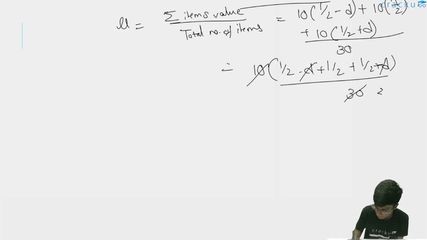
$$\mu=\frac{\text{sum of all observations}}{\text{number of observations}}.$$
So, adding every value once and then dividing by 30, we write
$$ \mu=\frac{10\!\left(\frac12-d\right)+10\!\left(\frac12\right)+10\!\left(\frac12+d\right)}{30}. $$
Now, multiply out each product:
$$ 10\left(\frac12-d\right)=10\cdot\frac12-10d=5-10d, $$
$$ 10\left(\frac12\right)=5, $$
$$ 10\left(\frac12+d\right)=10\cdot\frac12+10d=5+10d. $$
Adding these three partial sums gives
$$ (5-10d)+5+(5+10d)=15. $$
Substituting this back,
$$ \mu=\frac{15}{30}=\frac12. $$
Next, we turn to the variance. The population variance $$\sigma^2$$ is defined by
$$ \sigma^2=\frac1n\sum_{i=1}^n(x_i-\mu)^2, $$
where $$n$$ is the number of observations. Here $$n=30$$.
Let us compute each squared deviation from the mean $$\mu=\frac12$$:
There are ten items of the first kind (square $$0$$), ten items of the second kind (square $$d^2$$) and ten items of the third kind (square $$d^2$$). Hence the total of all squared deviations is
$$ 10\cdot0+10\cdot d^2+10\cdot d^2=20d^2. $$
Applying the variance formula, we divide this sum by the total number of observations (30):
$$ \sigma^2=\frac{20d^2}{30}=\frac23\,d^2. $$
According to the statement of the problem, the variance is given to be $$\frac43$$. Therefore we set
$$ \frac23\,d^2=\frac43. $$
Now, multiply both sides by 3 to clear the denominators:
$$ 2d^2=4. $$
Dividing by 2 gives
$$ d^2=2. $$
Taking absolute value (or, equivalently, the positive square root) yields
$$ |d|=\sqrt2. $$
Hence, the correct answer is Option D.
Was this solution helpful?
Click on the Email ☝️ to Watch the Video Solution
Create a FREE account and get:
_1.webp)

Educational materials for JEE preparation

Ask our AI anything

AI can make mistakes. Please verify important information.
AI can make mistakes. Please verify important information.
