
Join Our JEE Preparation Group
Prep with like-minded aspirants; Get access to free daily tests and study material.
Sign in
Please select an account to continue using cracku.in
↓ →
Join Our JEE Preparation Group
Prep with like-minded aspirants; Get access to free daily tests and study material.
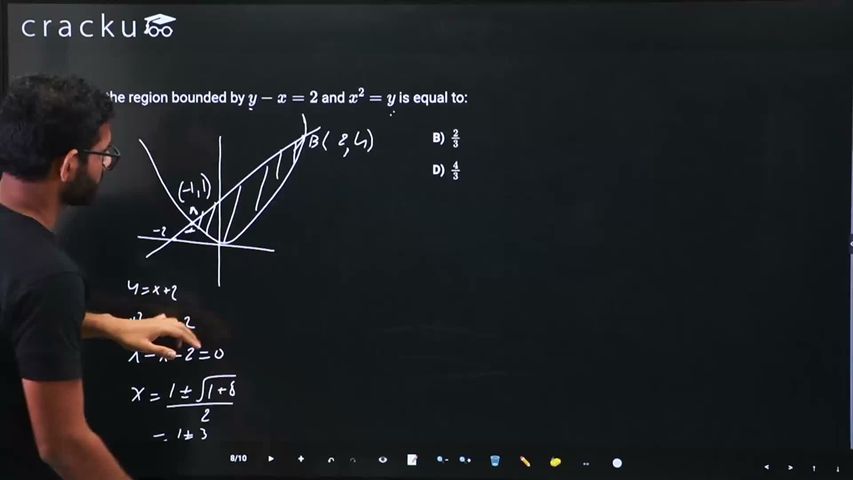
We have two bounding curves, namely the straight line $$y - x = 2$$ and the parabola $$x^{2} = y$$. First we write the line in the explicit form $$y = x + 2$$ so that both relations give $$y$$ in terms of $$x$$.
To locate the intersection points we equate the two expressions for $$y$$:
$$x + 2 = x^{2}.$$
Bringing all terms to one side,
$$x^{2} - x - 2 = 0.$$
Now we factor the quadratic:
$$x^{2} - x - 2 = (x - 2)(x + 1) = 0.$$
Setting each factor equal to zero gives the solutions
$$x - 2 = 0 \;\Rightarrow\; x = 2,$$
$$x + 1 = 0 \;\Rightarrow\; x = -1.$$
For these $$x$$-values, the corresponding $$y$$-values can be found from either curve; using the line $$y = x + 2$$ we get
$$y(2) = 2 + 2 = 4,$$
$$y(-1) = -1 + 2 = 1.$$
Thus the curves meet at the points $$(-1,\,1)$$ and $$(2,\,4)$$, so the horizontal span of the enclosed region is from $$x = -1$$ to $$x = 2$$.
Next we decide which curve lies above the other within this interval. Choosing an easy test point, say $$x = 0,$$ we find
For the line: $$y = 0 + 2 = 2,$$
For the parabola: $$y = 0^{2} = 0.$$
Because $$2 > 0,$$ the line $$y = x + 2$$ is above the parabola $$y = x^{2}$$ throughout the interval from $$x = -1$$ to $$x = 2$$.
The standard formula for the area between two curves $$y = f(x)$$ (upper) and $$y = g(x)$$ (lower) from $$x = a$$ to $$x = b$$ is
$$A = \int_{a}^{b} \bigl[\,f(x) - g(x)\,\bigr] \, dx.$$
Here $$f(x) = x + 2$$ and $$g(x) = x^{2},$$ with $$a = -1$$ and $$b = 2.$$ Substituting we obtain
$$A = \int_{-1}^{2} \bigl[(x + 2) - x^{2}\bigr] \, dx.$$
Simplifying the integrand,
$$A = \int_{-1}^{2} \bigl(-x^{2} + x + 2\bigr) \, dx.$$
We now integrate term by term:
$$\int \left(-x^{2}\right) dx = -\dfrac{x^{3}}{3},$$
$$\int x \, dx = \dfrac{x^{2}}{2},$$
$$\int 2 \, dx = 2x.$$
Putting these together, the antiderivative is
$$-\dfrac{x^{3}}{3} + \dfrac{x^{2}}{2} + 2x.$$
We evaluate this expression from $$x = -1$$ to $$x = 2$$.
At the upper limit $$x = 2$$:
$$-\dfrac{(2)^{3}}{3} + \dfrac{(2)^{2}}{2} + 2(2) = -\dfrac{8}{3} + \dfrac{4}{2} + 4 = -\dfrac{8}{3} + 2 + 4 = -\dfrac{8}{3} + 6 = \dfrac{-8 + 18}{3} = \dfrac{10}{3}.$$
At the lower limit $$x = -1$$:
$$-\dfrac{(-1)^{3}}{3} + \dfrac{(-1)^{2}}{2} + 2(-1) = -\left(-\dfrac{1}{3}\right) + \dfrac{1}{2} - 2 = \dfrac{1}{3} + \dfrac{1}{2} - 2.$$
Combining the fractions,
$$\dfrac{1}{3} + \dfrac{1}{2} = \dfrac{2}{6} + \dfrac{3}{6} = \dfrac{5}{6},$$
so the whole value at $$x = -1$$ equals
$$\dfrac{5}{6} - 2 = \dfrac{5}{6} - \dfrac{12}{6} = -\dfrac{7}{6}.$$
The required area is the difference of these two numerical values:
$$A = \left[\dfrac{10}{3}\right] - \left[-\dfrac{7}{6}\right] = \dfrac{10}{3} + \dfrac{7}{6}.$$
We take a common denominator of $$6$$:
$$\dfrac{10}{3} = \dfrac{20}{6},$$
so
$$A = \dfrac{20}{6} + \dfrac{7}{6} = \dfrac{27}{6} = \dfrac{9}{2}.$$
Thus the area of the region bounded by the given curves is $$\dfrac{9}{2}$$ square units.
Hence, the correct answer is Option C.
Was this solution helpful?
Click on the Email ☝️ to Watch the Video Solution
Create a FREE account and get:
_1.webp)

Educational materials for JEE preparation

Ask our AI anything

AI can make mistakes. Please verify important information.
AI can make mistakes. Please verify important information.
