
Join Our JEE Preparation Group
Prep with like-minded aspirants; Get access to free daily tests and study material.
Sign in
Please select an account to continue using cracku.in
↓ →
Join Our JEE Preparation Group
Prep with like-minded aspirants; Get access to free daily tests and study material.
Let $$f : (a, b) \rightarrow R$$ be twice differentiable function such that $$f(x) = \int_a^x g(t) \, dt$$ for a differentiable function $$g(x)$$. If $$f(x) = 0$$ has exactly five distinct roots in $$(a, b)$$, then $$g(x)g'(x) = 0$$ has at least:
We are given a twice-differentiable function $$f : (a,\,b) \to \mathbb R$$ defined by the relation
$$f(x)=\int_a^{x} g(t)\,dt,$$
for some differentiable function $$g(x).$$
Because $$f(x)$$ is an integral of $$g(t)$$, we immediately obtain its first and second derivatives with the help of the Fundamental Theorem of Calculus:
First derivative formula: If $$F(x)=\displaystyle\int_a^{x} h(t)\,dt,$$ then $$F'(x)=h(x).$$ Hence,
$$f'(x)=g(x).$$
Second derivative formula: Differentiating once more, we have
$$f''(x)=g'(x).$$
So the chain of equalities we have is
$$f'(x)=g(x)\quad\text{and}\quad f''(x)=g'(x).$$
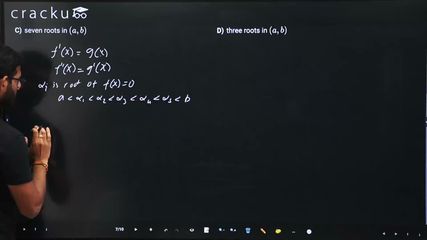
The equation $$f(x)=0$$ is said to possess exactly five distinct roots lying strictly inside the open interval $$(a,\,b).$$ Let us denote these five roots in increasing order by
$$a<\alpha_1<\alpha_2<\alpha_3<\alpha_4<\alpha_5<b.$$
Now we invoke Rolle’s Theorem. The theorem states:
Rolle’s Theorem (verbatim): If a function $$H(x)$$ is continuous on a closed interval $$[p,\,q]$$, differentiable on the open interval $$(p,\,q),$$ and satisfies $$H(p)=H(q),$$ then there exists at least one point $$c\in(p,\,q)$$ such that $$H'(c)=0.$$
We apply this theorem to $$f(x)$$ on every pair of consecutive zeros. Observe that
$$f(\alpha_k)=0=f(\alpha_{k+1})\quad\text{for }k=1,2,3,4.$$
Because $$f(x)$$ is continuous and differentiable on each closed interval $$[\alpha_k,\,\alpha_{k+1}],$$ Rolle’s theorem guarantees the existence of at least one number $$\beta_k\in(\alpha_k,\,\alpha_{k+1})$$ for which
$$f'(\beta_k)=0.$$
Recall that $$f'(x)=g(x).$$ Therefore, each $$\beta_k$$ is actually a zero of $$g(x).$$ We have located at least
$$\beta_1,\;\beta_2,\;\beta_3,\;\beta_4$$
with
$$\alpha_1<\beta_1<\alpha_2<\beta_2<\alpha_3<\beta_3<\alpha_4<\beta_4<\alpha_5.$$
Hence $$g(x)=0$$ possesses at least four distinct roots inside $$(a,\,b).$$ Summarising:
Number of distinct roots of $$g(x)=0$$ is at least $$4.$$
Next, we examine the derivative $$g'(x).$$ Because $$g(x)$$ is differentiable everywhere on $$(a,\,b),$$ we may again apply Rolle’s theorem, but now to $$g(x)$$ itself. Arrange its (at least four) distinct zeros in increasing order, say
$$\beta_1<\beta_2<\beta_3<\beta_4.$$
On each interval $$[\beta_j,\,\beta_{j+1}]$$ for $$j=1,2,3,$$ the conditions of Rolle’s theorem are satisfied for $$g(x)$$ (continuity, differentiability, and equal end-values $$g(\beta_j)=g(\beta_{j+1})=0$$). Consequently, for every such pair there is a point $$\gamma_j\in(\beta_j,\,\beta_{j+1})$$ where
$$g'(\gamma_j)=0.$$
Thus we have uncovered at least
$$\gamma_1,\;\gamma_2,\;\gamma_3$$
satisfying
$$\beta_1<\gamma_1<\beta_2<\gamma_2<\beta_3<\gamma_3<\beta_4.$$
Observe that each $$\gamma_j$$ lies strictly between neighbouring zeros $$\beta_j$$ and $$\beta_{j+1}$$ of $$g(x).$$ Hence no $$\gamma_j$$ coincides with any $$\beta_k.$$
We now collect all the roots relevant to the equation $$g(x)g'(x)=0.$$ This equation factors as
$$g(x)g'(x)=0\quad\iff\quad g(x)=0\quad\text{or}\quad g'(x)=0.$$
The roots we have already located are
• $$\beta_1,\;\beta_2,\;\beta_3,\;\beta_4$$ where $$g(x)=0,$$ and
• $$\gamma_1,\;\gamma_2,\;\gamma_3$$ where $$g'(x)=0.$$
Because each $$\gamma_j$$ sits strictly between two distinct $$\beta_k$$’s, none of the seven points coincide. Therefore, the set of distinct solutions of $$g(x)g'(x)=0$$ inside $$(a,\,b)$$ contains at least
$$4+3=7$$
elements.
Consequently, the equation $$g(x)g'(x)=0$$ has at least seven distinct roots in the open interval $$(a,\,b).$$
Hence, the correct answer is Option C.
Was this solution helpful?
Click on the Email ☝️ to Watch the Video Solution
Create a FREE account and get:
_1.webp)

Educational materials for JEE preparation

Ask our AI anything

AI can make mistakes. Please verify important information.
AI can make mistakes. Please verify important information.
