
Join Our JEE Preparation Group
Prep with like-minded aspirants; Get access to free daily tests and study material.
Sign in
Please select an account to continue using cracku.in
↓ →
Join Our JEE Preparation Group
Prep with like-minded aspirants; Get access to free daily tests and study material.
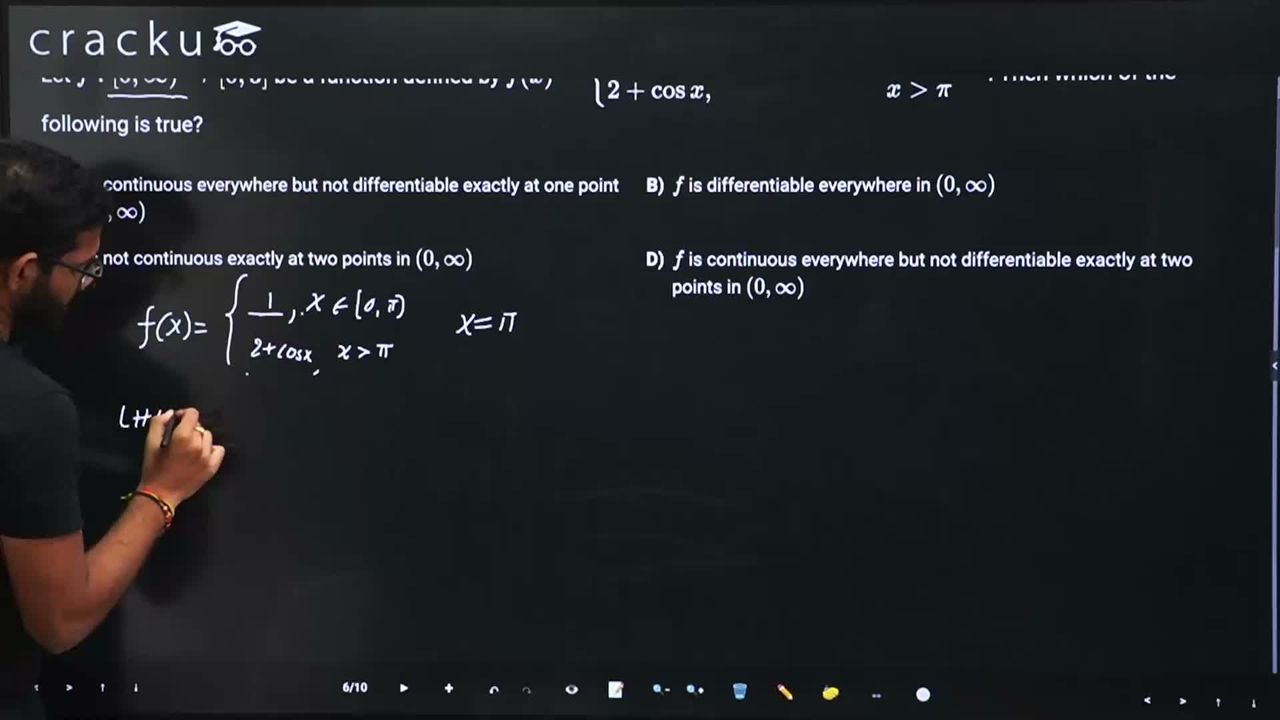
Let $$f : [0, \infty) \rightarrow [0, 3]$$ be a function defined by $$f(x) = \begin{cases} \max\{\sin t : 0 \leq t \leq \pi\}, & x \in [0, \pi] \\ 2 + \cos x, & x > \pi \end{cases}$$. Then which of the following is true?
We are given a function $$f : [0,\infty) \to [0,3]$$ defined by
$$ f(x)= \begin{cases} \displaystyle\max\{\sin t \;:\; 0\le t\le\pi\}, & 0\le x\le\pi,\\[4pt] 2+\cos x, & x>\pi. \end{cases} $$
On the interval $$[0,\pi]$$ the expression $$\max\{\sin t : 0\le t\le\pi\}$$ is a single real number, because for all real numbers $$t$$ in that closed interval the function $$\sin t$$ attains its largest value at $$t=\dfrac{\pi}{2}$$. We know the familiar fact
$$ \sin\Bigl(\dfrac{\pi}{2}\Bigr)=1\quad\text{and}\quad 0\le\sin t\le 1\text{ for }0\le t\le\pi. $$
Hence the maximum is actually the constant $$1$$. Therefore, for every $$x$$ with $$0\le x\le\pi$$ we have
$$ f(x)=1. $$
So we can rewrite the definition in a simpler two-piece form:
$$ f(x)= \begin{cases} 1, & 0\le x\le\pi,\\[6pt] 2+\cos x, & x>\pi. \end{cases} $$
Now we examine continuity and differentiability.
1. Continuity inside each open sub-interval.
• For $$0<x<\pi$$ the function is the constant $$1$$, which is continuous.
• For $$x>\pi$$ the expression $$2+\cos x$$ is a sum of continuous functions, hence continuous.
Therefore inside the separate pieces $$f$$ is continuous.
2. Continuity at the junction $$x=\pi$$.
We compute the left-hand value, the right-hand value and the limit.
Left value and left limit:
$$ \lim_{x\to\pi^-}f(x)=1,\qquad f(\pi)=1. $$
Right limit:
$$ \lim_{x\to\pi^+}f(x)=\lim_{x\to\pi^+}(2+\cos x)=2+\cos\pi=2-1=1. $$
Because left limit, right limit and the actual value are all equal to $$1$$, the function is continuous at $$x=\pi$$.
3. Differentiability inside each open sub-interval.
• For $$0<x<\pi$$ the function is constant, so
$$ f'(x)=0\quad\text{for }0<x<\pi. $$
• For $$x>\pi$$ we differentiate $$2+\cos x$$. Using the standard derivative $$\dfrac{d}{dx}(\cos x)=-\sin x$$, we get
$$ f'(x)=-\sin x\quad\text{for }x>\pi. $$
Thus $$f$$ is differentiable at every point inside the two pieces.
4. Differentiability at the junction $$x=\pi$$.
To check differentiability at a boundary point we must verify that the left-hand derivative and the right-hand derivative exist and are equal.
Left-hand derivative (using the constant piece):
$$ f'_-(\pi)=\lim_{h\to0^-}\frac{f(\pi+h)-f(\pi)}{h} =\lim_{h\to0^-}\frac{1-1}{h}=0. $$
Right-hand derivative (using the second piece):
Starting with the formula $$f(x)=2+\cos x$$ for $$x>\pi$$ and differentiating, we have $$f'(x)=-\sin x$$. Therefore
$$ f'_+(\pi)=\lim_{h\to0^+}\frac{f(\pi+h)-f(\pi)}{h} =\left[-\sin x\right]_{x=\pi}= -\sin\pi = 0. $$
The two one-sided derivatives are equal and finite, so $$f$$ is differentiable at $$x=\pi$$ as well.
5. Differentiability on $$(0,\infty)$$.
We have now shown that for every point $$x$$ with $$0<x<\pi$$, for every point $$x$$ with $$x>\pi$$, and also at the critical point $$x=\pi$$ itself, the derivative exists. Therefore $$f$$ is differentiable everywhere in the open interval $$(0,\infty)$$.
6. Final choice.
Among the options, the only statement that matches our conclusion is:
Option B: “$$f$$ is differentiable everywhere in $$(0,\infty)$$.”
Hence, the correct answer is Option B.
Was this solution helpful?
Click on the Email ☝️ to Watch the Video Solution
Create a FREE account and get:
_1.webp)

Educational materials for JEE preparation

Ask our AI anything

AI can make mistakes. Please verify important information.
AI can make mistakes. Please verify important information.
