
Join Our JEE Preparation Group
Prep with like-minded aspirants; Get access to free daily tests and study material.
Sign in
Please select an account to continue using cracku.in
↓ →
Join Our JEE Preparation Group
Prep with like-minded aspirants; Get access to free daily tests and study material.
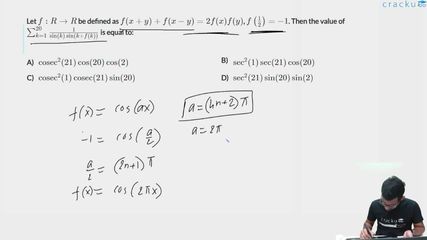
Let $$f : R \rightarrow R$$ be defined as $$f(x + y) + f(x - y) = 2f(x)f(y)$$, $$f\left(\frac{1}{2}\right) = -1$$. Then the value of $$\sum_{k=1}^{20} \frac{1}{\sin(k)\sin(k + f(k))}$$ is equal to:
We begin with the functional equation
$$f(x+y)+f(x-y)=2f(x)f(y)\qquad\qquad (1)$$
This is exactly the same relation that the cosine function satisfies, because we know the standard identity
$$\cos(\alpha+\beta)+\cos(\alpha-\beta)=2\cos\alpha\cos\beta.$$
Motivated by this similarity, we try the trial form $$f(x)=\cos(ax)$$ for some real constant $$a$$. Substituting this trial form in (1) gives
$$\cos\bigl(a(x+y)\bigr)+\cos\bigl(a(x-y)\bigr)=2\cos(ax)\cos(ay),$$
which is an identity that is always true for every real $$a$$. Hence every function of the shape $$f(x)=\cos(ax)$$ satisfies (1).
Because the domain and range are both the entire set of real numbers and we have the extra data $$f\!\left(\dfrac12\right)=-1,$$ we impose this condition:
$$f\!\left(\dfrac12\right)=\cos\!\left(a\cdot\dfrac12\right)=\cos\!\left(\dfrac a2\right)=-1.$$
The cosine of an angle equals $$-1$$ precisely when that angle equals an odd multiple of $$\pi$$. Hence
$$\frac a2=(2n+1)\pi\quad\Longrightarrow\quad a=2(2n+1)\pi=(4n+2)\pi,\qquad n\in\mathbb Z.$$
Choosing the smallest positive value (take $$n=0$$) gives $$a=2\pi$$, so from here on we work with
$$f(x)=\cos(2\pi x).$$
Now we turn to the required sum
$$S=\sum_{k=1}^{20}\frac1{\sin(k)\,\sin\bigl(k+f(k)\bigr)}.$$
For every integer $$k$$ we have $$f(k)=\cos(2\pi k)=1,$$ because the cosine of any integral multiple of $$2\pi$$ is $$1$$. Therefore
$$S=\sum_{k=1}^{20}\frac1{\sin k\,\sin(k+1)}.$$
To simplify each term we invoke the well-known cotangent difference identity. First we write the identity itself:
$$\cot A-\cot B=\frac{\sin(B-A)}{\sin A\;\sin B}.$$
Putting $$B=A+1$$ (remember that our angles are measured in radians) we obtain
$$\cot A-\cot(A+1)=\frac{\sin\!\bigl((A+1)-A\bigr)}{\sin A\;\sin(A+1)} =\frac{\sin 1}{\sin A\;\sin(A+1)}.$$
Solving this for the required reciprocal product gives
$$\frac1{\sin A\;\sin(A+1)}=\frac{\cot A-\cot(A+1)}{\sin 1}.$$
Applying this to each term of $$S$$ with $$A=k$$, we have
$$S=\sum_{k=1}^{20}\frac{\cot k-\cot(k+1)}{\sin 1} =\frac1{\sin 1}\sum_{k=1}^{20}\bigl(\cot k-\cot(k+1)\bigr).$$
Observe that the sum telescopes:
$$\sum_{k=1}^{20}\bigl(\cot k-\cot(k+1)\bigr) =(\cot1-\cot2)+(\cot2-\cot3)+\dots+(\cot20-\cot21)=\cot1-\cot21.$$
Thus
$$S=\frac{\cot1-\cot21}{\sin1}.$$
Next we rewrite the cotangents in terms of sines and cosines:
$$S=\frac{\dfrac{\cos1}{\sin1}-\dfrac{\cos21}{\sin21}}{\sin1} =\frac{\cos1}{\sin^{2}1}-\frac{\cos21}{\sin1\,\sin21}.$$
To combine the two fractions we place them over the common denominator $$\sin^{2}1\,\sin21$$:
$$S=\frac{\cos1\,\sin21-\cos21\,\sin1}{\sin^{2}1\,\sin21}.$$
The numerator is exactly the sine of a difference, because
$$\sin(b-a)=\sin b\cos a-\cos b\sin a,$$
so with $$b=21$$ and $$a=1$$ we have
$$\cos1\,\sin21-\cos21\,\sin1=\sin(21-1)=\sin20.$$
Hence the sum becomes
$$S=\frac{\sin20}{\sin^{2}1\,\sin21}.$$
Now we rewrite the denominator in cosecant notation. Remembering that $$\cosec\theta=\dfrac1{\sin\theta},$$ we have
$$\frac1{\sin^{2}1\,\sin21}=\cosec^{2}1\;\cosec21.$$
Therefore
$$S=\cosec^{2}(1)\;\cosec(21)\;\sin(20).$$
Looking at the given options, this matches exactly with Option C.
Hence, the correct answer is Option C.
Was this solution helpful?
Click on the Email ☝️ to Watch the Video Solution
Create a FREE account and get:
_1.webp)

Educational materials for JEE preparation

Ask our AI anything

AI can make mistakes. Please verify important information.
AI can make mistakes. Please verify important information.
