
Join Our JEE Preparation Group
Prep with like-minded aspirants; Get access to free daily tests and study material.
Sign in
Please select an account to continue using cracku.in
↓ →
Join Our JEE Preparation Group
Prep with like-minded aspirants; Get access to free daily tests and study material.
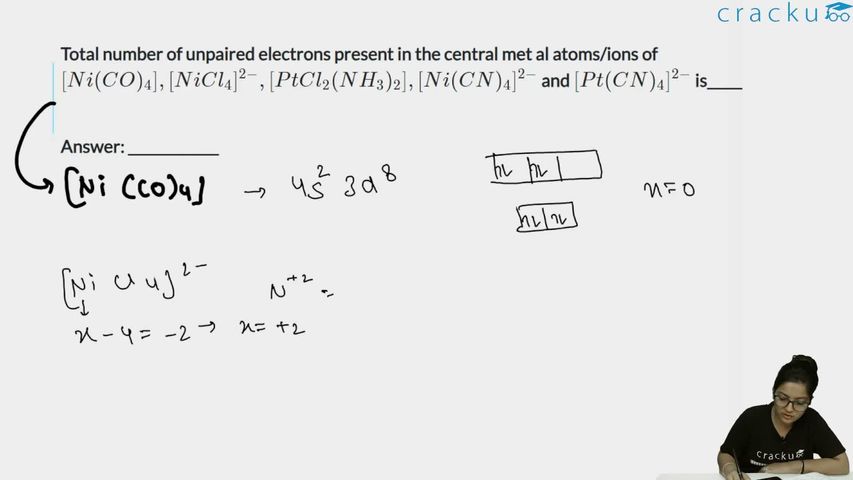
Total number of unpaired electrons present in the central met al atoms/ions of
$$[Ni(CO)_4],[NiCl_4]^{2-},[PtCl_2(NH_3)_2],[Ni(CN)_4]^{2-}$$ and $$[Pt(CN)_4]^{2-}$$ is_____
Correct Answer: 2
To find the total number of unpaired electrons in the central metal atoms/ions of the given complexes, we analyze each complex individually by determining the oxidation state of the central metal, its electron configuration, and the geometry and ligand field strength to assess the number of unpaired electrons.
Complex 1: $$[Ni(CO)_4]$$
- Oxidation state of Ni: CO is neutral, so Ni has oxidation state 0.
- Ni(0) has electron configuration [Ar] $$3d^8 4s^2$$. In coordination, CO is a strong field ligand, and the complex is tetrahedral.
- Strong field ligands cause pairing of electrons. The complex is diamagnetic, so unpaired electrons = 0.
Complex 2: $$[NiCl_4]^{2-}$$
- Oxidation state of Ni: Let oxidation state be x. Charge from Cl is -1 each, so x + 4(-1) = -2 → x = +2.
- Ni^{2+} has electron configuration [Ar] $$3d^8$$.
- $$Cl^-$$ is a weak field ligand, and the complex is tetrahedral. In a tetrahedral field with weak field ligands, the complex is high-spin.
- For $$d^8$$ in tetrahedral splitting: the t2 orbitals (lower energy, 3 orbitals) hold 6 electrons (paired), and the remaining 2 electrons occupy the e orbitals (higher energy, 2 orbitals) with one electron each, resulting in 2 unpaired electrons.
Complex 3: $$[PtCl_2(NH_3)_2]$$
- Oxidation state of Pt: Let oxidation state be x. Cl has -1 charge, $$NH_3$$ is neutral, so x + 2(-1) + 2(0) = 0 → x = +2.
- $$Pt^{2+}$$ has electron configuration [Xe] $$4f^{14} 5d^8$$.
- The complex is square planar (common for $$Pt^{2+}$$). Both $$Cl^-$$ and $$NH_3$$ are ligands that lead to strong field splitting in square planar geometry.
- For $$d^8$$ in square planar field: the $$d_{xy}, d_{xz}, d_{yz}$$ orbitals hold 6 electrons (paired), and the $$d_{z^2}$$ orbital holds the remaining 2 electrons (paired), with $$d_{x^2-y^2}$$ empty. Thus, unpaired electrons = 0.
Complex 4: $$[Ni(CN)_4]^{2-}$$
- Oxidation state of Ni: Let oxidation state be x. CN has -1 charge, so x + 4(-1) = -2 → x = +2.
- $$Ni^{2+}$$ has electron configuration [Ar] $$3d^8$$.
- $$CN^-$$ is a strong field ligand, and the complex is square planar.
- For $$d^8$$ in square planar field with strong field ligands: electrons pair completely (similar to $$Pt^{2+}$$ case), so unpaired electrons = 0.
Complex 5: $$[Pt(CN)_4]^{2-}$$
- Oxidation state of Pt: Let oxidation state be x. CN has -1 charge, so x + 4(-1) = -2 → x = +2.
- $$Pt^{2+}$$ has electron configuration [Xe] $$4f^{14} 5d^8$$.
- $$CN^-$$ is a strong field ligand, and the complex is square planar.
- For $$d^8$$ in square planar field: electrons pair completely, so unpaired electrons = 0.
Summary of unpaired electrons:
- $$[Ni(CO)_4]$$: 0
- $$[NiCl_4]^{2-}$$: 2
- $$[PtCl_2(NH_3)_2]$$: 0
- $$[Ni(CN)_4]^{2-}$$: 0
- $$[Pt(CN)_4]^{2-}$$: 0
Total unpaired electrons = 0 + 2 + 0 + 0 + 0 = 2.
Final Answer: 2
Was this solution helpful?
Click on the Email ☝️ to Watch the Video Solution
Create a FREE account and get:
_1.webp)

Educational materials for JEE preparation

Ask our AI anything

AI can make mistakes. Please verify important information.
AI can make mistakes. Please verify important information.
