
Join Our JEE Preparation Group
Prep with like-minded aspirants; Get access to free daily tests and study material.
Sign in
Please select an account to continue using cracku.in
↓ →
Join Our JEE Preparation Group
Prep with like-minded aspirants; Get access to free daily tests and study material.
Two liquids A and B form an ideal solution. At 320 K, the vapour pressure of the solution, containing 3 mol of A and 1 mol of B is 500 mm Hg. At the same
temperature, if 1 mol of A is farther added to this solution, vapour pressure of the solution increases by 20 mm Hg. Vapour pressure (in mm Hg) of B in pure state is ____ . (Nearest integer)
Correct Answer: 200
To begin, we apply Raoult's law to find the vapour pressure of pure B.
For an ideal solution, the total vapour pressure is
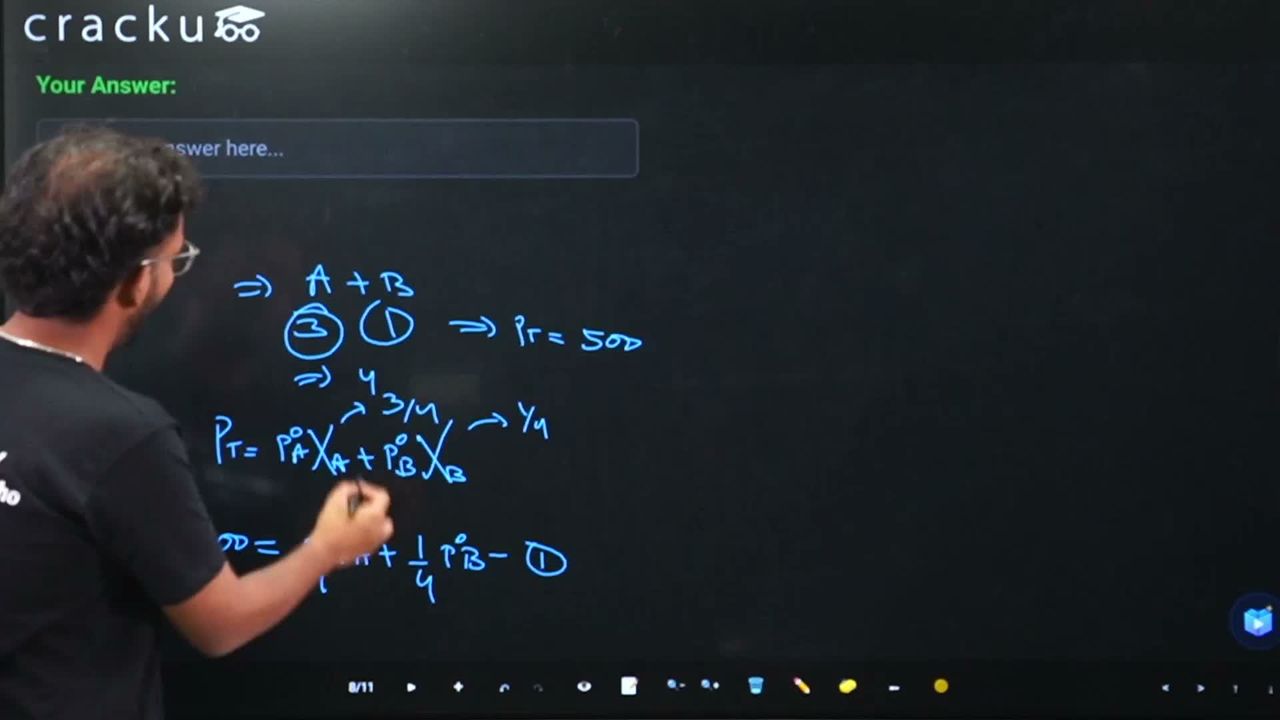
$$ P_{\text{total}} = x_A P_A^* + x_B P_B^* $$
where $$x_A, x_B$$ are mole fractions and $$P_A^*, P_B^*$$ are the vapour pressures of the pure components.
In the first mixture, there are 3 mol of A and 1 mol of B, giving a total of 4 mol. Thus
$$x_A = 3/4$$ and $$x_B = 1/4$$.
Substituting into Raoult's law gives
$$ \frac{3}{4}P_A^* + \frac{1}{4}P_B^* = 500 \quad \cdots (1) $$
After adding 1 mol of A, the amounts become 4 mol of A and 1 mol of B (total 5 mol), and the vapour pressure rises to 520 mm Hg.
The new mole fractions are $$x_A = 4/5$$ and $$x_B = 1/5$$.
Substituting again yields
$$ \frac{4}{5}P_A^* + \frac{1}{5}P_B^* = 520 \quad \cdots (2) $$
We now solve these equations simultaneously. Rewriting equation (1) gives
$$3P_A^* + P_B^* = 2000 \quad \cdots (1')$$
and equation (2) becomes
$$4P_A^* + P_B^* = 2600 \quad \cdots (2')$$
Subtracting (1') from (2') yields
$$ P_A^* = 2600 - 2000 = 600 \text{ mm Hg} $$
Substituting this value back into (1') gives
$$ 3(600) + P_B^* = 2000 $$
$$ 1800 + P_B^* = 2000 $$
$$ P_B^* = 200 \text{ mm Hg} $$
The answer is 200 mm Hg.
Was this solution helpful?
Click on the Email ☝️ to Watch the Video Solution
Create a FREE account and get:
_1.webp)

Educational materials for JEE preparation

Ask our AI anything

AI can make mistakes. Please verify important information.
AI can make mistakes. Please verify important information.
