
Join Our JEE Preparation Group
Prep with like-minded aspirants; Get access to free daily tests and study material.
Sign in
Please select an account to continue using cracku.in
↓ →
Join Our JEE Preparation Group
Prep with like-minded aspirants; Get access to free daily tests and study material.
The function $$f(x)$$, that satisfies the condition $$f(x) = x + \int_0^{\pi/2} \sin x \cos y f(y) dy$$, is:
We start with the functional equation
$$f(x)=x+\int_{0}^{\pi/2}\sin x\,\cos y\,f(y)\,dy.$$
The variable of integration is $$y$$, so for the whole integral the factor $$\sin x$$ behaves like a constant. Hence
$$f(x)=x+\sin x\int_{0}^{\pi/2}\cos y\,f(y)\,dy.$$
This expression shows that $$f(x)$$ must be a sum of a term proportional to $$x$$ and a term proportional to $$\sin x$$. Guided by this observation, we assume
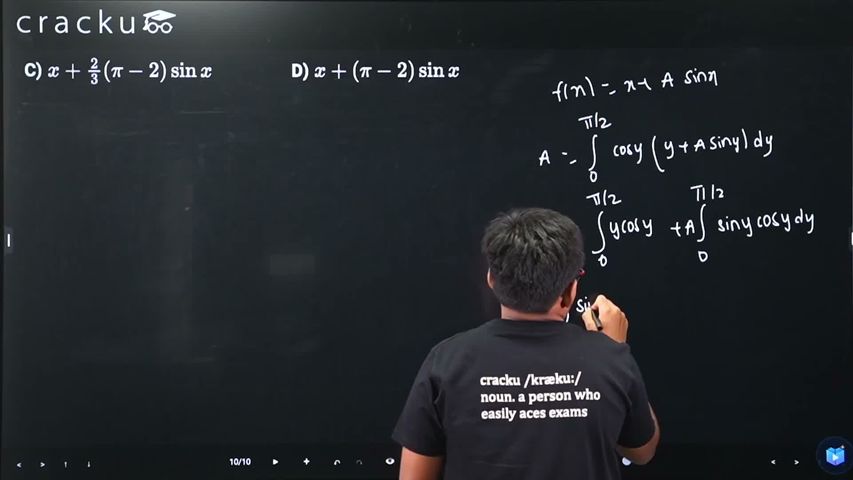
$$f(x)=x+A\sin x,$$
where $$A$$ is a constant to be determined. Now we substitute this trial form into the integral.
First we compute the integral
$$I=\int_{0}^{\pi/2}\cos y\,f(y)\,dy=\int_{0}^{\pi/2}\cos y\,(\,y+A\sin y\,)\,dy.$$
We split the integral into two simpler parts.
Part 1:
$$I_1=\int_{0}^{\pi/2}y\cos y\,dy.$$
Using integration by parts, with $$u=y$$ and $$dv=\cos y\,dy$$, we have $$du=dy$$ and $$v=\sin y$$. Therefore
$$I_1=y\sin y\Big|_{0}^{\pi/2}-\int_{0}^{\pi/2}\sin y\,dy
=\frac{\pi}{2}\cdot1-\bigl(-\cos y\bigr)\Big|_{0}^{\pi/2}
=\frac{\pi}{2}-\bigl[-\cos(\tfrac{\pi}{2})+ \cos(0)\bigr]
=\frac{\pi}{2}-\bigl[0-1\bigr]
=\frac{\pi}{2}-1.$$
Part 2:
$$I_2=A\int_{0}^{\pi/2}\cos y\,\sin y\,dy.$$
Using the substitution $$u=\sin y,\;du=\cos y\,dy$$, we get
$$I_2=A\int_{0}^{\pi/2}u\,du=A\left[\frac{u^{2}}{2}\right]_{0}^{\pi/2}
=A\left[\frac{\sin^{2}y}{2}\right]_{0}^{\pi/2}
=A\left[\frac{1^{2}}{2}-0\right]
=\frac{A}{2}.$$
Combining the two parts,
$$I=I_1+I_2=\left(\frac{\pi}{2}-1\right)+\frac{A}{2}.$$
Returning to the expression for $$f(x)$$, we substitute this value of $$I$$:
$$f(x)=x+\sin x\left(\frac{\pi}{2}-1+\frac{A}{2}\right).$$
But from our assumed form $$f(x)=x+A\sin x$$. Since the expression must hold for every $$x$$, the coefficients of $$\sin x$$ must be equal. Thus
$$A=\frac{\pi}{2}-1+\frac{A}{2}.$$
We now solve this simple linear equation for $$A$$. First bring like terms together:
$$A-\frac{A}{2}=\frac{\pi}{2}-1.$$
The left side simplifies to $$\frac{A}{2}$$, so
$$\frac{A}{2}=\frac{\pi}{2}-1.$$
Multiplying both sides by $$2$$ gives
$$A=\pi-2.$$
Finally, substituting $$A=\pi-2$$ into our trial form yields
$$f(x)=x+(\pi-2)\sin x.$$
This matches Option D in the list.
Hence, the correct answer is Option D.
Was this solution helpful?
Click on the Email ☝️ to Watch the Video Solution
Create a FREE account and get:
_1.webp)

Educational materials for JEE preparation

Ask our AI anything

AI can make mistakes. Please verify important information.
AI can make mistakes. Please verify important information.
