
Join Our JEE Preparation Group
Prep with like-minded aspirants; Get access to free daily tests and study material.
Sign in
Please select an account to continue using cracku.in
↓ →
Join Our JEE Preparation Group
Prep with like-minded aspirants; Get access to free daily tests and study material.
Number of paramagnetic ions among the following d- and f-block metal ions is _________.
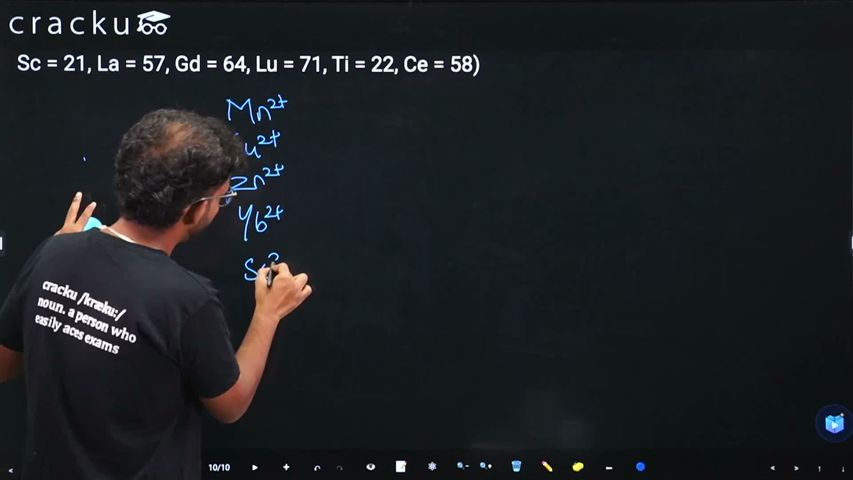
$$Mn^{2+}$$, $$Cu^{2+}$$, $$Zn^{2+}$$, $$Yb^{2+}$$, $$Sc^{3+}$$, $$La^{3+}$$, $$Gd^{3+}$$, $$Lu^{3+}$$, $$Ti^{4+}$$, $$Ce^{4+}$$
(Atomic number of Mn = 25, Cu = 29, Zn = 30, Yb = 70, Sc = 21, La = 57, Gd = 64, Lu = 71, Ti = 22, Ce = 58)
Correct Answer: 3
For a metal ion to be paramagnetic, its valence subshell (mainly $$3d$$, $$4d$$, $$5d$$ or $$4f$$, $$5f$$) must contain at least one unpaired electron. Hence we must:
1. Write the ground-state electronic configuration of the neutral atom.
2. Remove the required number of electrons to get the configuration of the ion (electrons are lost first from the $$ns$$ subshell, then from $$n(d/f)$$).
3. Check for unpaired electrons.
Electronic configurations (noble-gas core shown in brackets):
$$Mn\;(Z = 25):\; [Ar]\,3d^{5}\,4s^{2}$$
$$Mn^{2+}:\; [Ar]\,3d^{5}$$ (half-filled $$d^{5}$$, 5 unpaired e⁻) ⇒ paramagnetic.
$$Cu\;(Z = 29):\; [Ar]\,3d^{10}\,4s^{1}$$
$$Cu^{2+}:\; [Ar]\,3d^{9}$$ (one unpaired e⁻) ⇒ paramagnetic.
$$Zn\;(Z = 30):\; [Ar]\,3d^{10}\,4s^{2}$$
$$Zn^{2+}:\; [Ar]\,3d^{10}$$ (fully filled, all electrons paired) ⇒ diamagnetic.
$$Yb\;(Z = 70):\; [Xe]\,4f^{14}\,6s^{2}$$
$$Yb^{2+}:\; [Xe]\,4f^{14}$$ (fully filled $$4f^{14}$$) ⇒ diamagnetic.
$$Sc\;(Z = 21):\; [Ar]\,3d^{1}\,4s^{2}$$
$$Sc^{3+}:\; [Ar]$$ (no $$d$$ electrons) ⇒ diamagnetic.
$$La\;(Z = 57):\; [Xe]\,5d^{1}\,6s^{2}$$
$$La^{3+}:\; [Xe]$$ (no $$f$$ or $$d$$ electrons) ⇒ diamagnetic.
$$Gd\;(Z = 64):\; [Xe]\,4f^{7}\,5d^{1}\,6s^{2}$$
$$Gd^{3+}:\; [Xe]\,4f^{7}$$ (half-filled $$4f^{7}$$ with 7 unpaired e⁻) ⇒ paramagnetic.
$$Lu\;(Z = 71):\; [Xe]\,4f^{14}\,5d^{1}\,6s^{2}$$
$$Lu^{3+}:\; [Xe]\,4f^{14}$$ (fully filled $$4f^{14}$$) ⇒ diamagnetic.
$$Ti\;(Z = 22):\; [Ar]\,3d^{2}\,4s^{2}$$
$$Ti^{4+}:\; [Ar]$$ (no $$d$$ electrons) ⇒ diamagnetic.
$$Ce\;(Z = 58):\; [Xe]\,4f^{1}\,5d^{1}\,6s^{2}$$
$$Ce^{4+}:\; [Xe]$$ (no $$f$$ or $$d$$ electrons) ⇒ diamagnetic.
The ions that contain unpaired electrons are:
$$Mn^{2+},\;Cu^{2+},\;Gd^{3+}$$
Therefore, the number of paramagnetic ions is $$3$$.
Was this solution helpful?
Click on the Email ☝️ to Watch the Video Solution
Create a FREE account and get:
_1.webp)

Educational materials for JEE preparation

Ask our AI anything

AI can make mistakes. Please verify important information.
AI can make mistakes. Please verify important information.
