
Join Our JEE Preparation Group
Prep with like-minded aspirants; Get access to free daily tests and study material.
Sign in
Please select an account to continue using cracku.in
↓ →
Join Our JEE Preparation Group
Prep with like-minded aspirants; Get access to free daily tests and study material.
If the function $$f$$ defined on $$\left(-\frac{1}{3}, \frac{1}{3}\right)$$ by $$f(x) = \begin{cases} \frac{1}{x}\log_e\left(\frac{1+3x}{1-2x}\right), & \text{when } x \neq 0 \\ k, & \text{when } x = 0 \end{cases}$$, is continuous, then $$k$$ is equal to
Correct Answer: 5
We have a piece-wise definition of the function $$f$$ on the open interval $$\left(-\tfrac13,\; \tfrac13\right)$$:
$$ f(x)= \begin{cases} \dfrac{1}{x}\,\log_e\!\left(\dfrac{1+3x}{\,1-2x\,}\right), & \text{when } x\neq 0,\\[6pt] k, & \text{when } x=0. \end{cases} $$
The problem asks for the real number $$k$$ that makes the function continuous at $$x=0$$. By the definition of continuity, we need
$$ \lim_{x\to 0} f(x)=f(0)=k. $$
Thus we must evaluate the limit of the first branch as $$x\to 0$$ and then set that equal to $$k$$.
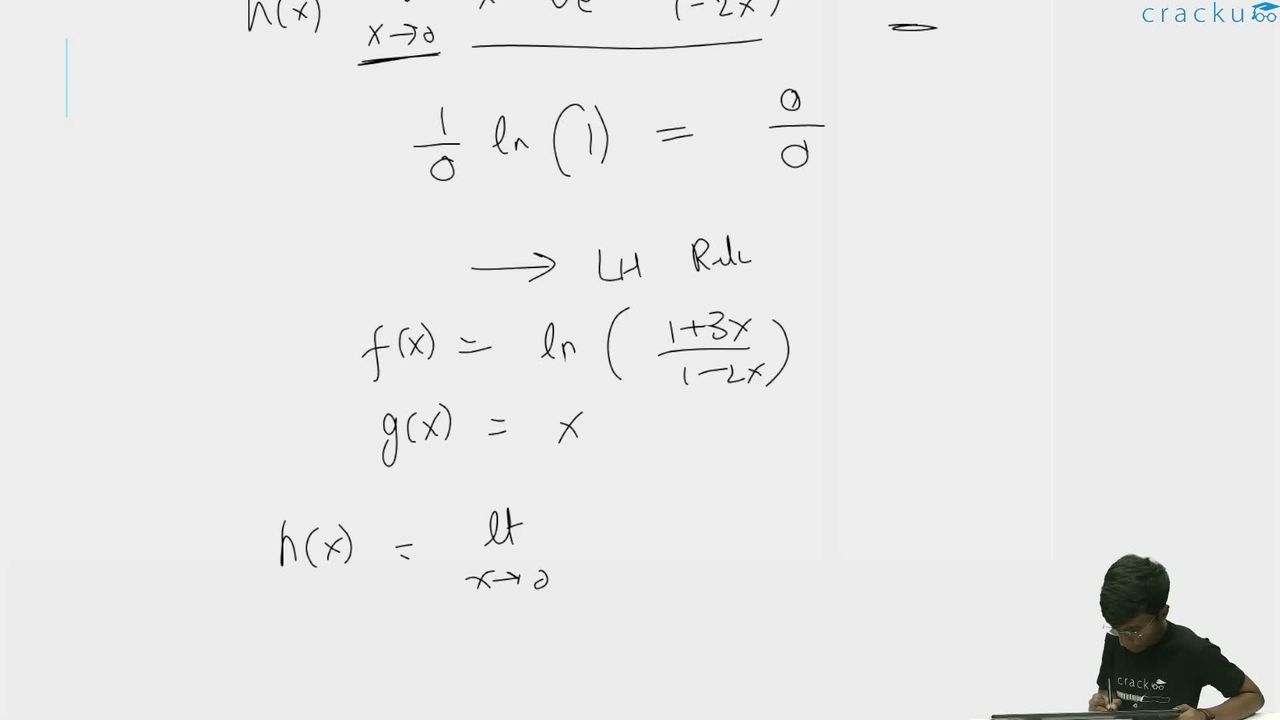
Observe that as $$x\to 0$$, both the numerator and the denominator inside the first branch approach zero:
$$ \log_e\!\left(\dfrac{1+3x}{1-2x}\right)\;\xrightarrow{x\to 0}\;\log_e 1 = 0, \quad x\xrightarrow{x\to 0}0, $$
so the limit has the indeterminate form $$\dfrac 0 0$$. The standard way to handle this form is to quote and use L’Hôpital’s Rule, which states:
“If $$\displaystyle\lim_{x\to a}\!g(x)=0$$ and $$\displaystyle\lim_{x\to a}\!h(x)=0$$ (or both infinite) and the derivatives exist near $$a$$, then
$$ \lim_{x\to a}\dfrac{g(x)}{h(x)}=\lim_{x\to a}\dfrac{g'(x)}{h'(x)}, $$
provided the right-hand limit exists.”
Here we identify
$$ g(x)=\log_e\!\left(\dfrac{1+3x}{1-2x}\right),\qquad h(x)=x. $$
We first find the derivative of $$g(x)$$. To simplify the logarithm we separate it using the logarithm identity $$\log(a/b)=\log a-\log b$$:
$$ g(x)=\log_e(1+3x)\;-\;\log_e(1-2x). $$
Now differentiate term by term:
$$ g'(x)=\dfrac{d}{dx}\bigl[\log_e(1+3x)\bigr]-\dfrac{d}{dx}\bigl[\log_e(1-2x)\bigr]. $$
Using the basic derivative formula $$\dfrac{d}{dx}\log_e(1+ax)=\dfrac{a}{1+ax}$$, we obtain
$$ g'(x)=\dfrac{3}{1+3x}-\!\Bigl(-\dfrac{2}{1-2x}\Bigr) =\dfrac{3}{1+3x}+\dfrac{2}{1-2x}. $$
The derivative of the denominator $$h(x)=x$$ is simply
$$ h'(x)=\dfrac{d}{dx}(x)=1. $$
Applying L’Hôpital’s Rule, the desired limit becomes
$$ \lim_{x\to 0}\dfrac{g(x)}{h(x)} =\lim_{x\to 0}\dfrac{g'(x)}{h'(x)} =\lim_{x\to 0}\Bigl[\dfrac{3}{1+3x}+\dfrac{2}{1-2x}\Bigr]. $$
Now we simply substitute $$x=0$$ into the rational expressions because they are continuous there:
$$ \dfrac{3}{1+3(0)}+\dfrac{2}{1-2(0)} =\dfrac{3}{1}+\dfrac{2}{1} =3+2 =5. $$
Thus
$$ \lim_{x\to 0} \dfrac{1}{x}\log_e\!\left(\dfrac{1+3x}{\,1-2x\,}\right)=5. $$
For continuity at the origin we therefore require
$$ k = 5. $$
Hence, the correct answer is Option 5.
Was this solution helpful?
Click on the Email ☝️ to Watch the Video Solution
Create a FREE account and get:
_1.webp)

Educational materials for JEE preparation

Ask our AI anything

AI can make mistakes. Please verify important information.
AI can make mistakes. Please verify important information.
