
Join Our JEE Preparation Group
Prep with like-minded aspirants; Get access to free daily tests and study material.
Sign in
Please select an account to continue using cracku.in
↓ →
Join Our JEE Preparation Group
Prep with like-minded aspirants; Get access to free daily tests and study material.
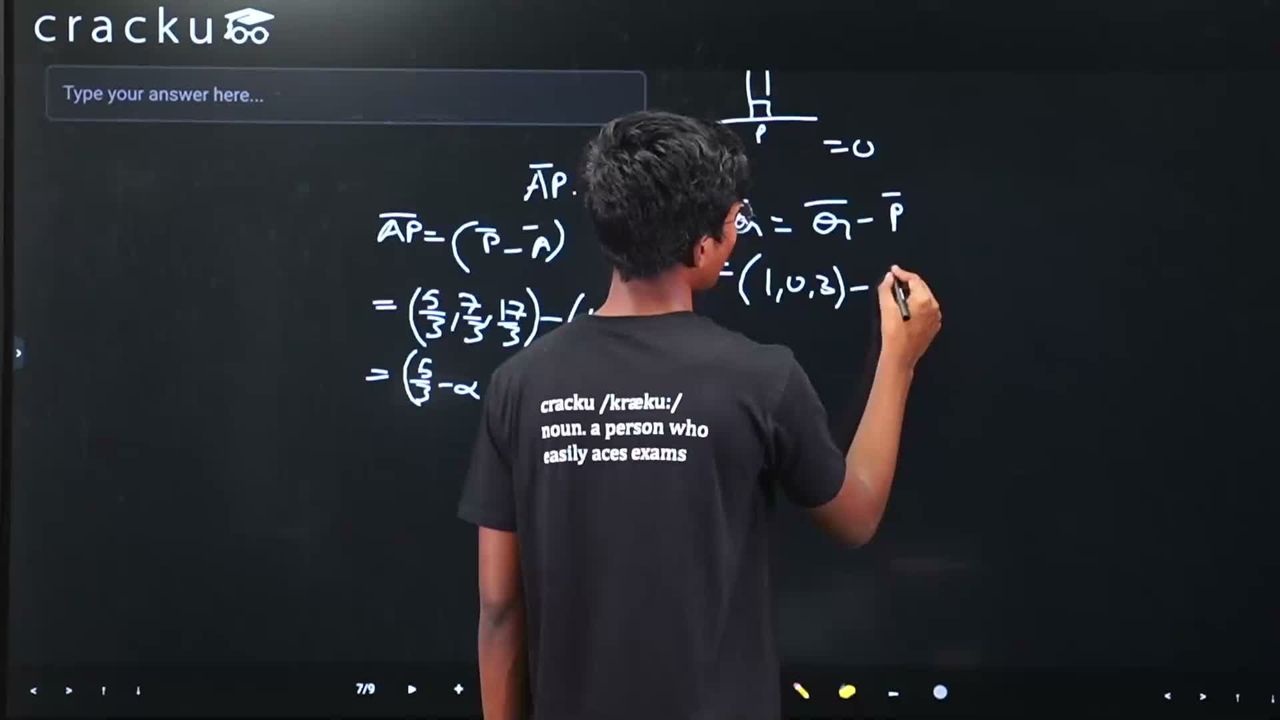
If the foot of the perpendicular drawn from the point $$(1, 0, 3)$$ on a line passing through $$(\alpha, 7, 1)$$ is $$\left(\frac{5}{3}, \frac{7}{3}, \frac{17}{3}\right)$$, then $$\alpha$$ is equal to
Correct Answer: 4
Point P=(1,0,3)P = (1, 0, 3)P=(1,0,3)
Line passes through A=(α,7,1)A = ($$\alpha\ $$, 7, 1)A=(α,7,1)
Foot of perpendicular from P to the line is
$$F=\ \left(\frac{5}{3},\frac{7}{3},\frac{17}{3}\right)$$
Now the main ideas :
Dot product of perpendicular vectors is = 0
Line passes through A and F, its direction vector is:
$$\vec{AF}$$= F - A
$$\vec{PF}$$ = F - P
$$\vec{PF}$$ = $$\left(\frac{5}{3}-\alpha\ ,\ \frac{7}{3}-7,\ \frac{17}{3}-1\right)$$
= $$\left(\frac{5}{3}-\alpha\ ,\ -\frac{14}{3},\ \frac{14}{3}\right)$$
Now use perpendicular condition
$$\vec{PF}$$ . $$\vec{AF}$$ = 0
$$\left(\frac{2}{3},\ \frac{7}{3},\ \frac{8}{3}\right)\ .\ \left(\frac{5}{3}-\alpha\ ,\ -\frac{14}{3},\ \frac{14}{3}\right)\ \ =\ 0$$
Compute dot product and equal it to Zero
$$\frac{2}{3}\left(\frac{5}{3}-\alpha\ \right)+\frac{7}{3}\left(-\frac{14}{3}\right)+\frac{8}{3}\left(\frac{14}{3}\right)\ \ =\ 0$$
$$\frac{10}{9}-\frac{2\alpha}{3}-\frac{98}{9}+\frac{112}{9}\ =\ 0$$
$$\frac{8}{3}\ -\ \frac{2\alpha}{3}\ =\ 0$$
$$8\ -\ 2\alpha\ \ =\ 0$$
$$2\alpha\ \ =\ 8$$
$$\alpha\ \ =\ 4$$
Hence the answer is $$\alpha\ \ =4$$
Was this solution helpful?
Click on the Email ☝️ to Watch the Video Solution
Create a FREE account and get:
_1.webp)

Educational materials for JEE preparation

Ask our AI anything

AI can make mistakes. Please verify important information.
AI can make mistakes. Please verify important information.
