
Join Our JEE Preparation Group
Prep with like-minded aspirants; Get access to free daily tests and study material.
Sign in
Please select an account to continue using cracku.in
↓ →
Join Our JEE Preparation Group
Prep with like-minded aspirants; Get access to free daily tests and study material.
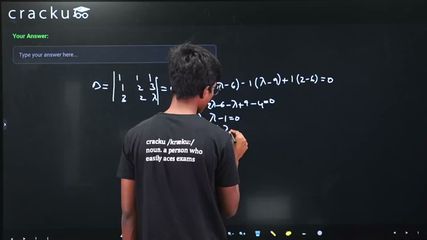
If the system of linear equations,
$$x + y + z = 6$$
$$x + 2y + 3z = 10$$
$$3x + 2y + \lambda z = \mu$$
has more than two solutions, then $$\mu - \lambda^2$$ is equal to
Correct Answer: 13
We have the system
$$x + y + z = 6$$
$$x + 2y + 3z = 10$$
$$3x + 2y + \lambda z = \mu$$
First we solve the first two equations to understand the set of common solutions they already permit.
From $$x + y + z = 6$$ and $$x + 2y + 3z = 10$$ we subtract the first from the second to eliminate $$x$$:
$$\bigl(x + 2y + 3z\bigr) - \bigl(x + y + z\bigr) = 10 - 6$$
$$y + 2z = 4$$
So we can express $$y$$ in terms of $$z$$:
$$y = 4 - 2z$$
Now we substitute this value of $$y$$ back into the first equation $$x + y + z = 6$$:
$$x + (4 - 2z) + z = 6$$
$$x + 4 - z = 6$$
$$x = 2 + z$$
Hence every solution of the first two equations can be written as
$$x = 2 + z, \qquad y = 4 - 2z, \qquad z \text{ is free}$$
Thus the first two equations already give infinitely many solutions (one free parameter $$z$$).
For the entire system to have “more than two solutions”, the third equation must not reduce the number of free parameters. Therefore every triple $$\bigl(2 + z,\; 4 - 2z,\; z\bigr)$$ must also satisfy the third equation. We now impose this condition.
The third equation is $$3x + 2y + \lambda z = \mu$$. Substituting $$x = 2 + z$$ and $$y = 4 - 2z$$ we obtain
$$3(2 + z) + 2(4 - 2z) + \lambda z = \mu$$
First expand each term:
$$3 \times 2 = 6,\;\; 3 \times z = 3z$$
$$2 \times 4 = 8,\;\; 2 \times (-2z) = -4z$$
So
$$6 + 3z + 8 - 4z + \lambda z = \mu$$
Combine the constants and the coefficients of $$z$$:
$$14 + (3z - 4z + \lambda z) = \mu$$
$$14 + (\lambda - 1)z = \mu$$
This equality must hold for all values of the free parameter $$z$$. The only way a linear expression in $$z$$ can equal a constant $$\mu$$ for every $$z$$ is if the coefficient of $$z$$ is zero. Therefore
$$(\lambda - 1) = 0 \quad\Longrightarrow\quad \lambda = 1$$
With $$\lambda = 1$$, the expression becomes simply
$$14 = \mu$$
So
$$\mu = 14$$
Now we compute the required quantity $$\mu - \lambda^2$$:
$$\mu - \lambda^2 = 14 - (1)^2 = 14 - 1 = 13$$
So, the answer is $$13$$.
Was this solution helpful?
Click on the Email ☝️ to Watch the Video Solution
Create a FREE account and get:
_1.webp)

Educational materials for JEE preparation

Ask our AI anything

AI can make mistakes. Please verify important information.
AI can make mistakes. Please verify important information.
