
Join Our JEE Preparation Group
Prep with like-minded aspirants; Get access to free daily tests and study material.
Sign in
Please select an account to continue using cracku.in
↓ →
Join Our JEE Preparation Group
Prep with like-minded aspirants; Get access to free daily tests and study material.
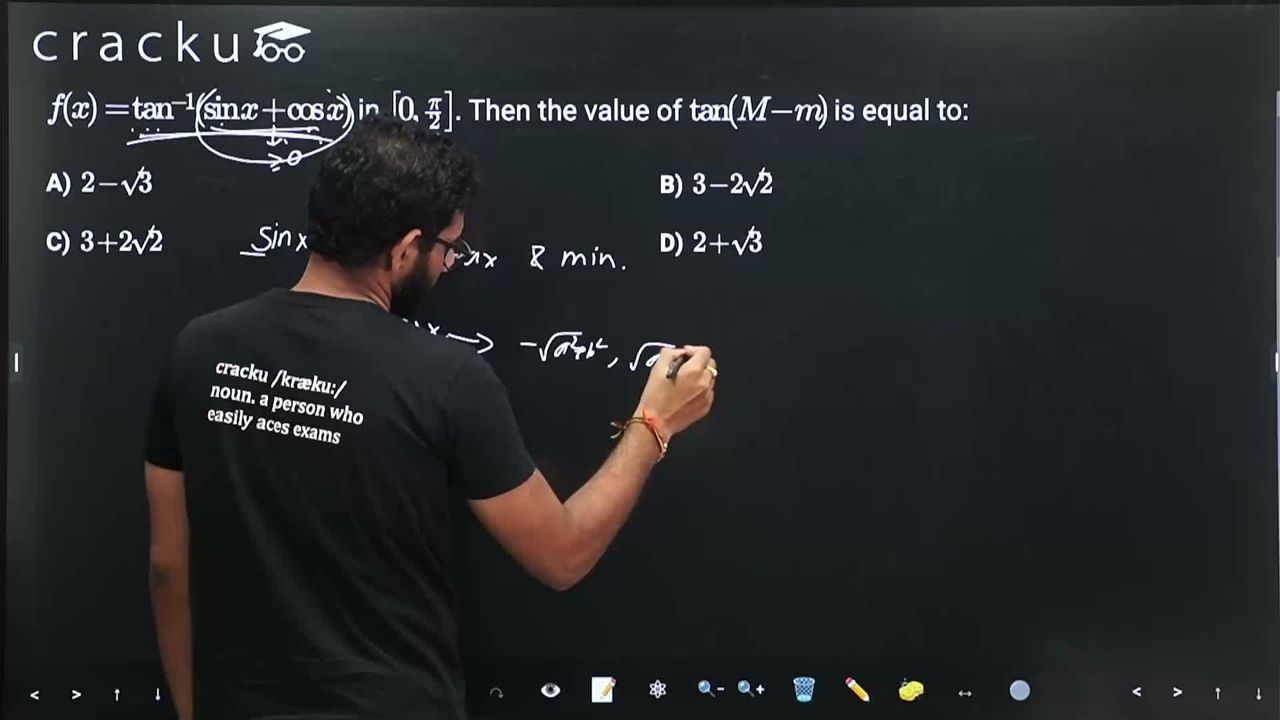
Let $$M$$ and $$m$$ respectively be the maximum and minimum values of the function $$f(x) = \tan^{-1}(\sin x + \cos x)$$ in $$\left[0, \frac{\pi}{2}\right]$$. Then the value of $$\tan(M - m)$$ is equal to:
We have the function $$f(x)=\tan^{-1}(\sin x+\cos x)$$ defined on the closed interval $$\left[0,\dfrac{\pi}{2}\right]$$. Because $$\tan^{-1}y$$ is an increasing function of its argument $$y$$, the maximum and minimum of $$f(x)$$ will occur at the same points where the expression $$\sin x+\cos x$$ attains its maximum and minimum on the given interval.
So we first study $$g(x)=\sin x+\cos x$$ on $$\left[0,\dfrac{\pi}{2}\right]$$. We differentiate:
$$g'(x)=\cos x-\sin x.$$
Setting the derivative equal to zero,
$$\cos x-\sin x=0 \;\Longrightarrow\; \cos x=\sin x \;\Longrightarrow\; x=\dfrac{\pi}{4},$$
because on $$\left[0,\dfrac{\pi}{2}\right]$$ the only solution is $$x=\dfrac{\pi}{4}$$. Next we examine concavity to confirm the nature of this critical point. We find the second derivative:
$$g''(x)=-\sin x-\cos x.$$
On $$\left[0,\dfrac{\pi}{2}\right]$$ both $$\sin x$$ and $$\cos x$$ are non-negative, so $$g''(x)<0$$ everywhere. Hence $$g(x)$$ is concave down, making the point $$x=\dfrac{\pi}{4}$$ a point of maximum.
We now evaluate $$g(x)$$ at the endpoints and at the critical point:
At $$x=0: \quad g(0)=\sin0+\cos0=0+1=1.$$
At $$x=\dfrac{\pi}{2}: \quad g\!\left(\dfrac{\pi}{2}\right)=\sin\dfrac{\pi}{2}+\cos\dfrac{\pi}{2}=1+0=1.$$
At $$x=\dfrac{\pi}{4}: \quad g\!\left(\dfrac{\pi}{4}\right)=\sin\dfrac{\pi}{4}+\cos\dfrac{\pi}{4}=\dfrac{\sqrt2}{2}+\dfrac{\sqrt2}{2}=\sqrt2.$$
Thus on the interval $$\left[0,\dfrac{\pi}{2}\right]$$ we have
$$g_{\text{min}}=1, \qquad g_{\text{max}}=\sqrt2.$$
Because $$f(x)=\tan^{-1}(g(x))$$ is monotonically increasing with respect to $$g(x)$$, the minimum and maximum of $$f(x)$$ occur where $$g(x)$$ is minimum and maximum, respectively. Therefore,
$$m = \min f(x)=\tan^{-1}(1)=\tan^{-1}(1)=\dfrac{\pi}{4},$$
$$M = \max f(x)=\tan^{-1}(\sqrt2).$$
We must now compute $$\tan(M-m)$$. To do so, we recall the tangent subtraction formula:
$$\tan(A-B)=\dfrac{\tan A-\tan B}{1+\tan A\,\tan B}.$$
Taking $$A=M=\tan^{-1}(\sqrt2)$$ and $$B=m=\dfrac{\pi}{4},$$ we substitute their tangents:
$$\tan(M)=\sqrt2, \qquad \tan(m)=\tan\!\left(\dfrac{\pi}{4}\right)=1.$$
Applying the formula,
$$\tan(M-m)=\dfrac{\sqrt2-1}{1+\sqrt2\cdot 1} =\dfrac{\sqrt2-1}{1+\sqrt2}.$$
To simplify, we rationalise the denominator by multiplying the numerator and denominator by $$(\sqrt2-1):$$
$$\tan(M-m)=\dfrac{\sqrt2-1}{1+\sqrt2}\;\cdot\;\dfrac{\sqrt2-1}{\sqrt2-1} =\dfrac{(\sqrt2-1)^2}{(\sqrt2+1)(\sqrt2-1)} =\dfrac{2-2\sqrt2+1}{2-1} =\dfrac{3-2\sqrt2}{1} =3-2\sqrt2.$$
Hence, the correct answer is Option B.
Was this solution helpful?
Click on the Email ☝️ to Watch the Video Solution
Create a FREE account and get:
_1.webp)

Educational materials for JEE preparation

Ask our AI anything

AI can make mistakes. Please verify important information.
AI can make mistakes. Please verify important information.
