
Join Our JEE Preparation Group
Prep with like-minded aspirants; Get access to free daily tests and study material.
Sign in
Please select an account to continue using cracku.in
↓ →
Join Our JEE Preparation Group
Prep with like-minded aspirants; Get access to free daily tests and study material.
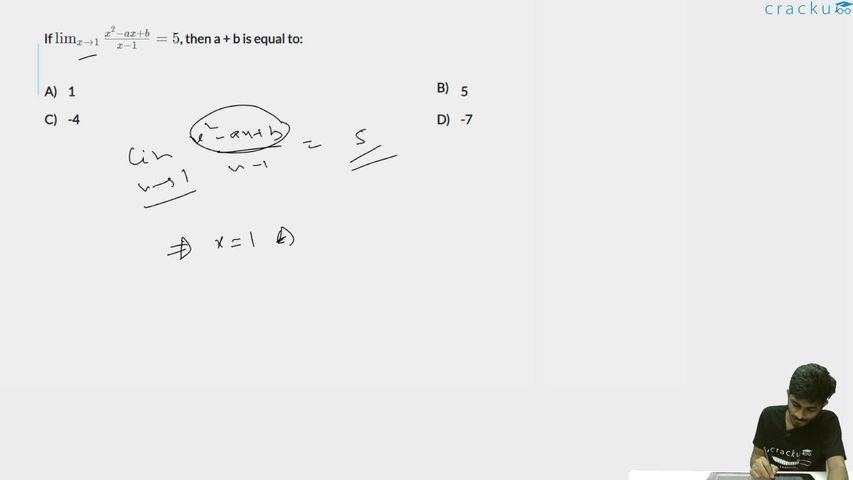
We have to evaluate the limit
$$\lim_{x \to 1}\dfrac{x^{2}-ax+b}{x-1}=5.$$
Because the denominator $$x-1$$ approaches $$0$$ as $$x \to 1$$, the limit can stay finite only if the numerator also becomes $$0$$ at $$x=1$$. Therefore we must have
$$1^{2}-a(1)+b=0 \quad\Longrightarrow\quad 1-a+b=0 \quad\Longrightarrow\quad b=a-1.$$
Knowing that $$x^{2}-ax+b$$ vanishes at $$x=1$$, the Factor Theorem tells us that $$x-1$$ is a factor of the quadratic. Hence we can write
$$x^{2}-ax+b=(x-1)(x-c)$$
for some real number $$c$$. Multiplying out the right-hand side gives
$$ (x-1)(x-c)=x^{2}-cx-x+ c=\;x^{2}-(c+1)x+c. $$
Comparing coefficients with the original quadratic $$x^{2}-ax+b,$$ we obtain
$$a=c+1 \quad\text{and}\quad b=c.$$
After canceling the common factor $$x-1,$$ the expression inside the limit simplifies to
$$\dfrac{x^{2}-ax+b}{x-1}=x-c.$$
Now we let $$x \to 1$$:
$$\lim_{x \to 1}(x-c)=1-c.$$
But the given limit equals $$5,$$ so we set
$$1-c=5 \quad\Longrightarrow\quad c=-4.$$
Substituting $$c=-4$$ into the relations $$a=c+1$$ and $$b=c,$$ we get
$$a=-4+1=-3 \quad\text{and}\quad b=-4.$$
Finally,
$$a+b=(-3)+(-4)=-7.$$
Hence, the correct answer is Option D.
Was this solution helpful?
Click on the Email ☝️ to Watch the Video Solution
Create a FREE account and get:
_1.webp)

Educational materials for JEE preparation

Ask our AI anything

AI can make mistakes. Please verify important information.
AI can make mistakes. Please verify important information.
