
Join Our JEE Preparation Group
Prep with like-minded aspirants; Get access to free daily tests and study material.
Sign in
Please select an account to continue using cracku.in
↓ →
Join Our JEE Preparation Group
Prep with like-minded aspirants; Get access to free daily tests and study material.
Let $$N$$ be the set of natural numbers and a relation $$R$$ on $$N$$ be defined by $$R = \{(x, y) \in N \times N : x^3 - 3x^2y - xy^2 + 3y^3 = 0\}$$. Then the relation $$R$$ is:
We start with the set $$N=\{1,2,3,\dots\}$$ of natural numbers and the relation
$$R=\{(x,y)\in N\times N : x^{3}-3x^{2}y-xy^{2}+3y^{3}=0\}.$$
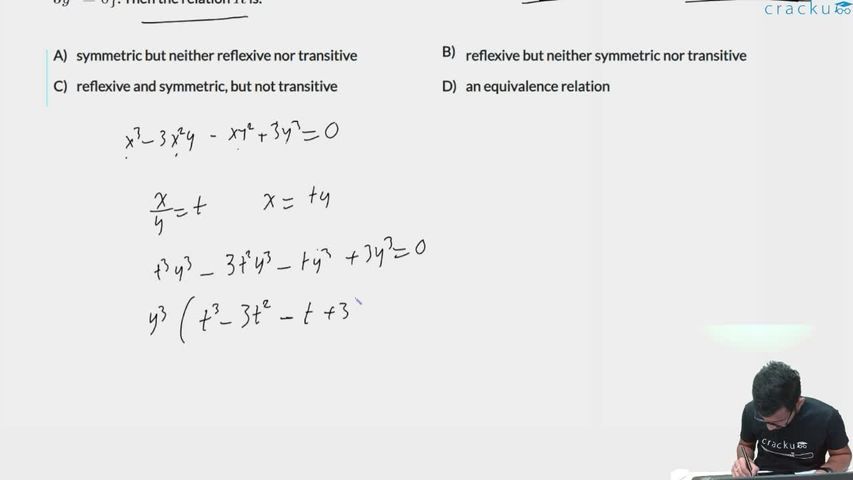
First we rewrite the condition in a more workable form. For any ordered pair $$(x,y)\in N\times N$$ with $$y\neq 0$$ (which is always true in $$N$$) let us put $$x=ty$$, i.e. let $$t=\dfrac{x}{y}.$$ Substituting $$x=ty$$ into the polynomial we get
$$$ x^{3}-3x^{2}y-xy^{2}+3y^{3} = (ty)^{3}-3(ty)^{2}\,y-(ty)\,y^{2}+3y^{3}. $$$
Simplifying each term gives
$$$ (ty)^{3}=t^{3}y^{3}, \qquad 3(ty)^{2}y = 3t^{2}y^{3}, \qquad (ty)y^{2}=ty^{3}. $$$
Hence
$$$ x^{3}-3x^{2}y-xy^{2}+3y^{3} = t^{3}y^{3}-3t^{2}y^{3}-t y^{3}+3y^{3} = y^{3}\bigl(t^{3}-3t^{2}-t+3\bigr). $$$
The factor $$y^{3}$$ is never zero in $$N$$, so the whole expression is zero exactly when
$$$ t^{3}-3t^{2}-t+3=0. $$$
Now we factor this cubic. We test the obvious integer divisor $$t=1$$:
$$$ 1^{3}-3(1)^{2}-1+3 =1-3-1+3=0, $$$
so $$t-1$$ is a factor. Performing polynomial division (or synthetic division) we get
$$$ t^{3}-3t^{2}-t+3=(t-1)(t^{2}-2t-3). $$$
Next we factor the quadratic $$t^{2}-2t-3$$:
$$$ t^{2}-2t-3=(t-3)(t+1). $$$
Therefore
$$$ t^{3}-3t^{2}-t+3=(t-1)(t-3)(t+1)=0. $$$
For $$t\in\mathbb{Q}$$ (and especially for $$t\in N$$) the roots are $$t=1,\;t=3,\;t=-1$$. Since $$t=\dfrac{x}{y}$$ is positive in $$N$$, the admissible values are
$$$ t=1\quad\text{or}\quad t=3. $$$
That is,
$$$ \dfrac{x}{y}=1\;\;\Longrightarrow\;\;x=y, \qquad \dfrac{x}{y}=3\;\;\Longrightarrow\;\;x=3y. $$$
Hence the defining equation vanishes precisely for the two patterns
$$$ R=\{(x,y)\in N\times N : x=y\ \text{or}\ x=3y\}. $$$
With this explicit description we can check the three properties one by one.
Reflexive: For every $$a\in N$$ we have $$a=a$$, so $$(a,a)\in R$$ by the first alternative $$x=y$$. Thus $$R$$ is reflexive.
Symmetric: Assume $$(x,y)\in R$$. Two sub-cases arise.
• If $$x=y$$, then $$(y,x)=(x,x)$$ is again in $$R$$, so symmetry is fine in this sub-case.
• If $$x=3y$$, then $$y=\dfrac{x}{3}$$. For $$(y,x)$$ to belong to $$R$$ we would need either $$y=x$$ (impossible because $$x=3y\neq y$$) or $$y=3x$$ (impossible because it would give $$x=0$$). Therefore $$(y,x)\notin R$$ whenever $$x=3y$$ with $$y\ge1$$. A concrete instance is $$(3,1)\in R$$ while $$(1,3)\notin R$$.
So the relation is not symmetric.
Transitive: We need to see whether $$(x,y)\in R$$ and $$(y,z)\in R$$ always force $$(x,z)\in R$$. Take the pairs
$$$ (x,y)=(9,3),\quad (y,z)=(3,1). $$$
The first belongs to $$R$$ because $$9=3\cdot3$$, the second because $$3=3\cdot1$$. However, $$(x,z)=(9,1)$$ satisfies neither $$9=1$$ nor $$9=3\cdot1$$, so $$(9,1)\notin R$$. Hence $$R$$ fails transitivity.
Collecting the results, $$R$$ is reflexive but neither symmetric nor transitive.
Hence, the correct answer is Option 2.
Was this solution helpful?
Click on the Email ☝️ to Watch the Video Solution
Create a FREE account and get:
_1.webp)

Educational materials for JEE preparation

Ask our AI anything

AI can make mistakes. Please verify important information.
AI can make mistakes. Please verify important information.
