
Join Our JEE Preparation Group
Prep with like-minded aspirants; Get access to free daily tests and study material.
Sign in
Please select an account to continue using cracku.in
↓ →
Join Our JEE Preparation Group
Prep with like-minded aspirants; Get access to free daily tests and study material.
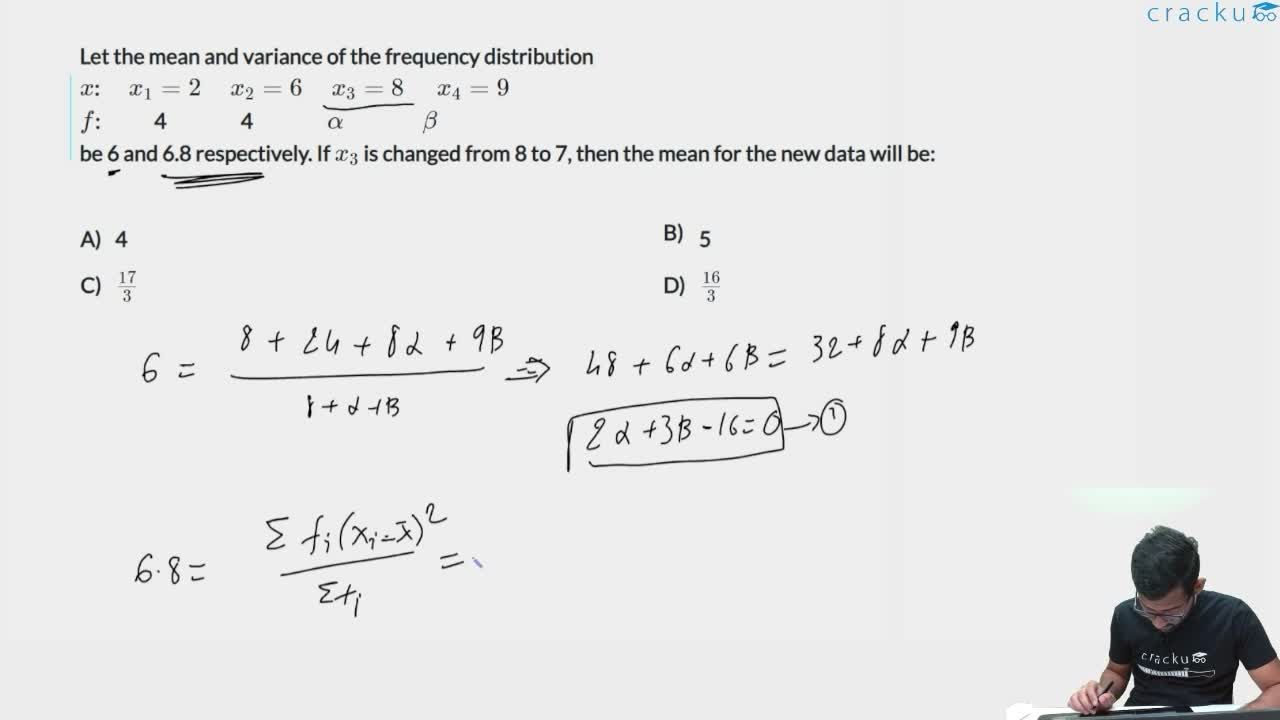
Let the mean and variance of the frequency distribution
$$x$$: $$x_1 = 2$$ $$x_2 = 6$$ $$x_3 = 8$$ $$x_4 = 9$$
$$f$$: 4 4 $$\alpha$$ $$\beta$$
be 6 and 6.8 respectively. If $$x_3$$ is changed from 8 to 7, then the mean for the new data will be:
First we write down the information given for the original frequency distribution.
The values are $$x_1 = 2,\;x_2 = 6,\;x_3 = 8,\;x_4 = 9$$ and the corresponding frequencies are $$f_1 = 4,\;f_2 = 4,\;f_3 = \alpha,\;f_4 = \beta.$$
We are told that the mean of this distribution is $$6.$$ By definition, the mean (denoted by $$\bar{x}$$) of a discrete frequency distribution is
$$\bar{x} \;=\; \dfrac{\displaystyle\sum_{i=1}^{4} f_i x_i}{\displaystyle\sum_{i=1}^{4} f_i}.$$
Substituting the known numbers we obtain
$$6 \;=\; \dfrac{4 \cdot 2 \;+\; 4 \cdot 6 \;+\; \alpha \cdot 8 \;+\; \beta \cdot 9}{4 + 4 + \alpha + \beta}.$$
Simplifying the numerator and denominator separately, we have
Numerator: $$4\cdot 2 = 8,\;\;4\cdot 6 = 24$$ so $$8 + 24 = 32.$$ Hence the numerator is $$32 + 8\alpha + 9\beta.$$
Denominator: $$4 + 4 = 8,$$ so the total frequency is $$8 + \alpha + \beta.$$
Therefore the mean equation becomes
$$6 \;=\; \dfrac{32 + 8\alpha + 9\beta}{8 + \alpha + \beta}.$$
Cross-multiplying gives
$$32 + 8\alpha + 9\beta \;=\; 6\,(8 + \alpha + \beta).$$
Expanding the right-hand side, $$6(8 + \alpha + \beta) = 48 + 6\alpha + 6\beta.$$
Now we bring all terms to one side:
$$32 + 8\alpha + 9\beta - 48 - 6\alpha - 6\beta = 0.$$
Combining like terms,
$$(8\alpha - 6\alpha) + (9\beta - 6\beta) + (32 - 48) = 0,$$ $$2\alpha + 3\beta - 16 = 0,$$ so
$$2\alpha + 3\beta = 16. \qquad (1)$$
Next we use the given variance. For a frequency distribution, the variance $$\sigma^{2}$$ is given by
$$\sigma^{2} \;=\; \dfrac{\displaystyle\sum_{i=1}^{4} f_i\,(x_i - \bar{x})^{2}}{\displaystyle\sum_{i=1}^{4} f_i}.$$
We are told that $$\sigma^{2} = 6.8.$$ Since the mean is $$\bar{x}=6,$$ we compute each squared deviation:
For $$x_1 = 2: (2-6)^2 = (-4)^2 = 16,$$ for $$x_2 = 6: (6-6)^2 = 0,$$ for $$x_3 = 8: (8-6)^2 = 2^2 = 4,$$ for $$x_4 = 9: (9-6)^2 = 3^2 = 9.$$
Multiplying by their frequencies gives
$$f_1(2-6)^2 = 4 \cdot 16 = 64,$$ $$f_2(6-6)^2 = 4 \cdot 0 = 0,$$ $$f_3(8-6)^2 = \alpha \cdot 4 = 4\alpha,$$ $$f_4(9-6)^2 = \beta \cdot 9 = 9\beta.$$
Hence the numerator of the variance expression is
$$64 + 4\alpha + 9\beta.$$
The denominator is the same total frequency $$8 + \alpha + \beta.$$
Thus the variance equation is
$$6.8 \;=\; \dfrac{64 + 4\alpha + 9\beta}{8 + \alpha + \beta}.$$
Cross-multiplying once again,
$$64 + 4\alpha + 9\beta \;=\; 6.8\,(8 + \alpha + \beta).$$
Compute $$6.8 \times 8 = 54.4,$$ so the right side is $$54.4 + 6.8\alpha + 6.8\beta.$$
Bringing all terms to the left gives
$$64 + 4\alpha + 9\beta - 54.4 - 6.8\alpha - 6.8\beta = 0.$$
Combining like terms,
$$(4\alpha - 6.8\alpha) + (9\beta - 6.8\beta) + (64 - 54.4) = 0,$$ $$-2.8\alpha + 2.2\beta + 9.6 = 0.$$
To clear the decimals, multiply every term by $$10$$:
$$-28\alpha + 22\beta + 96 = 0.$$
Dividing by $$2$$ for simplicity gives
$$-14\alpha + 11\beta + 48 = 0,$$ or equivalently
$$11\beta - 14\alpha = -48. \qquad (2)$$
Now we solve the simultaneous linear equations (1) and (2). From equation (1) we isolate $$\alpha$$:
$$2\alpha + 3\beta = 16 \;\;\Rightarrow\;\; 2\alpha = 16 - 3\beta \;\;\Rightarrow\;\; \alpha = 8 - \dfrac{3}{2}\beta.$$
Substituting this value of $$\alpha$$ into equation (2):
$$11\beta - 14\Bigl(8 - \dfrac{3}{2}\beta\Bigr) = -48.$$
First expand the term inside:
$$14\Bigl(8 - \dfrac{3}{2}\beta\Bigr) = 14 \cdot 8 - 14 \cdot \dfrac{3}{2}\beta = 112 - 21\beta.$$
Hence equation (2) becomes
$$11\beta - \bigl(112 - 21\beta\bigr) = -48.$$
Removing the parentheses carefully:
$$11\beta - 112 + 21\beta = -48.$$
Combine the $$\beta$$ terms:
$$(11\beta + 21\beta) - 112 = -48,$$ $$32\beta - 112 = -48.$$
Add $$112$$ to both sides:
$$32\beta = 64 \;\;\Rightarrow\;\; \beta = \dfrac{64}{32} = 2.$$
Now we substitute $$\beta = 2$$ back into $$\alpha = 8 - \dfrac{3}{2}\beta$$:
$$\alpha = 8 - \dfrac{3}{2}\times 2 = 8 - 3 = 5.$$
Thus we have determined the missing frequencies:
$$\alpha = 5,\quad \beta = 2.$$
Next, the problem states that the value $$x_3$$ is changed from $$8$$ to $$7.$$ Therefore the revised distribution is
$$x: 2,\;6,\;7,\;9$$ with the same frequencies $$4,\;4,\;5,\;2$$ respectively.
We now compute the mean of this new data set. The total frequency remains
$$N = 4 + 4 + 5 + 2 = 15.$$
The sum of the products $$f_i x_i$$ for the new data is
$$\begin{aligned} 4\cdot 2 &= 8,\\ 4\cdot 6 &= 24,\\ 5\cdot 7 &= 35,\\ 2\cdot 9 &= 18. \end{aligned}$$
Adding these contributions together,
$$8 + 24 = 32,\quad 32 + 35 = 67,\quad 67 + 18 = 85.$$
Hence the new mean $$\bar{x}_{\text{new}}$$ is
$$\bar{x}_{\text{new}} \;=\; \dfrac{85}{15} = \dfrac{17}{3}.$$
This value simplifies to $$5\dfrac{2}{3},$$ but writing it as an exact fraction clearly matches the choice given in the options.
Hence, the correct answer is Option C.
Was this solution helpful?
Click on the Email ☝️ to Watch the Video Solution
Create a FREE account and get:
_1.webp)

Educational materials for JEE preparation

Ask our AI anything

AI can make mistakes. Please verify important information.
AI can make mistakes. Please verify important information.
