
Join Our JEE Preparation Group
Prep with like-minded aspirants; Get access to free daily tests and study material.
Sign in
Please select an account to continue using cracku.in
↓ →
Join Our JEE Preparation Group
Prep with like-minded aspirants; Get access to free daily tests and study material.
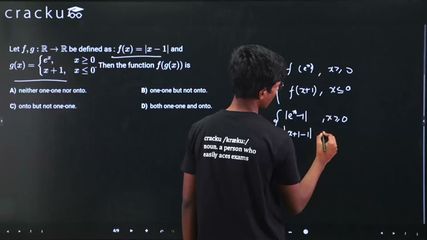
Let $$f, g : \mathbb{R} \rightarrow \mathbb{R}$$ be defined as : $$f(x) = |x - 1|$$ and $$g(x) = \begin{cases} e^x, & x \geq 0 \\ x + 1, & x \leq 0 \end{cases}$$. Then the function $$f(g(x))$$ is
Given $$f(x) = |x - 1|$$ and $$g(x) = \begin{cases} e^x, & x \geq 0 \\ x + 1, & x \leq 0 \end{cases}$$
We need to analyze $$f(g(x)) = |g(x) - 1|$$.
Case 1: $$x \geq 0$$
$$g(x) = e^x \geq 1$$, so $$f(g(x)) = |e^x - 1| = e^x - 1$$.
Case 2: $$x \leq 0$$
$$g(x) = x + 1$$. When $$x = 0$$, $$g(0) = 1$$. When $$x < 0$$, $$g(x) < 1$$.
$$f(g(x)) = |x + 1 - 1| = |x| = -x$$ (since $$x \leq 0$$).
So $$f(g(x)) = \begin{cases} e^x - 1, & x \geq 0 \\ -x, & x \leq 0 \end{cases}$$
At $$x = 0$$: $$e^0 - 1 = 0$$ and $$-0 = 0$$. Continuous.
One-one check:
For $$x \geq 0$$: $$e^x - 1$$ is strictly increasing from 0 to $$\infty$$.
For $$x \leq 0$$: $$-x$$ is strictly decreasing (as a function of x) from $$\infty$$ to 0.
Both parts give non-negative outputs, and both give value 0 at $$x = 0$$. For any $$c > 0$$, there are two values of $$x$$ giving $$f(g(x)) = c$$: one positive (from $$e^x - 1 = c$$) and one negative (from $$-x = c$$, i.e., $$x = -c$$). So the function is not one-one.
Onto check:
The range of $$f(g(x))$$ is $$[0, \infty)$$, but the codomain is $$\mathbb{R}$$. Negative values are never attained. So it is not onto.
The correct answer is Option (1): neither one-one nor onto.
Was this solution helpful?
Click on the Email ☝️ to Watch the Video Solution
Create a FREE account and get:
_1.webp)

Educational materials for JEE preparation

Ask our AI anything

AI can make mistakes. Please verify important information.
AI can make mistakes. Please verify important information.
