
Join Our JEE Preparation Group
Prep with like-minded aspirants; Get access to free daily tests and study material.
Sign in
Please select an account to continue using cracku.in
↓ →
Join Our JEE Preparation Group
Prep with like-minded aspirants; Get access to free daily tests and study material.
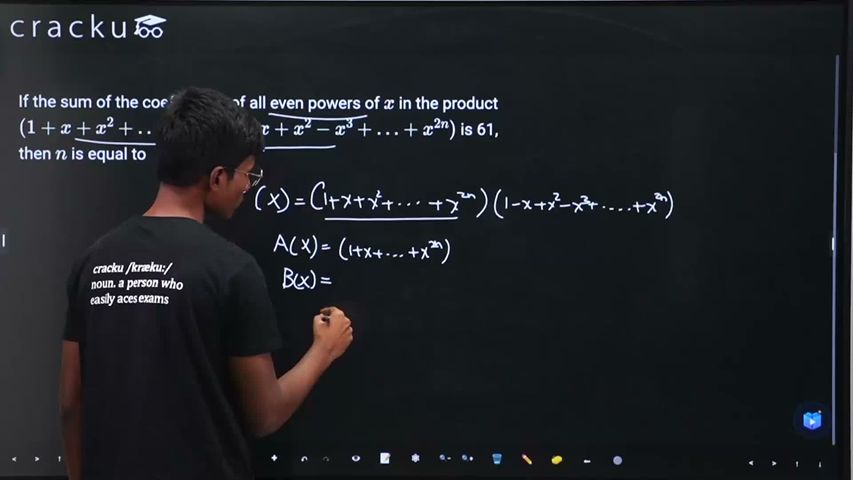
If the sum of the coefficients of all even powers of $$x$$ in the product $$(1 + x + x^2 + \ldots + x^{2n})(1 - x + x^2 - x^3 + \ldots + x^{2n})$$ is 61, then $$n$$ is equal to
Correct Answer: 30
We have to study the product
$$P(x)=(1+x+x^2+\ldots +x^{2n})\,(1-x+x^2-x^3+\ldots +x^{2n}).$$
Denote the two factors separately as
$$A(x)=1+x+x^2+\ldots +x^{2n},\qquad B(x)=1-x+x^2-x^3+\ldots +x^{2n}.$$
The problem asks for the sum of the coefficients of all even powers of $$x$$ in $$P(x)$$, and tells us that this sum equals 61. A classical trick allows us to obtain that sum without expanding the whole product.
For any polynomial $$Q(x)=q_0+q_1x+q_2x^2+\ldots,$$ the sum of the coefficients of its even-powered terms is
$$\text{(sum of even coefficients)}=\frac{Q(1)+Q(-1)}{2}.$$
This identity holds because substituting $$x=1$$ totals all coefficients, while substituting $$x=-1$$ subtracts every odd-powered coefficient from its even neighbour, leaving only twice the even-powered ones. Dividing by 2 therefore recovers the desired sum.
Applying that idea to our polynomial $$P(x)=A(x)B(x),$$ we need $$P(1)$$ and $$P(-1).$$ We compute them factor by factor.
First evaluate each factor at $$x=1$$:
$$A(1)=1+1+1+\ldots +1\quad\text{(total of }2n+1\text{ ones)}=2n+1.$$
For $$B(1)$$ we have an alternating sum with an even number of sign changes, because the highest power is $$x^{2n}$$ where $$2n$$ is even. Writing the first few terms makes the pattern clear:
$$B(1)=1-1+1-1+\ldots -1+1.$$
Every adjacent pair $$1-1$$ cancels to 0, and since the total number of terms is odd (namely $$2n+1$$), one lone $$+1$$ remains at the end. Therefore
$$B(1)=1.$$
Hence
$$P(1)=A(1)\,B(1)=(2n+1)\times 1=2n+1.$$
Next evaluate at $$x=-1$$. Begin with $$A(-1)$$:
$$A(-1)=1+(-1)+(-1)^2+(-1)^3+\ldots +(-1)^{2n}.$$
This is the same alternating sum just seen, and, as before, the terms cancel pairwise leaving a single $$+1$$, so
$$A(-1)=1.$$
For $$B(-1)$$ every term picks up a factor $$(-1)^k$$ from the variable and already carries the coefficient $$(-1)^k$$, giving
$$B(-1)=\sum_{k=0}^{2n}(-1)^k\,(-1)^k=\sum_{k=0}^{2n}(-1)^{2k}=\sum_{k=0}^{2n}1.$$
Because $$(-1)^{2k}=1$$ for every integer $$k$$, we simply get $$2n+1$$ ones:
$$B(-1)=2n+1.$$
Therefore
$$P(-1)=A(-1)\,B(-1)=1\times(2n+1)=2n+1.$$
With both values ready, we invoke the even-coefficient formula stated earlier:
$$\text{Sum of even coefficients}=\frac{P(1)+P(-1)}{2} =\frac{(2n+1)+(2n+1)}{2}=2n+1.$$
The question tells us that this sum equals 61, so we write
$$2n+1=61.$$
Solving for $$n$$ gives
$$2n=60\quad\Longrightarrow\quad n=30.$$
Hence, the correct answer is Option 30.
Was this solution helpful?
Click on the Email ☝️ to Watch the Video Solution
Create a FREE account and get:
_1.webp)

Educational materials for JEE preparation

Ask our AI anything

AI can make mistakes. Please verify important information.
AI can make mistakes. Please verify important information.


