
Join Our JEE Preparation Group
Prep with like-minded aspirants; Get access to free daily tests and study material.
Sign in
Please select an account to continue using cracku.in
↓ →
Join Our JEE Preparation Group
Prep with like-minded aspirants; Get access to free daily tests and study material.
An unbiased coin is tossed 5 times. Suppose that a variable X is assigned the value k when k consecutive heads are obtained for $$k = 3, 4, 5$$, otherwise X takes the value $$-1$$. Then the expected value of X, is
We begin by recalling the fundamental fact that tossing an unbiased coin five times produces $$2^{5}=32$$ equally likely sequences.
The random variable $$X$$ takes only four possible values:
$$X=5$$ if the sequence contains five consecutive heads,
$$X=4$$ if it contains four but not five consecutive heads,
$$X=3$$ if it contains exactly three consecutive heads and never four or five in a row,
$$X=-1$$ in every other case.
We now find the probability of each of these four mutually exclusive events.
1. Probability that $$X=5$$
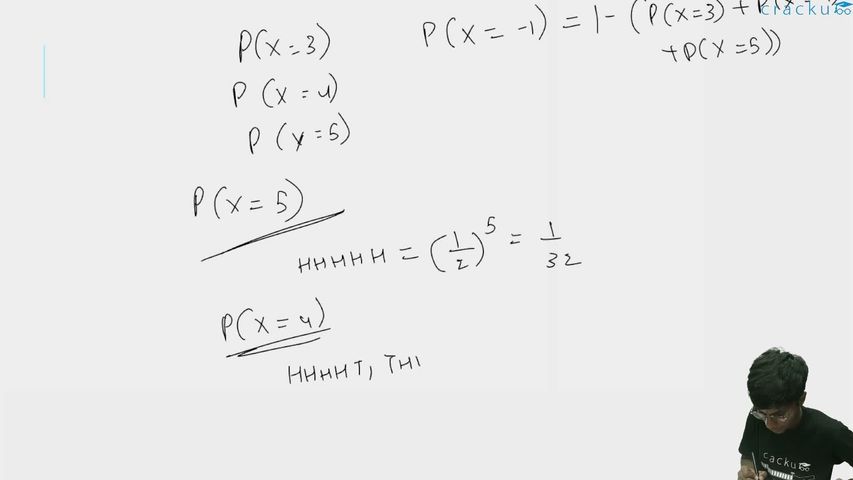
Five consecutive heads can occur in only one way, namely the single sequence $$\text{HHHHH}$$. Thus
$$P(X=5)=\frac{1}{32}.$$
2. Probability that $$X=4$$
We need four heads in a row but not five. The block of four heads can start either at the first toss or at the second toss.
• If it starts at toss 1 we have $$\text{HHHHT}.$$
• If it starts at toss 2 we have $$\text{THHHH}.$$
There are exactly two such sequences and none of them equals the string of five heads already counted, so
$$P(X=4)=\frac{2}{32}=\frac{1}{16}.$$
3. Probability that $$X=3$$
We require a block of exactly three consecutive heads while forbidding any block of four or five. Let the block HHH start at position k.
(i) k = 1 ⇒ pattern $$\text{HHH}x_{4}x_{5}.$$
To avoid four heads, $$x_{4}=\text{T}.$$ The fifth toss can be either H or T, giving the two strings
$$\text{HHHTH},\; \text{HHHTT}.$$
(ii) k = 2 ⇒ pattern $$x_{1}\text{HHH}x_{5}.$$
Here $$x_{1}=\text{T}$$ (otherwise we would have four heads) and $$x_{5}=\text{T}$$ for the same reason, yielding the single string
$$\text{THHHT}.$$
(iii) k = 3 ⇒ pattern $$x_{1}x_{2}\text{HHH}.$$
To avoid a block of four heads, $$x_{2}=\text{T}.$$ The first toss $$x_{1}$$ can be H or T, giving
$$\text{HTHHH},\; \text{TTHHH}.$$
Counting them all, we have
$$5$$ sequences: \;$$$\text{HHHTH},\, \text{HHHTT},\, \text{THHHT},\, \text{HTHHH}$$$, $$\text{TTHHH}.$$
Thus
$$P(X=3)=\frac{5}{32}.$$
4. Probability that $$X=-1$$
This is simply the complement of the three cases already counted:
$$$P(X=-1)=1-\Bigl[\frac{1}{32}+\frac{2}{32}+\frac{5}{32}\Bigr] =1-\frac{8}{32} =\frac{24}{32} =\frac{3}{4}.$$$
5. Expected value of $$X$$
By definition, the expectation of a discrete random variable is $$E[X]=\sum x_{i}\,P(X=x_{i}).$$ Substituting our four values we get
$$$ \begin{aligned} E[X] &= 5\!\left(\frac{1}{32}\right) +4\!\left(\frac{2}{32}\right) +3\!\left(\frac{5}{32}\right) +(-1)\!\left(\frac{24}{32}\right) \\[6pt] &= \frac{5}{32}+\frac{8}{32}+\frac{15}{32}-\frac{24}{32} \\[6pt] &= \frac{28-24}{32} \\[6pt] &= \frac{4}{32} \\[6pt] &= \frac{1}{8}. \end{aligned} $$$
Hence, the correct answer is Option B.
Was this solution helpful?
Click on the Email ☝️ to Watch the Video Solution
Create a FREE account and get:
_1.webp)

Educational materials for JEE preparation

Ask our AI anything

AI can make mistakes. Please verify important information.
AI can make mistakes. Please verify important information.


