
Join Our JEE Preparation Group
Prep with like-minded aspirants; Get access to free daily tests and study material.
Sign in
Please select an account to continue using cracku.in
↓ →
Join Our JEE Preparation Group
Prep with like-minded aspirants; Get access to free daily tests and study material.
If the mean and variance of the following data: 6, 10, 7, 13, $$a$$, 12, $$b$$, 12 are 9 and $$\frac{37}{4}$$ respectively, then $$(a - b)^2$$ is equal to:
We start with the eight observations 6, 10, 7, 13, $$a$$, 12, $$b$$, 12. The number of observations is $$n = 8$$.
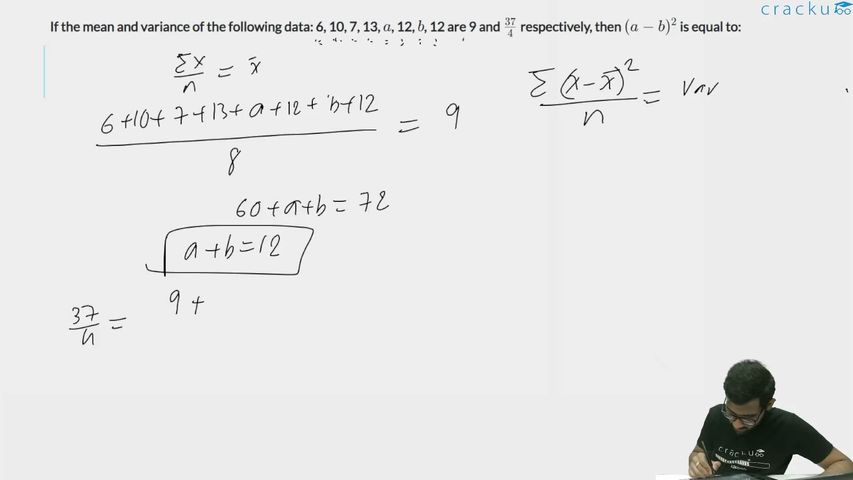
The mean is given to be $$9$$. For any data set, the mean $$\bar x$$ is obtained by the formula $$\bar x = \dfrac{\text{sum of all observations}}{n}.$$ So we have
$$9 = \dfrac{6 + 10 + 7 + 13 + a + 12 + b + 12}{8}.$$
Adding the known numbers first, $$6 + 10 + 7 + 13 + 12 + 12 = 60.$$ Hence
$$9 = \dfrac{60 + a + b}{8}.$$
Multiplying both sides by $$8$$, $$72 = 60 + a + b.$$ So
$$a + b = 72 - 60 = 12.$$
Next, the variance is given as $$\dfrac{37}{4}$$. For a population of size $$n$$, the variance $$\sigma^{2}$$ is defined as $$\sigma^{2} = \dfrac{\sum (x - \bar x)^2}{n}.$$ Therefore
$$\dfrac{37}{4} = \dfrac{(6-9)^2 + (10-9)^2 + (7-9)^2 + (13-9)^2 + (a-9)^2 + (12-9)^2 + (b-9)^2 + (12-9)^2}{8}.$$
We now evaluate the squared deviations of the known numbers:
$$\begin{aligned} (6-9)^2 &= (-3)^2 = 9,\\ (10-9)^2 &= 1^2 = 1,\\ (7-9)^2 &= (-2)^2 = 4,\\ (13-9)^2 &= 4^2 = 16,\\ (12-9)^2 &= 3^2 = 9,\\ (12-9)^2 &= 3^2 = 9. \end{aligned}$$
Adding these six values, $$9 + 1 + 4 + 16 + 9 + 9 = 48.$$
Substituting into the variance formula and multiplying both sides by $$8$$ gives
$$8 \times \dfrac{37}{4} = 48 + (a-9)^2 + (b-9)^2.$$
Since $$8 \times \dfrac{37}{4} = 2 \times 37 = 74$$, we obtain
$$(a-9)^2 + (b-9)^2 = 74 - 48 = 26.$$
Let us expand the left side. We know the algebraic identity $$(x-9)^2 = x^2 - 18x + 81.$$ Applying this to both $$a$$ and $$b$$,
$$(a-9)^2 + (b-9)^2 = (a^2 - 18a + 81) + (b^2 - 18b + 81) = a^2 + b^2 - 18(a + b) + 162.$$
We already found $$a + b = 12$$, so substitute:
$$a^2 + b^2 - 18 \times 12 + 162 = a^2 + b^2 - 216 + 162 = a^2 + b^2 - 54.$$
Set this equal to $$26$$ (from the variance condition):
$$a^2 + b^2 - 54 = 26 \quad\Longrightarrow\quad a^2 + b^2 = 80.$$
To find $$(a-b)^2$$, recall the identity $$(a-b)^2 = a^2 + b^2 - 2ab.$$ We already know $$a^2 + b^2 = 80$$, but we still need $$ab$$. Using another standard identity, $$(a + b)^2 = a^2 + b^2 + 2ab.$$
Substituting $$a + b = 12$$ and $$a^2 + b^2 = 80$$, we have
$$12^2 = 144 = 80 + 2ab.$$
Hence $$2ab = 144 - 80 = 64 \quad\Longrightarrow\quad ab = 32.$$
Now apply the identity for $$(a-b)^2$$:
$$(a-b)^2 = 80 - 2 \times 32 = 80 - 64 = 16.$$
Hence, the correct answer is Option D.
Was this solution helpful?
Click on the Email ☝️ to Watch the Video Solution
Create a FREE account and get:
_1.webp)

Educational materials for JEE preparation

Ask our AI anything

AI can make mistakes. Please verify important information.
AI can make mistakes. Please verify important information.
